
Strong fundraising goals only work when they connect money, mission, and timing. If the number is vague, the team cannot plan; if it is inflated, supporters feel the gap immediately; and if it is too small, the campaign underfunds the very change it is meant to create. In this article I break down how to set a realistic target, translate it into donor-sized asks, and keep the campaign visible without losing credibility.
A useful target is specific, fundable, and easy to explain
- Start with the real cost of the work, then add fees and a small contingency if prices can move.
- Use donor history and current capacity to decide what is realistic, not just what would be ideal.
- Break the total into lead gifts, mid-level gifts, and community gifts so the ask ladder feels believable.
- Track net revenue, donor growth, recurring gifts, and retention, not just the headline dollar amount.
- Change the target only when the scope changes, and explain the reason in plain language.
What a strong campaign target actually does
I usually think of the target as a planning tool first and a message second. A useful number tells the team what to build, how long the campaign needs to run, and what kind of donor support has to happen in the right order. It also keeps the story honest: the amount should map to a real community need, not an arbitrary round number chosen because it sounds large enough.
Well-built fundraising goals do three jobs at once. They define the scope of the work, give your team a benchmark for progress, and help supporters understand the difference their gift makes. When those three pieces line up, the campaign feels focused; when they do not, every appeal starts to sound generic.
That is why I start with the outcome, then work backward to the money. Once that role is clear, the next step is to build the number from real inputs rather than optimism.
How I build the number from budget, capacity, and timing
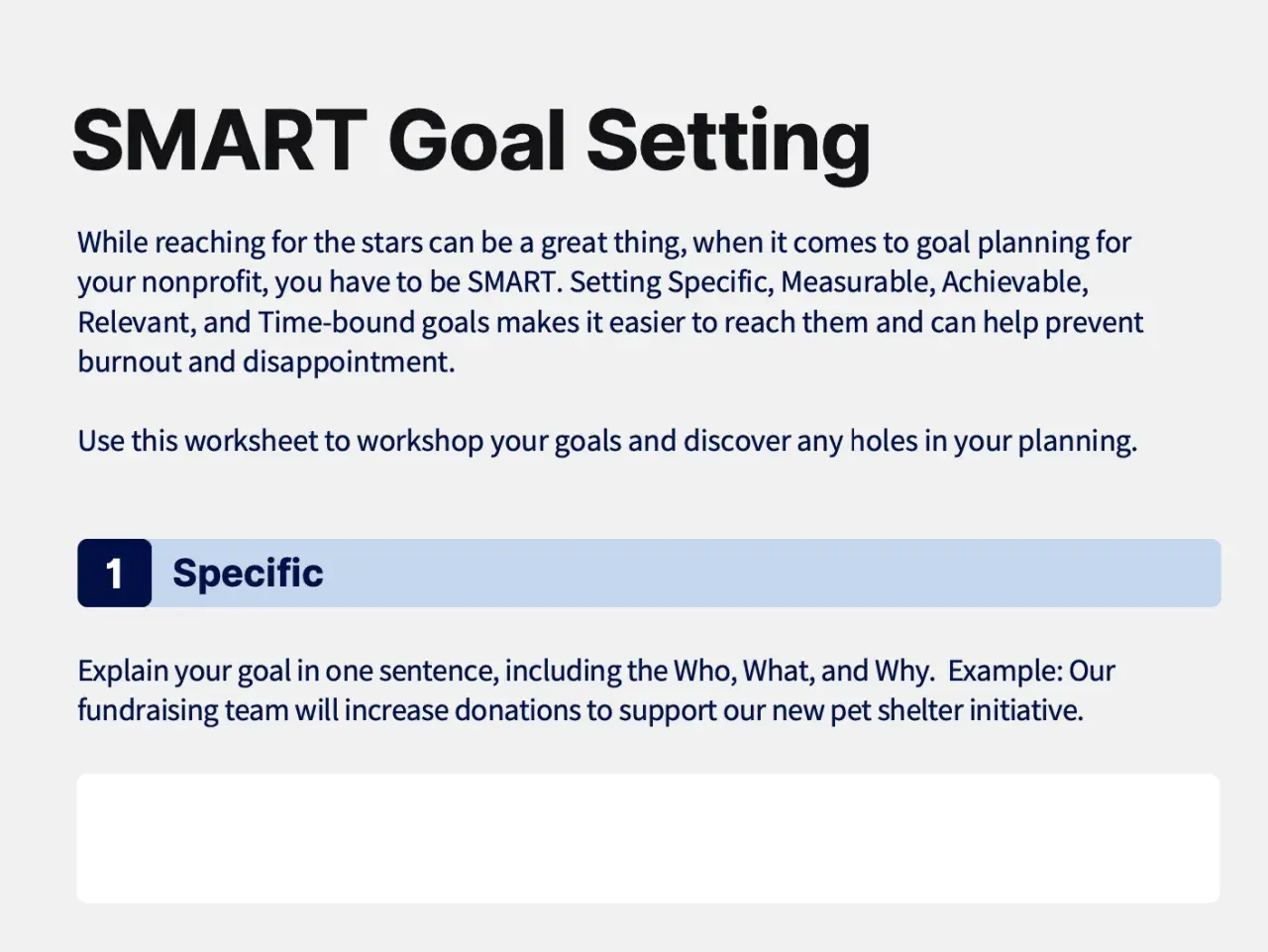
The strongest target is built from the cost of the work, not the other way around. I like to make the number SMART: specific, measurable, achievable, relevant, and time-bound. That keeps the team from drifting into vague hopes and forces every line item to earn its place.
| Input | What I look for | Why it matters |
|---|---|---|
| Direct project cost | Program expenses, staffing, supplies, technology, and travel | This is the baseline the campaign must actually cover. |
| Fundraising costs | Platform fees, event costs, printing, ads, and staff time | Otherwise the goal looks successful on paper but falls short in practice. |
| Donor history | Largest gifts, average gifts, recurring gifts, and seasonality | It shows what the base can support right now, not three years ago. |
| Campaign window | Six weeks, three months, twelve months, or longer | Time changes what is realistic and which channels can do the work. |
| Contingency | A small buffer when costs are uncertain | I often use 10% to 15% when prices can move or estimates are thin. |
If the project costs $50,000 and the fundraising channel adds extra fees or production costs, I would not pretend those costs disappear. I would set the target on the full amount needed in hand, because donors are funding the outcome, not the spreadsheet line item. The practical question is always the same: how much money do you need so the work can actually happen?
After that, the question becomes how the total should be divided across donors and milestones.

How to turn one target into donor-sized milestones
Large targets become believable when they are broken into tiers. I like to map the total into lead gifts, mid-level gifts, and broad-based support, because donors rarely give in a flat line. A gift range chart is useful here: it helps estimate how many gifts you need at each level and whether the campaign can genuinely get there from your current pool.| Layer | Typical role | What I watch |
|---|---|---|
| Lead gifts | Carry a large share of the total early in the campaign | Board capacity, major donor relationships, and timing |
| Mid-level gifts | Build momentum and prove broader support | Conversion from past donors and realistic ask amounts |
| Community gifts | Round out the target and widen participation | Peer-to-peer outreach, small recurring gifts, and social reach |
For a mature campaign, a small set of donors often carries a disproportionate share of the total. That is not a flaw in the model; it is the logic that makes the model workable. In capital campaigns, it is common to secure roughly 50% to 70% of the target in a quiet phase before the public launch, because early major gifts create proof before the broader audience is asked to fill the rest.
For example, a $100,000 campaign may need one or two lead gifts, several mid-level commitments, and a wider base of smaller gifts to close the gap. The exact mix depends on your donor base, but the pattern is the same: the bigger the target, the more important it is to design the path to it before you start talking publicly.
Different campaign models ask for different target structures, which is why format matters next.
Which target structure fits your campaign model
Not every campaign should be measured in the same way. An annual fund, a gala, a crowdfunding push, and a capital campaign all need different math. If you force the same structure onto every effort, you end up with a target that looks tidy but does not match how money is actually raised.
| Campaign type | Best way to set the target | What success looks like | Common trap |
|---|---|---|---|
| Annual fund | Base it on unrestricted revenue needs and donor retention, not just growth percentage | Stable monthly or year-round support | Chasing total dollars only and ignoring churn |
| Event fundraiser | Set a net target after direct expenses | Surplus revenue plus sponsor value | Calling gross ticket sales the win |
| Crowdfunding campaign | Use a short, visible target with a clear use of funds | Fast momentum and shareability | Making the story too broad |
| Capital campaign | Build phased commitments, often with a quiet phase first | Major gift traction before public launch | Announcing too early |
| Emergency appeal | Keep the ask simple and the timeline urgent | Rapid cash flow and clear need | Overexplaining the mechanics |
I am strict about events because gross revenue can be misleading. A $25,000 gala that costs $18,000 to stage is not a $25,000 fundraising success; it is a $7,000 result before any longer-term donor value is counted. That distinction matters, especially in the United States, where donors and boards often want a clean answer about what the event actually delivered.
Once the structure is chosen, the way you communicate the number decides whether people trust it.
How to keep the number visible without making donors tune out
Visibility helps only when it builds trust. I use progress bars, milestone updates, and short impact notes because they show movement without drowning people in internal jargon. A visible goal meter works because supporters can see momentum rather than being asked to imagine it.
- Show what each increment funds, not just the final total.
- Refresh donors at 25%, 50%, 75%, and 100% so progress feels real.
- Use one clear message across email, web, social, and board updates.
- Keep donation pages mobile-friendly and easy to complete in a few steps.
- If the target changes, explain the scope change instead of silently editing the page.
I also like modest matching opportunities when they are genuine, because they add urgency without becoming theatrical. The point is not to pressure people; it is to make the path to impact visible. If supporters understand how the money will be used and can see the campaign moving, they are more likely to trust the ask and share it with others.
That leaves the mistakes that quietly derail good plans even when the messaging looks polished.
The mistakes that quietly break a campaign target
The most common failure is not lack of effort. It is a target that was never grounded in reality. When I audit campaigns, I usually see the same problems surface again and again.
- Setting a round number before reviewing the budget and donor history.
- Confusing gross and net revenue, especially for events.
- Assuming small gifts will make up for the lack of lead gifts.
- Announcing the target without a timeline or update rhythm.
- Changing the number without explaining why the scope changed.
- Measuring success only by dollars and ignoring retention or recurring giving.
The biggest mistake is emotional, not technical: a team picks a number it wants to be true instead of a number it can defend. Supporters can sense that immediately, and in a crowded U.S. fundraising market, they have plenty of other causes to choose from. If the target feels honest, the campaign can build momentum; if it feels forced, even a good story starts to lose traction.
The checklist I would keep before the first ask goes out
Before a campaign launches, I would write down four things: the exact amount needed, the donor mix expected to cover it, the deadline, and the proof points I will use to show progress. I would also decide in advance which numbers count as success beyond revenue, such as new recurring donors, stronger retention, or first-time supporters who may give again later.
- One sentence that explains why the target exists.
- The budget or program need behind the number.
- The donor tiers that will carry the campaign.
- The update schedule for staff, board, and public donors.
- The metrics I will review after the campaign closes.
When those pieces are clear, the target stops being a guess and becomes a practical tool for community impact.
