
The best service matches a real need and a realistic commitment
- Direct service is the fastest way to make an immediate difference through food banks, shelters, cleanups, and tutoring.
- Skills-based and virtual work can be just as valuable, especially if you have limited time or professional expertise.
- Recurring service usually has more impact than a one-off event, even if the event feels more visible.
- Family and school-friendly projects work best when they are simple, safe, and easy to repeat.
- The right project should fit your energy, transportation, and ability to keep showing up.
What community service looks like when it actually helps
When I look at volunteer work that matters, I usually separate it into two categories: service that responds to an immediate need, and service that builds long-term capacity. Both are useful, but they do different jobs. A food pantry shift helps people eat today; tutoring, mentoring, or fundraising helps the organization keep serving next month.
In the U.S., the most effective volunteer roles often map to the same broad needs AmeriCorps uses in its service framework: education, public safety, the environment, health, housing, and other basic human needs. That is a useful way to think about the topic because it moves the conversation away from vague goodwill and toward actual problem-solving. I also think it helps to distinguish between direct service, behind-the-scenes service, and skills-based service. A person carrying boxes in a warehouse, designing a flyer for a nonprofit, and reading with a child after school are all serving the community, but the structure, training, and time commitment are different. That difference matters when you are trying to choose a role that you can sustain, because the best volunteer fit is the one you can actually keep doing.Once you understand that, the examples become much easier to evaluate. The next step is looking at the kinds of work that produce the clearest results.

Direct service examples that make immediate difference
Direct service is the most visible form of volunteering, and it is usually what people picture first. I like it because the cause-and-effect chain is easy to see: a task gets done, a need gets reduced, and the organization can keep moving.
- Food bank sorting and distribution - Volunteers inspect donations, organize shelves, and help move groceries into the hands of families faster. This matters because food banks often run on tight schedules, and bottlenecks at intake can slow everything downstream.
- Meal delivery for seniors or homebound neighbors - This is more than dropping off a tray. The interaction itself can reduce isolation, which is one of the quiet problems many older adults face.
- Reading support and tutoring - Even one hour a week can help a child practice literacy or homework routines. The best versions are consistent, not heroic.
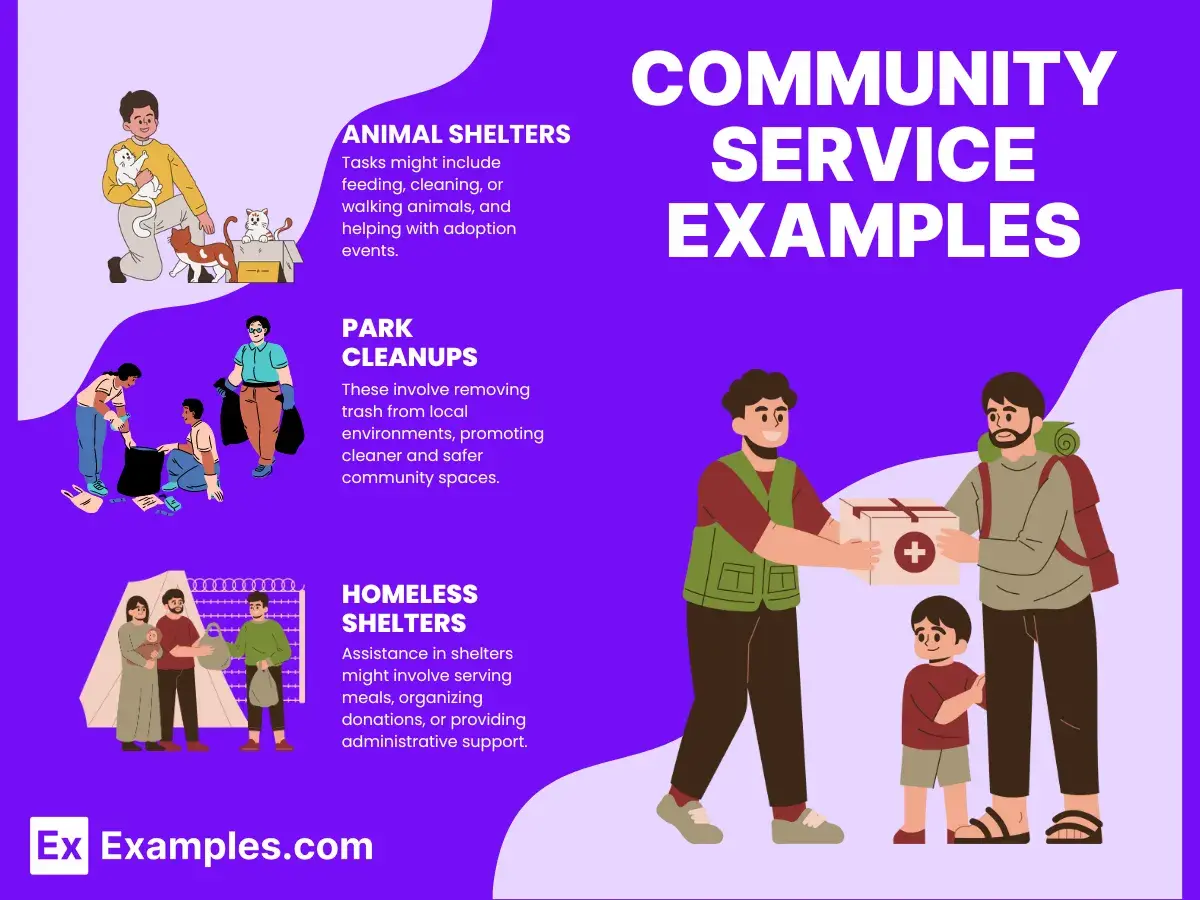
- Park, trail, or neighborhood cleanups - These projects improve how a place feels and how safe it is to use. I like them as starter projects because they are easy to understand and easy to join.
- Animal shelter support - Walking dogs, cleaning spaces, or helping with adoption events gives shelters more breathing room. It is a good example of service that helps both people and animals at once.
- Soup kitchen or shelter support - Serving meals, setting up beds, or greeting guests can sound simple, but these roles are essential when demand is high and staff are stretched thin.
- Disaster relief support - Packing supplies, helping with registration, or assisting recovery teams is especially important after storms, fires, or floods. In the U.S., this kind of volunteer work often becomes critical very quickly.
These are the examples people usually think of first, but they are not the whole picture. Some of the most valuable service today happens away from the public eye, and that is where skills-based volunteering enters the picture.
Skills-based and virtual volunteering for busy people
Not every useful volunteer role requires you to be on site. Points of Light has done a good job of showing how online volunteering now includes tutoring, social media support, transcription, captioning, and other micro-volunteering tasks. That shift matters because it lowers the barrier to entry without lowering the value of the work.
For many professionals, this is where volunteering becomes sustainable. If you have an hour between meetings or can help from home on weekends, your skills may be more useful than your physical presence.
- Virtual tutoring or mentoring - Useful when travel is hard or when the student and volunteer live in different parts of the country. It is especially effective when the sessions are regular and structured.
- Resume review and interview coaching - This is a strong option for people with hiring experience. A well-written resume or a sharper interview can change someone’s job search trajectory faster than many people expect.
- Social media and content support - Nonprofits often need help turning good work into clear communication. A few posts, a content calendar, or a better photo library can improve outreach immediately.
- Bookkeeping, budgeting, or grant research - These tasks are not flashy, but they keep small organizations stable. I would put them near the top of the list for long-term impact.
- Translation and interpretation - This is one of the most overlooked forms of service in diverse communities. If language access is the barrier, translation work can remove it fast.
- Data entry or transcription - These are classic micro-volunteering jobs. They are not glamorous, but they help nonprofits keep records clean and searchable.
- Web and tech help - Updating a website, fixing a signup form, or improving accessibility can save staff dozens of hours over time.
My rule of thumb is simple: if a nonprofit already spends money paying for the skill, your volunteer version probably has real value. The only catch is scope. Skills-based service works best when the organization knows exactly what it needs and you know exactly what you are agreeing to do.
Good options for families, students, and groups
Group volunteering works best when the task is simple enough for mixed ages and mixed abilities, but still concrete enough to matter. I do not love activities that exist only because they photograph well; I prefer projects that leave a visible result and teach people how community systems actually work.
- School reading events - Families can read with younger children, help stock classrooms, or assist with library organization. This is a strong entry point for students because it shows them how learning support works in practice.
- Community gardens - Planting, weeding, watering, and harvesting can connect food access with neighborhood pride. It is also a good long-term project because the results build over time.
- Backpack and school supply drives - These are useful when they are targeted. A drive that is coordinated with a school or nonprofit is much more effective than collecting random items and hoping they fit a need.
- Senior center visits and card-making projects - These can be simple but meaningful, especially when they are paired with real interaction instead of being treated as a box to check.
- Neighborhood beautification - Painting, planting, litter pickup, and small repairs can improve a block quickly. I like these projects because they show young volunteers that civic care is hands-on.
- Kit packing for shelters or hospitals - Hygiene kits, winter kits, and welcome kits are easy to organize for a group. They are not a substitute for deeper service, but they fill immediate gaps.
How I would choose the right project for your time and strengths
If I had to narrow volunteer options down to one question, it would be this: what can you do consistently without burning out? A project that you can repeat for three months is usually more valuable than an ambitious one-day effort that you never repeat.
The table below is the framework I use when I compare service options.
| Example | Typical time commitment | Best for | Main trade-off |
|---|---|---|---|
| Food bank shift | 2 to 4 hours | People who want direct, hands-on work | Usually physical and schedule-specific |
| Virtual tutoring | 1 hour weekly | Consistent volunteers with reliable internet | Requires preparation and punctuality |
| Meal delivery | 2 to 3 hours weekly or biweekly | Drivers and people who like one-on-one contact | Often tied to route timing |
| Social media or design help | 2 to 6 hours monthly | Professionals with digital skills | Needs clear scope and feedback |
| Park cleanup or neighborhood sweep | 2 to 3 hours monthly | Groups, families, and first-time volunteers | Visible impact, but often short-lived without follow-up |
| Grant research or bookkeeping | 2 to 5 hours monthly | People with office or finance experience | Less visible, but highly valuable |
Here is the part many people skip: ask about training, age limits, transportation, and whether the organization needs one-time help or repeat volunteers. Those details tell you whether the role is realistic. I also pay attention to whether the nonprofit seems organized enough to use help well; if the instructions are vague, the impact often is too.
That practical filter saves time, and it also protects the organization from volunteers who mean well but do not match the actual need. Once you can match your strengths to the right role, the next risk is simple but common: doing the wrong kind of service for the right reason.
The mistakes that make service feel busier than it should
Most volunteer mistakes are not moral failures. They are mismatches between intention and execution. The good news is that these are fixable if you name them early.
- Choosing a project because it looks meaningful - A photogenic event is not automatically a useful one. Ask what problem it solves and who benefits.
- Overcommitting too early - A weekly role sounds noble until your calendar breaks. Start smaller than you think you can manage, then expand if it fits.
- Ignoring training and boundaries - If a role involves children, health, data, or vulnerable adults, the organization’s rules are there for a reason. Good service respects those limits.
- Bringing unrequested donations - Extra items can create work for staff if they are not needed. It is better to give the right thing than a large pile of the wrong thing.
- Expecting instant results - Some service is immediate, but much of it is cumulative. Real change often comes from repeated, unglamorous effort.
I think this is where mature volunteering starts: not in the desire to help, but in the willingness to help in the way that is actually needed. That is a subtle shift, but it changes the quality of the work a great deal.
What I would check before I show up
If I were choosing a volunteer role today, I would run through five quick checks before I signed up: what is the need, how often is help required, what training is expected, what time window is realistic, and what outcome should I expect. Those questions prevent most bad matches before they happen.
- Confirm the specific task instead of assuming the assignment.
- Ask whether the role is one-time, seasonal, or recurring.
- Check whether you need background screening, orientation, or special gear.
- Make sure the site, shift time, and transportation all work together.
- Decide in advance whether you can repeat the commitment for at least a few months.
That is the simplest way I know to turn good intentions into useful service. If the project solves a real problem, fits your life, and lets the organization rely on you, it is probably the right one.
