
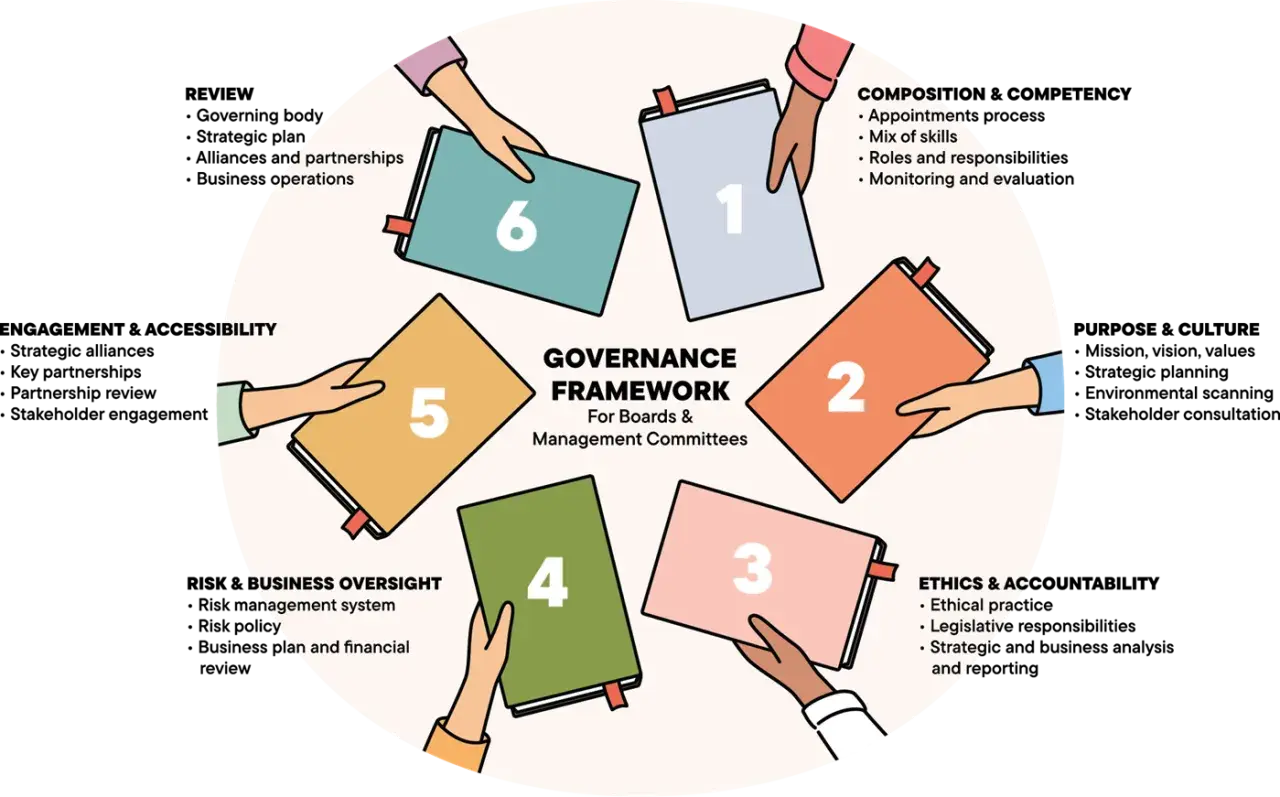
Strong board governance is what turns a board of directors into a working system of oversight, not just a ceremonial group that meets a few times a year. It shapes how decisions get made, how risk gets handled, how leaders are held accountable, and how a mission stays steady when pressure rises. In practice, that means the board is not there to run the organization day to day; it is there to protect direction, integrity, and long-term impact.
The board should spend its energy on direction, oversight, and accountability
- A healthy board sets strategy, approves budgets, and evaluates leadership, but it does not micromanage staff.
- Clear boundaries between directors and management prevent confusion, delays, and power struggles.
- Written policies, clean records, and regular review cycles make oversight real instead of symbolic.
- Meeting rhythm matters: a tight agenda, a useful dashboard, and focused committees keep the board effective.
- Weak boards usually fail in predictable ways, especially around conflicts of interest, follow-through, and financial visibility.
What good board governance actually covers
When I look at an effective board, I do not start with titles. I start with the system: who sets direction, who checks performance, who owns risk, and how the organization proves it is acting in the public interest or mission interest. In a nonprofit or community-focused organization, the board’s work usually sits around three jobs: fiduciary oversight, strategic guidance, and generative thinking, which is the discipline of asking the questions that shape the future rather than only reacting to the present.That sounds abstract until you see the practical version. The board should know whether the mission is still relevant, whether the budget matches the plan, whether the executive director or CEO is performing well, and whether the organization is protected from avoidable legal and ethical problems. For mission-driven groups, I also want the board to reflect some real connection to the community being served, because lived experience usually sharpens judgment in ways credentials alone do not.
The main point is simple: a board is healthiest when it spends more time on judgment and accountability than on operations. Once that is clear, the next question is where the board’s authority stops and management begins.
Where the board stops and management starts
Many boards become ineffective because they confuse oversight with execution. They approve a strategy, then start rewriting staff work plans. Or they hire a capable executive and then second-guess every program decision. That is not leadership; it is role confusion. A board should define the destination, test whether the organization is still on course, and intervene when there is drift or danger. Management should decide how the work gets done.
| Topic | Board level decision | Management level decision |
|---|---|---|
| Mission and priorities | Set or refine the mission, approve annual priorities, and confirm strategic trade-offs | Translate priorities into programs, staffing plans, and operating targets |
| Budget and finance | Approve the annual budget, review cash flow, and monitor financial risk | Manage spending, forecasting, vendors, and day-to-day controls |
| Leadership | Hire, evaluate, support, and if needed replace the CEO or executive director | Lead the team, coach managers, and execute performance plans |
| Programs | Approve major program shifts or closures when they affect strategy or mission | Design program details, schedules, and service delivery methods |
| Operations | Set policy, risk tolerance, and accountability expectations | Handle staff workflow, technology choices, and vendor coordination |
A practical board also knows when to step back. Executive session, for example, is a private portion of a board meeting where directors talk without management present. That is useful for honest evaluation, conflict handling, and leadership feedback. For smaller organizations, a board of 7 to 11 active members is often easier to coordinate than a larger group, but size only helps if the roles are clear and the board actually stays disciplined. Once that line is in place, the board can focus on the policies and records that make oversight credible.
The policies and records that keep oversight honest
Good intentions are not enough. If the board cannot point to the documents, policies, and records that shape its decisions, then oversight is fragile. I like to think of these items as the board’s memory and guardrails. They keep the organization from drifting when new members join, staff changes, or a difficult decision lands on the agenda.
The National Council of Nonprofits is blunt about conflicts of interest: a written policy is one of the most important policies a nonprofit board can adopt. I agree with that framing. If directors, staff, or vendors can influence decisions that benefit them personally, the board needs a clear process for disclosure, recusal, and documentation.
| Document or control | Why it matters | How often I would review it |
|---|---|---|
| Bylaws | Define authority, voting rules, board composition, and basic governance structure | At least annually and whenever the organization changes materially |
| Conflict-of-interest policy | Protects decisions from private benefit, favoritism, and hidden influence | Annually, with signed disclosures from every director |
| Committee charters | Clarify what each committee owns and what stays with the full board | Annually, or sooner if committees are duplicating work |
| Meeting minutes | Create a record of decisions, approvals, dissent, and follow-up actions | At every meeting |
| Financial dashboard | Shows trends in cash, revenue, expenses, reserves, and risk signals | Every board meeting |
| CEO or executive director evaluation | Links leadership performance to mission, strategy, and accountability | At least annually |
These documents are not paperwork for paperwork’s sake. They make the board less dependent on memory, personalities, and informal politics. They also create continuity when new directors join, which is especially useful for community organizations that rely on volunteers and rotating leadership. The next piece is rhythm, because even strong policies fail if the meetings themselves are shallow or chaotic.
How meeting rhythm changes board quality
A board can have excellent bylaws and still perform badly if meetings are bloated, reactive, or poorly prepared. I prefer a rhythm that is predictable but not sleepy. For many organizations, that means a full board meeting every quarter, committee work in between, and lighter check-ins only when the mission or risk profile calls for them. Fast-moving groups sometimes need monthly meetings; very small or stable groups may work with fewer, longer sessions. The key is not frequency by itself. It is whether the meeting produces decisions, clarity, and momentum.
BoardSource recommends a formal board self-assessment every two years, and I think that is a minimum, not a luxury. The board should also do a lighter annual review of attendance, preparation, committee effectiveness, and whether agendas are still aligned with the organization’s real priorities. If a board never looks at itself, it eventually mistakes habit for health.
In practice, the best meetings usually share the same habits: a short consent calendar for routine approvals, a focused dashboard, a few strategic questions, and a hard stop for off-agenda drift. I also want every director to know what is expected before the meeting starts, because a packet that arrives late is often a sign that the board is being asked to react instead of govern. Once that rhythm is right, the difference between strong and weak boards becomes much easier to see.
What strong and weak boards look like in practice
Board quality is often obvious once you compare the patterns side by side. The table below is not theory; it is the kind of contrast I watch for when I assess whether a board is actually doing its job.
| Area | Strong board | Weak board |
|---|---|---|
| Agenda discipline | Topics are chosen because they matter to mission, risk, or strategy | Meetings wander, repeat old arguments, or absorb operational trivia |
| Information flow | Directors get a concise dashboard and can ask better questions | Directors get a giant packet and still do not know what needs attention |
| Decision-making | Votes are informed, documented, and tied to clear owners | Decisions are vague, delayed, or quietly revisited later |
| Financial oversight | The board understands cash, reserves, trends, and material risks | Members approve budgets without really understanding the numbers |
| Ethics and independence | Conflicts are disclosed, recusal is normal, and dissent is allowed | Personal relationships and influence shape decisions behind the scenes |
| Follow-through | Action items are tracked and reviewed until they are closed | Everyone agrees in the room, then nothing happens afterward |
The warning signs are usually familiar: one person dominates every conversation, committees drift into management work, directors do not read materials, or the board avoids hard decisions about leadership. In community and social-good organizations, there is an extra risk as well, which is over-identifying with the mission and underestimating the need for discipline. Passion is useful. Structure is what keeps passion from becoming confusion. That is why the next step is a practical reset, not a grand redesign.
What I would fix first in a struggling board
If I had to improve a weak board quickly, I would not start with a retreat and a motivational speech. I would start with a few operational changes that make governance clearer within weeks, not months. These are the fixes that usually move the needle fastest.
- Clarify the role of the board in one sentence. If directors cannot explain what they are accountable for, every other problem gets worse.
- Set an annual governance calendar. Put budget review, CEO evaluation, conflict disclosures, committee reports, and self-assessment on the calendar before the year begins.
- Trim the board packet. Include only what directors need to make decisions and spot risk. Extra pages do not create better oversight.
- Review committee scope. Committees should prepare work, not replace the full board’s responsibility.
- Adopt or refresh term limits. A common pattern is two consecutive three-year terms, which creates enough continuity without letting the board stagnate.
- Use a small set of metrics. Pick a dashboard that shows mission output, financial health, and risk in plain language.
- Create space for honest review. A short annual conversation about attendance, preparation, and board culture is more useful than pretending everything is fine.
When those basics are in place, governance becomes visible. Directors know what they are supposed to do, management knows what it owns, and the organization spends less time correcting avoidable mistakes. That is usually where real trust starts to build, which is the point of the board in the first place.
The boards that serve communities well are rarely the most theatrical ones. They are the ones that stay disciplined, ask sharper questions, and protect the mission with a clear structure. If you want better results, start with role clarity, cleaner information, and a meeting rhythm that respects everyone’s time, then keep tightening the system until accountability feels routine rather than exceptional.
