
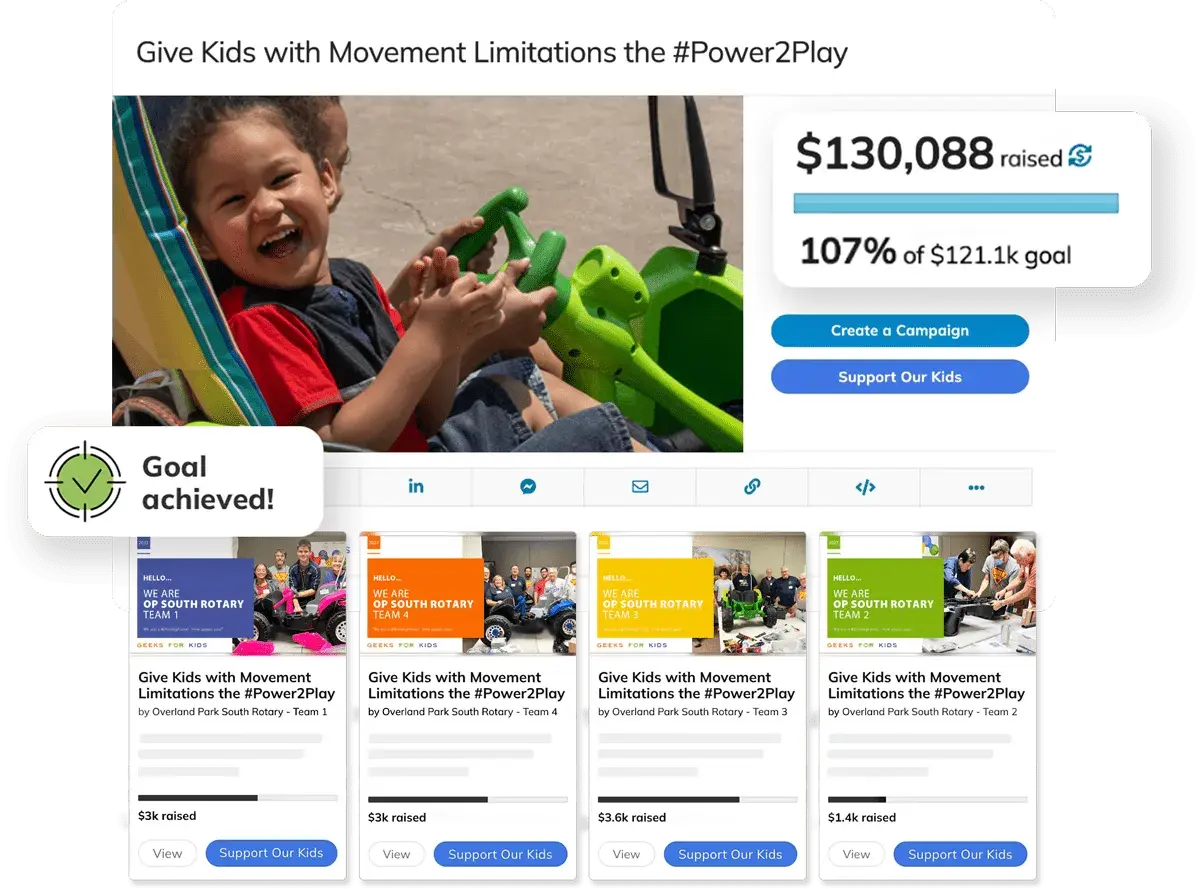
Choosing a crowdfunding platform for a nonprofit is rarely about the prettiest page. It is about how quickly you can launch, how much donor data you can keep, and whether the tool helps a small team run a campaign without creating extra work. In the fundrazr vs gofundme comparison, the real decision is whether you need a reach-first fundraising channel or a more configurable nonprofit workflow.
Key takeaways for nonprofit teams choosing a platform
- GoFundMe is strongest when you want broad visibility, quick setup, and a donor experience that feels familiar to the general public.
- FundRazr is stronger when a nonprofit needs peer-to-peer events, registration rules, waivers, tax receipts, or CRM connections.
- In the U.S., GoFundMe’s certified nonprofit fee is 2.9% + $0.30 per donation, while FundRazr’s cheapest setup has no platform fee but still uses payment-processing fees.
- If recurring giving is central, FundRazr is more flexible on the campaign side; GoFundMe supports recurring donations too, but the standard product is lighter.
- For larger nonprofit operations, the hidden cost is often staff time, not just transaction fees.
The real question behind the comparison
When I look at this decision for a U.S. nonprofit, I do not start with feature names. I start with the job the platform has to do. GoFundMe is built around discoverability, social proof, and simple supporter-led fundraising. FundRazr behaves more like nonprofit software: it gives you more control over campaign structure, donor journeys, and the mechanics behind events and recurring programs.
That difference matters because two organizations can have the same fundraising goal and still need very different tools. A crisis appeal, a memorial, or a one-page annual appeal usually benefits from speed and reach. A walk-a-thon, a school fundraiser with registration fees, or a campaign that has to sync back to an existing CRM usually needs more operational control.
Seen that way, the choice is not really about which brand is bigger. It is about whether your team needs a platform that helps people give quickly or a platform that helps staff manage a more structured fundraising program.

Fees and take-home money in the U.S.
Fees are easy to compare on paper, but the practical impact depends on how you use the platform. In the U.S., GoFundMe’s certified nonprofit setup starts at $0 to create or manage a fundraiser and charges a 2.9% + $0.30 transaction fee per donation. FundRazr offers an Optional Tips model with no platform fee, plus payment-processing fees, and also a Fee Recovery model where a platform fee applies.
| Criterion | FundRazr | GoFundMe |
|---|---|---|
| Fee to start | None | None |
| Platform fee | 0% with Optional Tips; 1% for donation forms or 5% for fundraising pages with Fee Recovery | No platform fee to start or manage; optional donor contribution |
| Payment processing | About 2.9% + $0.30, depending on processor and region; nonprofits may qualify for a reduced rate | 2.9% + $0.30 for certified nonprofits |
| Recurring gifts | Recurring revenue is built into donation forms and microprojects | Recurring donations are available; supporters pay a 5% fee per recurring donation on the standard product |
| Advanced nonprofit branch | The nonprofit workflow lives in the main platform | GoFundMe Pro is the separate advanced nonprofit product |
At a simple $100 donation level, GoFundMe’s U.S. certified nonprofit fee works out to $3.20 before bank or conversion costs. FundRazr’s Optional Tips model lands in the same processing range before any optional donor tip or fee-recovery setting changes the math. That is why I would not choose on fee alone unless you are running very high volume and every basis point matters.
The better question is how much campaign control you need after the donation arrives. That leads directly to the operational strengths on each side.
Where FundRazr fits nonprofit workflows better
FundRazr stands out when the campaign has more moving parts than a standard donation page. Its current nonprofit tooling includes peer-to-peer pages, donation forms, microprojects, wishlists, perks, and event-style fundraising. The big advantage is not a single feature; it is how those pieces work together for teams that need structure.
- Peer-to-peer campaigns can include team captains, leaderboards, registration forms, optional registration fees, and waiver collection.
- Donation forms can support one-time gifts or recurring revenue, which is useful for sustainers and membership-style giving.
- CRM and marketing connections can run through native integrations or Zapier, which matters if your nonprofit already has a data stack.
- Payment options include PayPal, Stripe, credit cards, Google Pay, and Apple Pay, so donors have familiar checkout choices.
- Tax receipts, contribution tracking, and thank-you messages are built into the peer-to-peer workflow, which reduces back-office cleanup.
For me, that makes FundRazr the stronger choice for organizations that run walks, rides, school events, fiscal-sponsorship campaigns, or recurring community programs. It is less about polished storytelling alone and more about operational range. The tradeoff is that teams who only need a fast public appeal may not use half of what the platform offers.
That naturally leads to the opposite question: when does a simpler, reach-oriented platform win instead?
Where GoFundMe wins on reach and simplicity
GoFundMe’s strength is that it lowers the barrier to participation. The nonprofit page is designed for supporter-led fundraising, social sharing, and quick campaign creation, and GoFundMe places that page in front of a community of more than 200 million people. For many nonprofits, that kind of built-in audience is the real asset.
The platform also adds practical trust signals. Verified nonprofit status is shown on claimed pages, donor contributions are optional, and the setup flow leans on smart goals, AI-generated content, and built-in nudges to help campaigns get moving. If your team needs more discovery and less configuration, that is a compelling mix.
Recurring giving is available too, which matters for monthly donor programs, but the standard GoFundMe experience is still lighter than a full nonprofit operations stack. Supporters can set recurring donations, and they pay a 5% fee per recurring gift on the standard product. If recurring revenue or peer-to-peer complexity is central to your model, I would look closely at whether the basic nonprofit page is enough or whether your organization is really in GoFundMe Pro territory.
In practice, I treat GoFundMe as the better choice when the main problem is awareness and donor acquisition. It is not trying to be the most configurable nonprofit system. It is trying to get the right story in front of more people with as little friction as possible.
Which platform fits common nonprofit scenarios
The cleanest way to decide is to map the platform to the campaign you actually run, not the one you wish you ran. A simple table usually makes that obvious.
| Nonprofit scenario | Better fit | Why it fits |
|---|---|---|
| Fast-moving public appeal | GoFundMe | Quick setup, familiar donor experience, and strong built-in reach. |
| Walks, rides, or team fundraising events | FundRazr | Leaderboards, registration rules, waivers, and event-style management give staff more control. |
| Recurring donor program | FundRazr or GoFundMe Pro | FundRazr supports recurring revenue in its campaign structure; GoFundMe’s standard product supports recurring donations, but the fee model and feature depth are lighter. |
| Nonprofit with an existing CRM | FundRazr | Native integrations and Zapier help the fundraiser connect back to your data stack. |
| Cause-driven supporter sharing | GoFundMe | The platform is built around social proof and wide sharing, which helps when donors act as amplifiers. |
| Mixed fundraising across events and campaigns | FundRazr | Its campaign types are broader, so one platform can handle more than one fundraising model. |
The mistake I see most often is choosing by headline fee alone. The second mistake is using a simple donation page for a campaign that actually needs event registration, team pages, or donor segmentation. Those two errors usually cost more in staff hours than the platform fee ever would.
What I would test before making the switch
If I were helping a nonprofit choose between these platforms this week, I would run a small live test on both before making a final call. I would build the same campaign story, use the same suggested donation amounts, and check three things: how fast the page is to launch, how clean the donor experience feels on mobile, and how painful the follow-up work looks after the first donations arrive.
- Estimate the net result at your real average gift size, not just at $100.
- Check whether the platform gives you the donor data, receipts, and exports your finance team actually needs.
- Look at the admin path for updates, team pages, recurring gifts, and thank-you workflows.
- Decide whether your next campaign is mainly about awareness or about operational control.
If I had to choose in one sentence, I would use GoFundMe for broad nonprofit reach and FundRazr for structured fundraising programs that need more software-like control. The hidden win is not the lower fee number; it is the platform that helps your team raise more with less friction, fewer manual steps, and a donor experience people will actually complete.
