
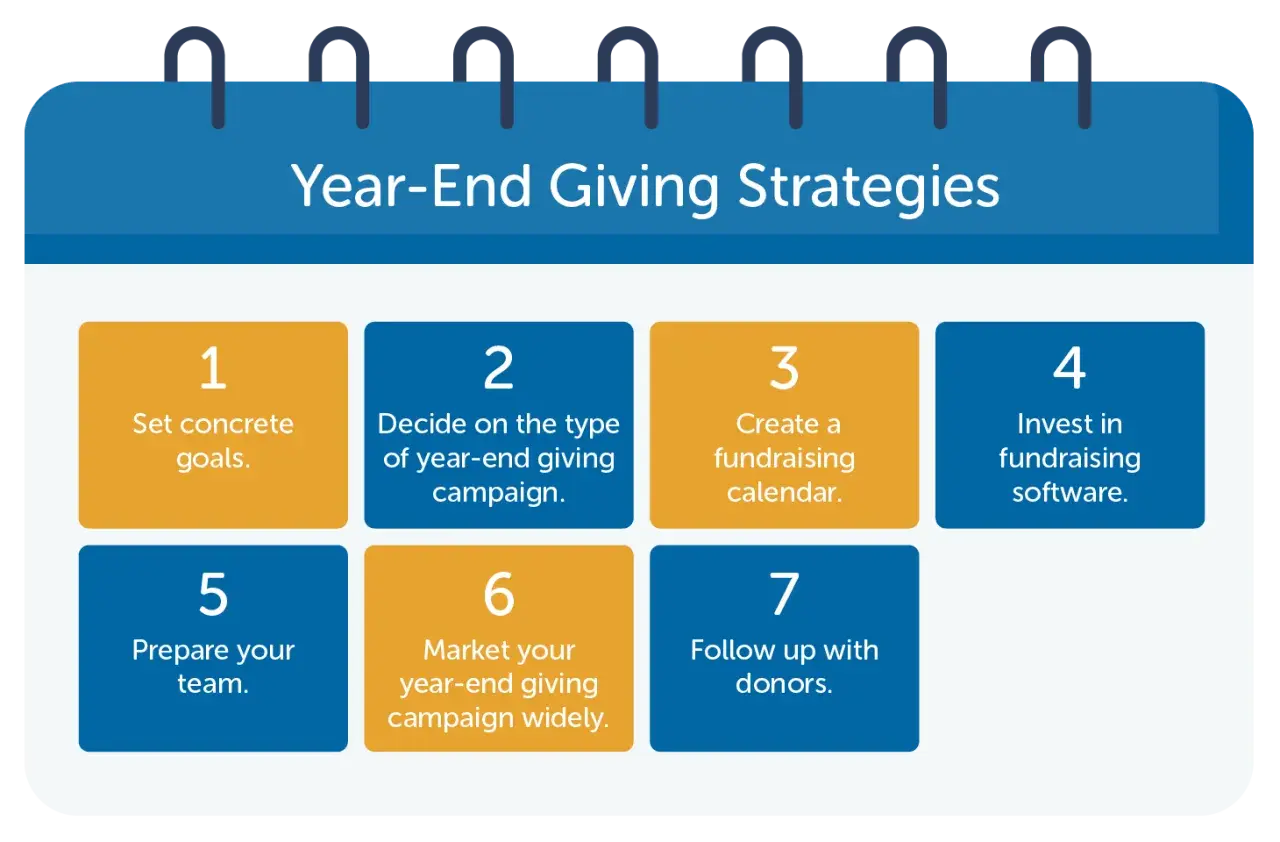
Year-end fundraising works best when it feels concrete. The best year-end giving campaign ideas are not about being louder; they are about making the gift feel specific, timely, and worth acting on now. In the U.S., the final stretch of the calendar is shaped by GivingTuesday, holiday attention, and the December 31 deadline, so the organizations that win are usually the ones that reduce friction and show impact fast.
These campaigns work when they make generosity feel specific, visible, and easy to act on
- Lead with one measurable outcome per appeal instead of a broad, vague fundraising request.
- Use GivingTuesday, which falls on December 1, 2026, as a kickoff, not a finish line.
- Matching gifts, recurring giving, and segmented asks usually outperform generic one-time appeals.
- A short, well-timed sequence of emails and social posts beats one crowded campaign with too many messages.
- The thank-you plan matters, because December donors are easiest to retain when they hear back quickly.
What donors are really responding to in the last weeks of the year
I usually think about the year-end season as a trust test. Donors are already being asked to spend, donate, travel, and make holiday decisions, so they are more selective than at other times of year. What cuts through is not cleverness for its own sake, but clarity: what the gift does, why it matters now, and why this organization is worth backing today.
Three signals matter most. First, urgency, because a real deadline helps people act. Second, relevance, because supporters want to see how their gift connects to a real need in their community. Third, trust, because even generous people hesitate when the path from donation to impact feels blurry. I would not build the whole campaign around tax language, but I would absolutely use the calendar honestly. For many U.S. donors, December 31 is a natural point to make a decision, and that is enough of a reason to give them a clear next step.
That is also why the strongest year-end appeals usually feel narrower than people expect. Instead of asking for “support our mission,” they ask for funds that cover meals, emergency shelter nights, scholarships, or a specific program gap. The more visible the outcome, the less friction there is in saying yes. Once that framing is in place, the choice of campaign format becomes much easier.
The campaign formats I would prioritize first
Not every year-end tactic deserves equal attention. If I had to narrow the field to the approaches that are most reliable for nonprofit fundraising, I would start with the ones below. They are not flashy, but they are easy for donors to understand and easier for teams to execute well.
| Campaign format | Best for | Why it works | Main risk |
|---|---|---|---|
| Matching gift drive | Fast momentum and mid-size donor engagement | It makes the impact immediate and easy to grasp | If the match is unclear or too large, the message loses force |
| Recurring giving push | Retention and budget stability | It turns a one-time gift into ongoing support | If you frame it like a backup option, conversion drops |
| Peer-to-peer campaign | Communities with volunteers, alumni, or advocates | Supporters bring trust and reach that institutional messaging cannot | It needs simple tools and clear prompts or it stalls |
| Countdown campaign | Last 7 to 10 days of December | It creates a visible deadline and repeated small wins | Without progress updates, urgency can feel manufactured |
| Gratitude-led appeal | After GivingTuesday or after a campaign milestone | It reminds donors that their previous gift mattered | If gratitude replaces the ask, revenue slows |
Matching gift drives
A matching gift is one of the cleanest year-end offers because the logic is immediate. A donor gives, and the value is doubled. If you can secure a 1:1 match, the story is simple enough to repeat across email, social, and your donation page without explanation fatigue. I also like time-limited matches, such as a 72-hour challenge or a match tied to a specific deadline, because they compress decision-making and create a visible push.
The limitation is obvious: a match without a credible backer or a clear cap can feel abstract. If you cannot secure a large match, a smaller but concrete challenge still works. What matters is not the size of the gift on paper, but the clarity of the offer in the donor’s mind.
Recurring giving pushes
Year-end is often when organizations forget to ask for monthly support, which is a mistake. A recurring gift is not a consolation prize. It is a different kind of commitment, and it can be far more valuable than a single December donation. I would especially use this approach when the organization provides ongoing community services, because donors can easily understand the link between monthly support and predictable impact.
The best version of this ask is not “please consider becoming a monthly donor.” It is “help us keep this work steady all year long.” That shift matters. It makes recurring giving feel like a practical act of care, not a financial upsell.
Peer-to-peer ambassador campaigns
Peer-to-peer fundraising works well when supporters already have their own networks and a reason to care deeply about the mission. Volunteers, board members, alumni, family ambassadors, and chapter leaders can all serve as credible messengers. They do not need to write polished appeals. They need a short story, a clear goal, and an easy link to share.This tactic is especially useful when you want to extend reach without increasing ad spend. The tradeoff is control. You will not get the same consistency across every message, so the campaign needs a simple framework, a shared deadline, and a short bank of approved talking points.
Read Also: Holiday Fundraising - Maximize Year-End Donations
Gratitude-led appeals
I like gratitude-led appeals because they feel honest. They remind supporters what has already been accomplished, then make the next step feel natural. This is one of the most effective ways to follow a milestone, such as GivingTuesday, because it avoids sounding like the organization is moving the goalposts. Instead, it says, in effect, “here is what your support already did, and here is what we can still do together.”
That tone is especially important for community-based organizations. People want to feel their gift belongs to something real, not just to a fundraising machine. Gratitude makes that connection visible.
Who to ask first and how to segment the list
The same message rarely works equally well for every donor group. Segmentation is where a lot of year-end campaigns either gain precision or lose it. If I were planning the list from scratch, I would prioritize five groups in this order: recent donors, lapsed donors, monthly donors, major donors, and community advocates.
- Recent donors already raised their hand once, so the ask can be direct. Invite them to finish the year with another visible win.
- Lapsed donors need a memory trigger. Reference the last project they supported and show what changed since then.
- Monthly donors are ideal candidates for an upgrade, a matching challenge, or a special year-end message of thanks.
- Major donors should receive a more personal conversation. Many are better suited to a matching gift or sponsorship than a standard appeal.
- Advocates and volunteers can be asked to amplify the message, especially if they are comfortable with peer-to-peer sharing.
The mistake I see most often is sending one broad appeal to everyone and hoping the copy will do the segmentation work. It will not. A donor who gave $25 last spring does not need the same message as a board member who can unlock a challenge gift. The more clearly you distinguish the ask, the less you have to rely on generic urgency. That leads naturally into the message itself, which has to do some heavy lifting without feeling forced.
How to write the message so it feels human and urgent
The strongest year-end appeals are rarely the longest. They usually follow a tight pattern: one problem, one proof point, one action. I would keep the structure simple enough that a donor can understand it in a single pass, because the final weeks of the year are not when people want to decode a complicated narrative.
Here is the framework I use most often:
- Open with the need in one sentence.
- Connect it to a real person, program, or community outcome.
- Explain exactly what a gift will do.
- Use one deadline, not three.
- Give the donor one clear action button.
Donation forms matter just as much as the copy around them. If the page asks for too much, you will lose people at the moment of intent. In most cases, name, email, amount, and payment details are enough. Anything extra should be justified by clear fundraising value. I also recommend keeping subject lines short and human, such as Help us finish strong by December 31 or Your gift can still go further this week. They sound like a real person asking for help, which is exactly the tone the season needs.
Once the message is clear, the next challenge is sequencing it well enough that the campaign feels alive instead of repetitive.

A four-week rollout you can actually manage
The year-end window works best when the team is not improvising. A simple four-week plan is usually enough for most nonprofits, and it is often more effective than trying to build a sprawling campaign with too many moving pieces.
| Week | Primary focus | What to ship |
|---|---|---|
| Week 1 | Set the offer | Choose the goal, confirm the story, secure any match, and finalize the donation page |
| Week 2 | Build the assets | Draft emails, social posts, images, and a short thank-you plan |
| Week 3 | Launch and learn | Send the first appeal, monitor response, and adjust the subject line or framing if needed |
| Week 4 | Close with urgency | Use a countdown, post progress updates, and send a final deadline reminder |
If your team is small, simplify the channel mix before you simplify the story. A clean landing page, one strong email sequence, and a few well-timed social posts will usually outperform a busy but inconsistent campaign.
The mistakes I see most often
Year-end campaigns fail for predictable reasons. The good news is that most of them are fixable before launch if you are willing to be honest about what is not helping.
- The ask is too broad. “Support our mission” sounds noble, but it is hard to act on.
- The deadline is unclear. A year-end appeal without a real cutoff loses urgency quickly.
- There is no visible proof of impact. Donors want to know what their money will do.
- The donation path is clunky. Extra fields and broken links quietly kill conversions.
- The campaign ends without stewardship. If people give and then hear nothing, you lose the next gift before it exists.
- Everything is framed as a crisis. Urgency has a place, but constant alarm makes people tune out.
If I had to pick the single most common issue, it is this: teams spend too much time trying to sound creative and not enough time making the decision easy. Creativity should live in the framing, the story, or the offer, not in confusing the donor. The cleaner the path, the better the result. That is also why the work after December 31 matters more than many organizations realize.
What I would keep in place after December 31
I treat January as part of the year-end campaign, not as a separate afterthought. The first job is stewardship. Thank donors quickly, explain what happened, and close the loop on the impact they made possible. That follow-up should happen in 24 to 48 hours for the most engaged supporters, and no later than the first few days of January for everyone else.Then review the campaign with a practical lens. Which segment converted best? Which message produced the strongest response? Did the match outperform the countdown? Did monthly giving attract the right supporters? Those answers are more valuable than a vague sense that the campaign was “good” or “busy.” They tell you what to repeat, what to stop, and what to tighten before the next appeal.
The strongest year-end fundraising does two things at once. It raises money for a real need now, and it creates a better relationship with the people who made that gift possible. If you build your campaign around that idea, you are not just finishing the year well. You are setting up the next one on stronger ground.
