
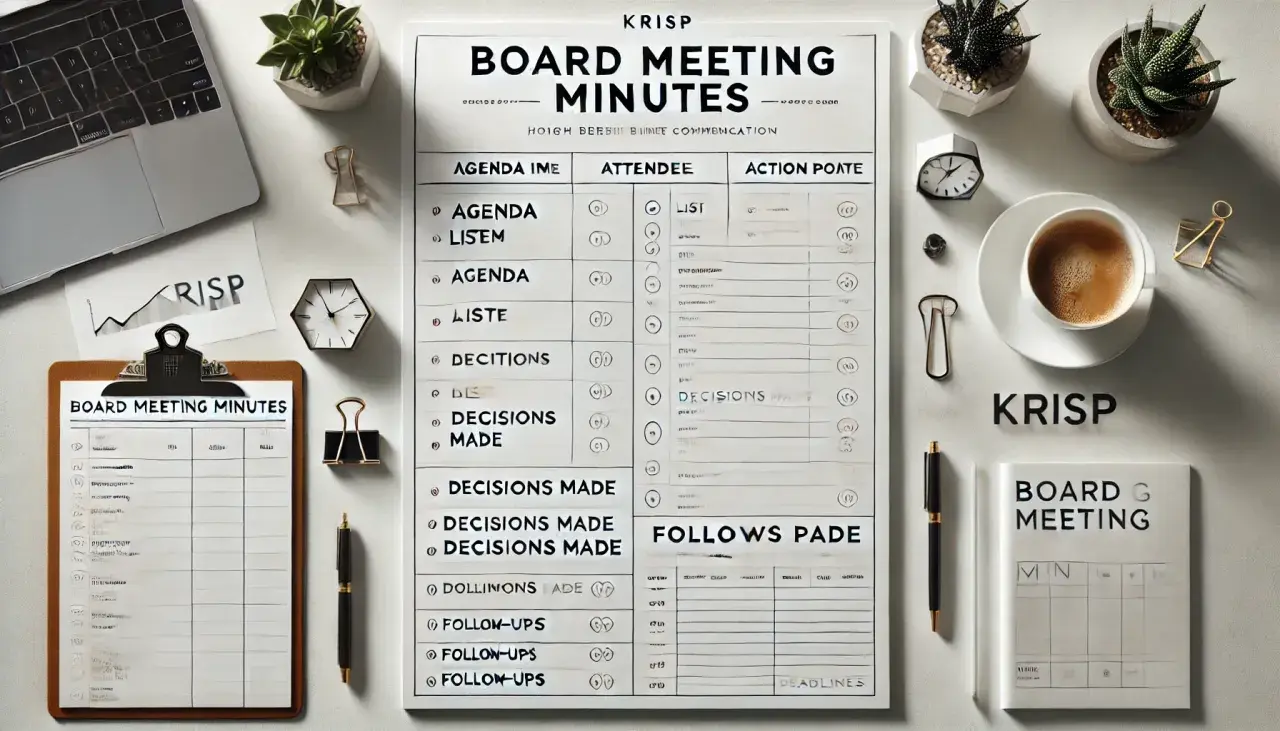
Key points for a reliable board record
- Minutes should capture decisions, votes, attendance, quorum, recusals, and action items, not a transcript of the room.
- The best draft is concise, factual, and organized around the agenda, so directors can review it quickly at the next meeting.
- In the United States, the exact legal standard depends on the entity and state, but minutes are treated as core governance records.
- Mission-driven boards should show how their decisions connect to purpose, budget, risk, and community impact.
- Late drafts, vague language, and missing vote counts are the most common reasons minutes become weak evidence.
Why the record matters more than most boards think
I usually tell directors to treat the minutes as the board’s memory with legal consequences. They show that the board met, had a quorum, discussed the right issues, and took action through a proper vote or resolution. The Council of Nonprofits notes that board meeting minutes are legal documents, and that is the right frame: they are not a diary of the conversation, but a record that can stand on its own if the board ever needs to prove what it did.
For nonprofits, that matters even more because the record may need to support grant decisions, conflict-of-interest handling, executive compensation, or a program shift that affects the community. A good set of minutes also helps new directors understand the history behind earlier choices, which makes governance steadier and less personality-driven. Once that purpose is clear, the next question is what the document should actually contain, and what it should leave out.
What belongs in the minutes and what should stay out
The cleanest minutes are action-focused. I want to see enough detail to reconstruct the decision, but not so much that the document turns into a transcript or a recap of every opinion in the room.
| Type | What to record | Why it matters | Example |
|---|---|---|---|
| Include | Attendance and quorum | Shows the board had authority to act | 8 of 11 directors present; quorum confirmed at 6:05 p.m. |
| Include | Motions and vote results | Shows exactly what the board approved | Motion to approve the outreach budget passed 7-1 with 1 abstention. |
| Include | Recusals and conflicts | Documents fair handling of bias risk | One director recused from a vendor contract discussion due to a family tie. |
| Include | Action items and owners | Turns decisions into follow-through | CFO to revise the forecast and circulate it before the next meeting. |
| Include | Key reports or approvals | Preserves the factual basis for major decisions | Finance committee presented reserve levels before the board vote. |
| Avoid | Word-for-word debate, jokes, side conversations, or personal commentary | Keeps the record clear, neutral, and readable | Long quotations and emotional back-and-forth usually belong nowhere near the final version. |
I also prefer to note executive sessions in a restrained way: the minutes can show that the board entered a closed session and list the general topic, without exposing sensitive detail. That balance keeps the record useful without making it noisy or risky. Once the content is clear, the drafting process becomes much easier.
How I draft minutes without slowing the meeting down
The easiest way to keep up is to prepare before the meeting starts. I build the draft from the agenda, leave room for each action item, and note the exact wording of motions once they are stated. That way I am recording decisions in real time instead of trying to reconstruct them from memory later.
- Start with the agenda and list each item in the same order the board will hear it.
- Record attendance, the chair, and whether a quorum is present as soon as the meeting opens.
- Write down motions, the mover, the seconder, and the vote result, including abstentions or recusals.
- Capture only the key reasoning that explains a decision, especially when money, risk, or mission impact is involved.
- Draft the first version promptly, ideally within 24 hours, while the discussion is still fresh.
- Bring the approved version back at the next regular meeting, so the board can accept it with any corrections.
I prefer this workflow because it keeps the document short enough to be useful and detailed enough to be defensible. It also works well for virtual meetings, where there is less room for casual side notes and more need for precise action tracking. If your board uses digital tools, they can help with speed, but I still edit heavily because raw transcripts usually capture speech better than governance.
Compliance points that matter in the United States
U.S. requirements are not identical from one entity to another, so I always start with the bylaws, the board’s retention policy, and the governing state law. For exempt organizations, the IRS expects records that support the return and show that the organization is operating as required; that makes minutes part of the organization’s evidence trail, not just an internal convenience.
| Compliance area | Practical rule | What can go wrong |
|---|---|---|
| Bylaws and state law | Follow the stricter standard and keep the format consistent from meeting to meeting. | Missing required approvals or vague records that do not support board action. |
| Approval process | Use a clear method, whether the board votes to approve or the chair and secretary sign the final version. | No clean proof that the final record was reviewed and accepted. |
| Retention | Store approved minutes in a secure archive and keep core governance records permanently when possible. | Lost history when a director changes, a dispute arises, or an audit begins. |
| Confidential matters | Separate executive-session notes from ordinary minutes and keep the wording minimal. | Accidental disclosure of sensitive staff, legal, or donor information. |
| Nonprofit accountability | Document decisions that show mission alignment, fiscal oversight, and conflict-of-interest handling. | Weak support for a grant, compensation, or program decision if later questioned. |
That is also why I recommend a document-retention policy that names who stores the final version, where it lives, and how long it is kept. In practice, consistency is more valuable than fancy formatting. Even a plain record can do its job if it is complete, timely, and easy to retrieve. Even with the right legal framework, a few common habits can still weaken the record.
Common mistakes that weaken the record
- Too much narration - writing who argued what, instead of what the board decided.
- Too little specificity - vague phrases like “the board discussed the budget” with no vote count or action.
- Missing recusals and abstentions - a problem when conflicts of interest matter.
- Late drafting - memory fades fast, and the details get softer with every day.
- Inconsistent formatting - makes it harder to compare meetings over time.
- Blurring confidential topics - executive-session detail should not be mixed into ordinary minutes.
One thing I see often is a board that tries to make the minutes sound polished instead of accurate. The better habit is to make them exact, then readable, then approved. When those three are in that order, the document holds up better under scrutiny and is easier for new directors to trust. The boards that get this right tend to be the ones that connect the document back to mission, risk, and impact.
How mission-driven boards use minutes to stay accountable
For a community-focused board, the minutes should show more than legal compliance. They should show how the board connected mission, budget, risk, and impact before making a decision. If a nonprofit approves a neighborhood food program, for example, the record should show the rationale, the funding source, any conflicts, the vote, and who is responsible for the next step. That does not mean over-explaining the story; it means documenting enough context to prove thoughtful stewardship.
I find this especially important when the board is balancing social good with limited resources. A brief note explaining why one initiative was prioritized over another can be invaluable later, because it helps future directors understand the trade-off instead of reopening the entire debate. In that sense, good minutes are a governance tool, not just an administrative task, and they help the board stay aligned with the community it serves. That is why I treat the archive as part of governance, not just storage.
Keep the record useful long after the meeting closes
The best minutes are easy to retrieve, easy to read, and easy to trust six months later. That usually means a clean template, prompt drafting, a clear approval process, and a retention policy that tells everyone where the approved version lives and how long it stays there.
When I review board records, I look for one simple test: could someone who was not in the room understand what was decided, why it mattered, and what still needs to happen? If the answer is yes, the minutes are doing their job. If not, the board has room to tighten the process before the next meeting.
