
The strongest boards know exactly who owns each part of governance
- The board’s job is governance: strategy, oversight, fiduciary control, and leadership accountability.
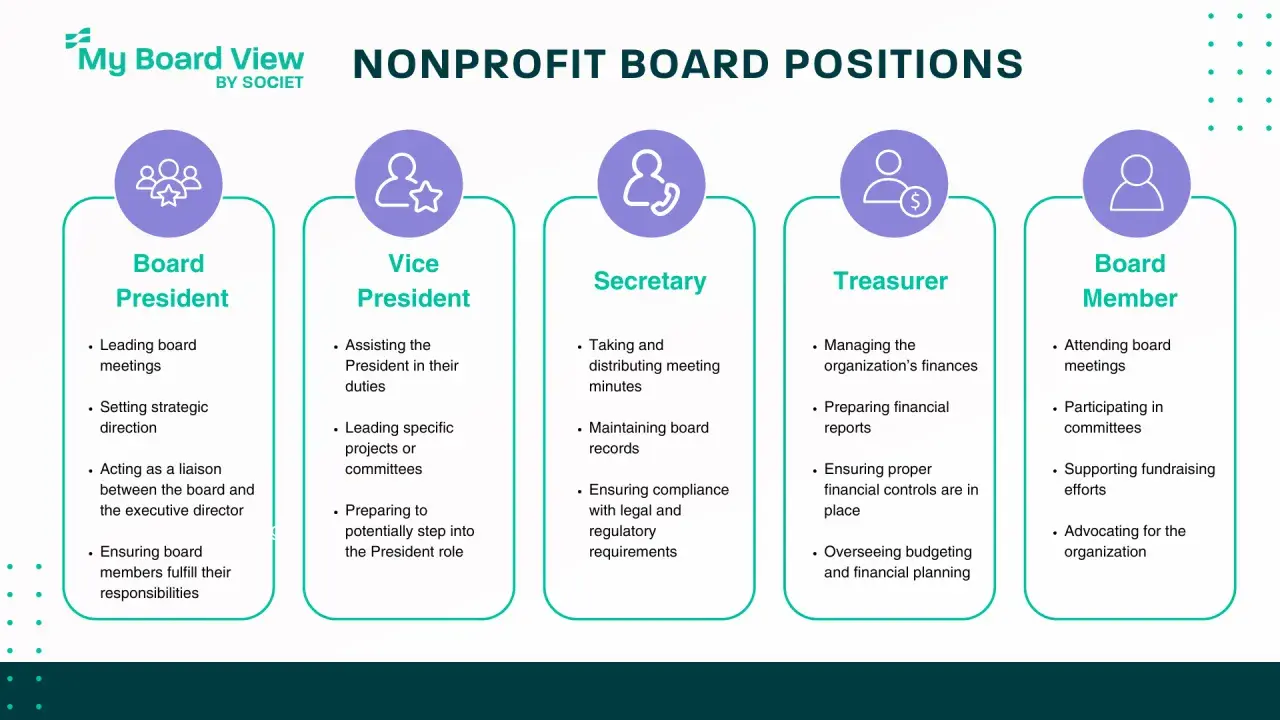
- The core officer seats are usually chair or president, vice chair, secretary, and treasurer.
- Committee chairs turn board priorities into focused work without replacing staff leadership.
- In U.S. nonprofits, board members often also support fundraising, advocacy, and mission stewardship.
- Clear role descriptions, conflict-of-interest policies, and accurate records prevent most governance mistakes.
What a board actually does
I separate governance from management as soon as a board gets serious about its mission. Governance is the board’s job; management is the staff’s job. The board sets direction, hires and reviews the chief executive, approves major budgets, monitors risk, and makes sure the organization stays legally and ethically sound. Staff members, by contrast, run day-to-day operations, deliver programs, and execute the strategy the board has approved.
That line sounds simple until it is tested. In a food bank, a community health nonprofit, or a local arts organization, board members can be tempted to solve operational problems themselves because they care deeply about the mission. I understand the instinct, but it usually backfires. The board becomes slow, political, and oddly ineffective when it starts acting like an extra layer of staff.
In mission-driven work, directors also carry fiduciary duties. I think of those as three overlapping obligations: care, loyalty, and obedience to the mission and governing documents. The National Council of Nonprofits is blunt about this point: board members are fiduciaries who must steer the organization with sound, ethical, and legal oversight while helping it secure the resources it needs to serve its community.
That is the real backdrop for any board seat. Once the board understands its lane, the individual positions become easier to define and much easier to use well. From there, the question becomes how to distribute responsibility without creating confusion.

The core officer roles and what each one carries
Most boards work best with a small set of officers. The exact titles vary by bylaws, and some organizations use chair and president interchangeably, while others separate them. What matters is not the label, but the responsibility attached to it.
| Role | Main responsibility | What usually goes wrong |
|---|---|---|
| Chair or president | Leads the board, shapes meeting agendas, keeps discussion on strategy, and works closely with the chief executive. | Becoming a shadow CEO instead of a governance leader. |
| Vice chair | Supports the chair, prepares to step in when needed, and often helps coordinate special projects or succession planning. | Having no defined purpose until the chair is unavailable. |
| Secretary | Keeps minutes, preserves resolutions, manages board records, and makes sure notices and documentation are accurate. | Treating the role like simple note-taking instead of record stewardship. |
| Treasurer | Oversees financial reporting, budget review, controls, and audit readiness on behalf of the board. | Becoming the only person who understands the numbers. |
| Director at large | Brings independent judgment, votes on board matters, serves on committees, and represents the mission externally. | Sitting quietly and mistaking attendance for contribution. |
I usually tell boards that the chair manages the room, the secretary preserves the record, and the treasurer guards the financial story. Everything else flows from that. If any one of those seats is vague, the entire board spends extra time cleaning up avoidable confusion.
One more practical point: the board member without an officer title is not a second-tier person. A good director at large is often where the board’s best questions come from, because that seat is supposed to stay close to the mission, the evidence, and the real-world consequences of a decision. Once those core roles are clear, the next layer of structure becomes much easier to use well.
Committee chairs and the work that keeps the board useful
The officer roles get the most attention, but committee chairs often decide whether a board actually moves anything forward. A strong committee chair does not create busywork; they narrow the issue, frame the decision, and bring the full board a recommendation that is ready to discuss.
In practice, the most useful committees are the ones that match the organization’s real risks and goals:
- Governance or nominating committee - recruits new directors, identifies skill gaps, and leads onboarding.
- Finance or audit committee - reviews budgets, reserves, controls, financial reports, and audit findings.
- Development or fundraising committee - supports resource development without turning board service into staff-level solicitation work.
- Program or impact committee - checks whether services are producing meaningful outcomes, not just activity.
- Ad hoc task forces - handle one-time work such as a CEO search, bylaw revision, or capital campaign.
There is a limit, though, and it matters. Small boards often overload themselves by creating a committee for every problem. That usually produces more meetings, more follow-up, and less clarity. I would rather see a smaller number of well-defined committees with short charters than a long list of groups that exist mostly on paper.
An advisory board can add expertise, but it is not the same thing as a governing board. An advisory group can advise, introduce contacts, or share insight, yet it does not carry the same fiduciary duty or voting authority. Mixing those two structures is a common source of confusion, especially in early-stage nonprofits and community organizations.
When committee chairs are chosen carefully, they do more than lighten the load. They help the board stay strategic, which is the only reason committees should exist in the first place.
How U.S. nonprofit and corporate boards differ
The basic logic of board service is similar across sectors, but the emphasis changes. That matters in the United States, where nonprofit, private-company, and public-company boards often use the same titles while working under very different pressures.
| Setting | Typical emphasis | How the roles usually function |
|---|---|---|
| Nonprofit or charity | Mission, public trust, legal compliance, fundraising, and community accountability | The chair works closely with the executive director, the treasurer watches sustainability and controls, and directors often support outreach and advocacy. |
| Public company | Shareholder value, risk oversight, executive performance, and regulatory discipline | The chair is often separate from management, independent directors carry more weight, and committee work is more formalized. |
| Private or family business | Owner goals, confidentiality, speed, and succession | Roles may be more flexible, but clear bylaws matter even more because informal authority can become messy quickly. |
One useful governance term here is independent director, which means a board member without a management relationship that could weaken objective oversight. In some public companies, a lead independent director helps coordinate the outside directors’ perspective when the chair is not fully independent. That setup is less common in nonprofits, but the principle is the same: the board needs people who can think clearly about performance without being captured by daily operations.
BoardSource points out that boards are generally strongest when they focus on oversight, strategy, and resource stewardship, and weaker when they drift into external work like fundraising, advocacy, or community-building without a clear plan. I agree with that framing, especially for mission-driven organizations. The titles may look familiar across sectors, but the board’s purpose is never identical.
That is why the bylaws matter so much. The name of a seat is less important than the authority, term length, and reporting line written into the governing documents. If those pieces are unclear, the board may look organized while still operating in a very ad hoc way.
How to choose the right people for each role
Choosing the right board of directors positions is less about prestige than clarity. I always start by asking what the organization actually needs: financial literacy, community credibility, legal discipline, fundraising reach, program expertise, or succession stability. Then I map people to those gaps instead of filling seats with whoever is most available.
- Write one-page role descriptions. If a seat cannot be explained clearly, it will be misused.
- Match skills to gaps. A good chair is not just influential; they are organized, calm, and able to keep the room focused.
- Separate finance oversight from enthusiasm. A treasurer should understand controls and reporting, not just like numbers.
- Use reasonable terms. Many boards use 2- or 3-year terms because that is long enough for continuity and short enough to avoid stagnation.
- Plan for succession. The vice chair should not exist only as a placeholder; the role should create a real path to continuity.
- Document conflicts and independence. A conflict-of-interest policy is not decorative. It protects credibility before problems become public.
In very small organizations, one person may wear two hats. That can be unavoidable, and sometimes it is the only practical option. But I do not pretend it is ideal. The tradeoff is usually more risk of burnout, less accountability, and a higher chance that no one feels fully responsible for a decision.
If your board is recruiting for a mission-driven organization, the best candidates are usually people who combine commitment with discipline. Community passion matters, but it does not replace financial judgment, meeting discipline, or an ability to ask hard questions without turning every discussion into a fight.
What an effective board structure looks like in practice
When I review a healthy board, I look for a few signs that are hard to fake: a chair who keeps the meeting moving, a secretary whose minutes actually tell the story, a treasurer who can explain the numbers without drama, and directors who understand the difference between oversight and implementation. If those elements are present, the board is probably using its structure well.
- Every director knows who leads, who records, and who owns financial oversight.
- New members are onboarded before they are asked to vote on major issues.
- Committees prepare decisions instead of hiding them.
- Conflicts of interest are disclosed early, not cleaned up after the fact.
- The board talks about outcomes, not just activity.
That is the real value of strong board structure. It does not exist to create hierarchy for its own sake. It exists to make trust possible, so the organization can focus on the community it serves. If the roles are clear, the mission gets more room to breathe. If they are vague, even a talented board will spend too much energy untangling its own process instead of advancing the work.
