
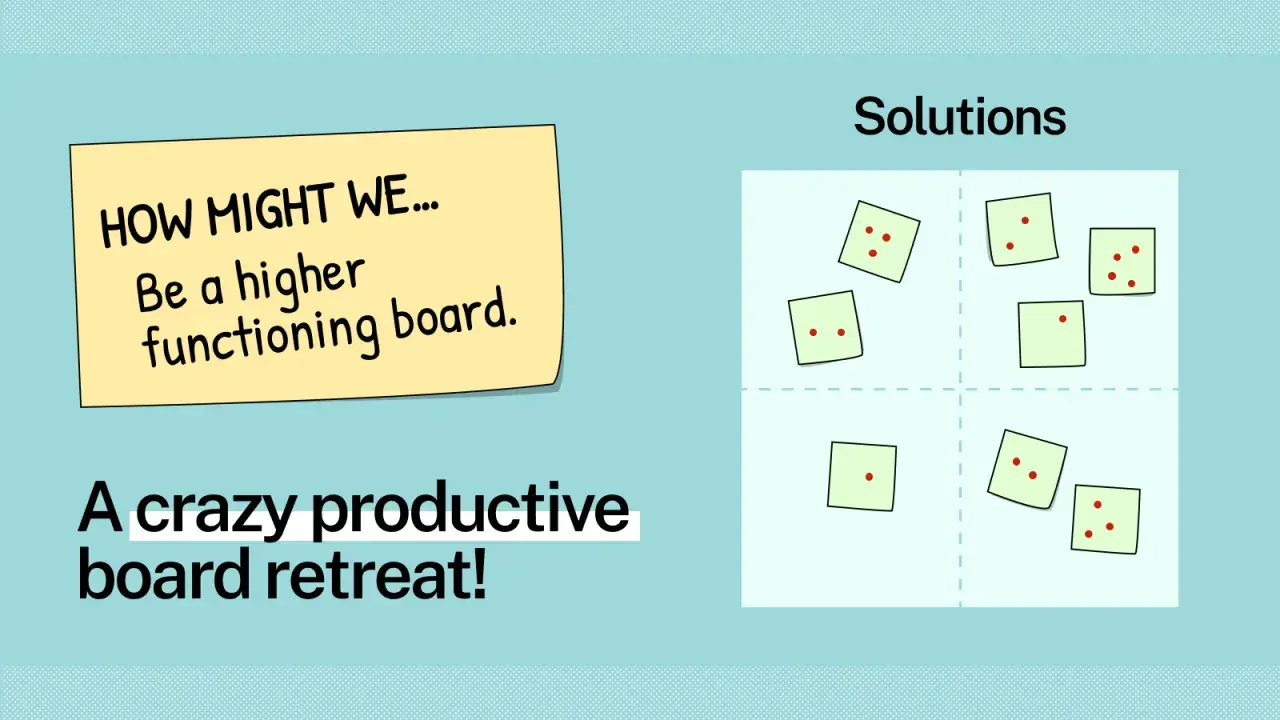
Board governance works best when directors can step away from routine reports and look at the organization with some distance. A strong retreat agenda gives them that space: it creates room for strategic decisions, role clarity, leadership transitions, and the kind of honest conversation that rarely fits inside a regular board meeting. In practice, the retreat should feel focused and human, not ceremonial.
Key takeaways for planning a board retreat that leads to action
- The retreat should handle issues that are too complex, strategic, or relational for a standard board meeting.
- Most boards do better with a clear purpose, a limited number of topics, and visible decision points.
- A full-day format is usually the best balance for governance work that needs reflection and follow-through.
- Routine reports, minutes, and approval-only items should stay out of the main working time.
- The retreat is only useful if it ends with owners, deadlines, and a follow-up date already on the calendar.
What the retreat is really for in board governance
BoardSource treats the annual retreat as the place for large, complicated issues that regular meetings cannot handle well, and that is the right lens. In a mission-driven organization, the retreat is not an escape from governance; it is governance at a higher altitude. It is where I would expect the board to step back and ask whether the structure, strategy, and board culture are actually helping the organization serve people well.
That means the retreat should focus on a small set of high-value questions: Are we clear on our strategic priorities? Do we have the right leadership pipeline? Are board roles, committee work, and staff boundaries working as they should? Are we spending our time on the decisions that matter most?
Just as important, the retreat should not be treated like a long version of a routine meeting. If the room is full of financial reports, minute approvals, and status updates, the board will leave with less energy than it brought in. Once the purpose is clear, the next step is to choose a format that fits the amount of work ahead.
Choose the format before you draft the day
I usually start with the format, because the format quietly decides what kind of conversation is possible. A half-day retreat can work for a single issue or a board reset. A full-day retreat is better when the board needs strategic discussion plus governance decisions. An overnight retreat makes sense only when the board needs deeper culture work, leadership transitions, or a major reset in trust.
| Format | Best for | Typical length | Watch out for |
|---|---|---|---|
| Half-day | One focused topic, a quick board reset, or a lighter planning session | 3-4 hours | Too little time for hard decisions or complex discussion |
| Full day | Strategy, governance review, and one or two significant decisions | 6-8 hours | Agenda bloat if every committee wants a turn |
| Overnight or two-day | Succession planning, culture repair, executive transition, or major restructuring | 1.5-2 days | Fatigue if the day is not broken into clear working blocks |
If the board has only one thing to solve, I would keep the retreat tight. If the board needs to think, debate, and decide, I would protect a full day and use it well. The format tells you how much time you have; the schedule tells you whether that time will matter.

A one-day schedule that keeps governance work moving
This is the kind of board retreat schedule I trust most: a clear opening, enough space for real discussion, a social break that does not feel forced, and a closing block that converts talk into commitments. It is not meant to be copied blindly. It is a workable pattern that you can adjust to your board’s current issue.| Time | Session | Purpose |
|---|---|---|
| 8:30-9:00 | Arrival, coffee, informal connection | Helps people settle in before the work starts |
| 9:00-9:20 | Opening, purpose, and working norms | Sets expectations for how the board will make decisions |
| 9:20-10:10 | Board health check | Names what is working, what is blocked, and what needs attention |
| 10:10-10:25 | Break | Prevents the first session from spilling into the rest of the day |
| 10:25-11:30 | Strategic priorities | Focuses the board on 1-2 choices that shape the next 12 months |
| 11:30-12:00 | Governance issues | Reviews board composition, committee load, or policy gaps |
| 12:00-12:45 | Lunch and relationship time | Builds trust without pretending it is a separate goal |
| 12:45-1:45 | Leadership pipeline and succession | Looks at board, executive, and committee continuity |
| 1:45-2:30 | Small-group breakouts | Lets people pressure-test options before the full group decides |
| 2:30-2:45 | Break | Protects energy for the decision block |
| 2:45-3:30 | Decision synthesis | Brings the group to shared conclusions and tradeoffs |
| 3:30-4:00 | Actions, owners, and deadlines | Turns the retreat from a discussion into a governance tool |
| 4:00-4:15 | Closing reflection | Confirms what changed and what happens next |
The important part is not the exact time stamp. It is the rhythm: open clearly, work deeply, pause often enough to stay sharp, and end with decisions that can be tracked. That rhythm matters even more once you tailor the retreat to the board’s real problem.
Tailor the discussion to the board's current job
Not every board retreat should try to do everything. In fact, the best ones usually have one dominant purpose and a few supporting topics. If the board is trying to solve a leadership transition, the agenda should look different than if it is rebuilding trust after a difficult year or aligning around a new strategy.
If succession is the pressure point
Put leadership continuity near the center of the day, not at the end when people are tired. That includes the board chair pipeline, committee leadership, executive succession, and emergency coverage if a transition happens sooner than expected. One reason I push this topic hard is that BoardSource has reported that only 29% of nonprofit boards have a written succession plan, which means many boards are already behind before a transition begins.
If new members need onboarding
Use part of the retreat to explain how the board actually works, not just what the mission says. New directors need context on decision rights, committee structure, meeting expectations, and the difference between oversight and management. A retreat is one of the few settings where they can ask basic questions without slowing down a formal meeting.
If trust or performance is the issue
Keep the conversation specific and facilitated. Boards under strain usually do not need more abstract language about teamwork. They need clear norms, honest feedback, and a shared view of what effective governance looks like. If the board has drifted into silence or side conversations, the retreat is the right time to name that pattern directly and reset expectations.
Read Also: Effective Board Meeting Setup - Boost Decisions & Governance
If strategy needs a reset
Do not cover ten priorities. Choose the few choices that genuinely shape the next phase of the organization’s work. For a mission-driven board, that may mean service reach, community partnerships, fundraising capacity, or program concentration. The point is to make tradeoffs visible. Once the content matches the real problem, the next risk is wasting the time you have already protected.
The mistakes that waste the best intentions
The most common retreat mistakes are not dramatic. They are small design errors that slowly drain the room.
- Starting with long reports instead of a clear decision question.
- Trying to solve too many issues in one sitting.
- Leaving no room for small-group discussion, which usually means the loudest voices win.
- Skipping breaks and social time, then wondering why the group feels flat by midafternoon.
- Ending without owners, deadlines, or a follow-up checkpoint.
- Using generic icebreakers that have no connection to mission or governance.
I would also avoid the false comfort of a retreat that feels pleasant but produces nothing. A good retreat is not judged by how smooth the day felt in the moment. It is judged by whether the board leaves with sharper priorities, clearer roles, and a shorter list of unresolved confusion. The last step is making those outcomes visible before everyone walks out the door.
What the board should leave with before the room empties
If I were closing a retreat, I would not let the group leave until three things were true: the board could name the decisions it made, the owners for each next step were clear, and the follow-up date was already scheduled. That is the difference between a thoughtful off-site and an expensive conversation.
- Three to five concrete decisions or agreed directions
- Named owners for every action item
- Deadlines that are specific enough to track
- A short written recap sent to directors within a few days
- A board meeting or check-in scheduled to review progress
For mission-driven organizations, that follow-through is where board governance becomes real. The retreat should sharpen judgment, reduce ambiguity, and leave the board better prepared to serve the community with discipline and purpose.
