
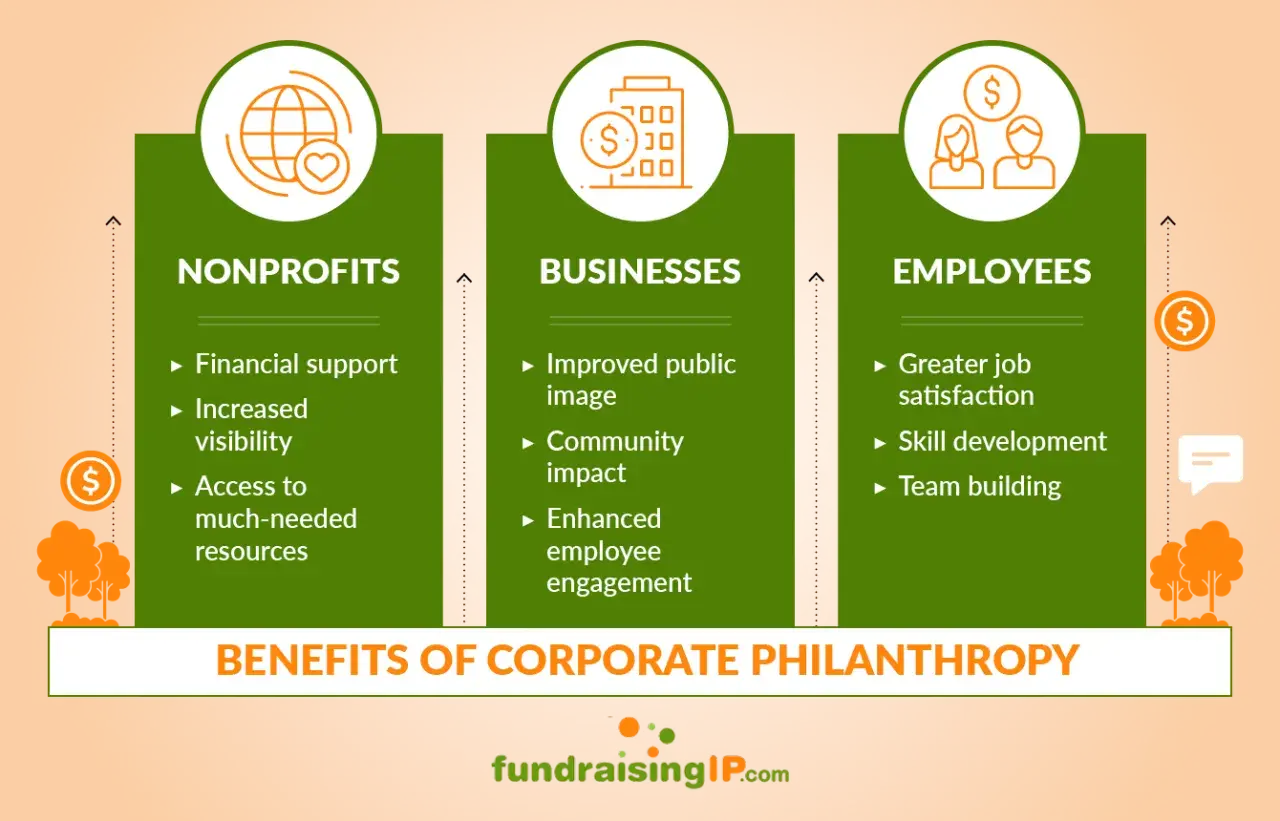
Corporate giving works best when it is structured, easy to repeat, and tied to a real fundraising need. The strongest business philanthropy examples are not random checks; they are systems that move money, time, and visibility toward a cause. In this article, I break down the main models used by U.S. companies and show how nonprofits can turn them into steadier fundraising instead of one-off wins.
What corporate giving needs to do to matter
- Matching gifts, volunteer grants, foundation grants, in-kind support, and pledge models are the most useful corporate-giving patterns for fundraisers.
- In the U.S., large employers often offer matching programs, but participation is still low enough that nonprofits leave money behind without a clear ask.
- The best partnerships combine cash with employee engagement, visibility, or technical help.
- A strong corporate gift is specific, measurable, and easy for employees or CSR teams to approve.
- The goal is not just a larger donation; it is repeatable fundraising.
What counts as corporate philanthropy in fundraising
In U.S. fundraising, corporate philanthropy is the part of the budget conversation where a company becomes more than a sponsor. It can mean a direct grant from a foundation, an employee match, volunteer-time funding, in-kind advertising, donated software, or a pledge model that ties giving to sales or equity. I pay attention to the structure first, because the structure tells you whether the support is a one-off gesture or a repeatable source of money.
That distinction matters. A straight check helps a campaign close a gap, but a matching program, volunteer grant, or recurring pledge can keep producing value long after the first donation clears. For nonprofits, that usually means more predictable cash flow, better donor conversion, and a stronger story to tell on the next appeal. Once you separate the structure from the logo, the examples become much easier to compare.
The business donation models that work best
The most useful models are not the flashiest ones. They are the ones a fundraiser can explain in one sentence, attach to a donation page, and renew next year without reinventing the ask.
| Model | U.S. example | What it looks like | Why it helps fundraising | Where it falls short |
|---|---|---|---|---|
| Matching gifts | Microsoft, Apple, Salesforce | An employee donates and the company matches the gift, often dollar for dollar up to an annual cap. | Doubles donor impact and creates a clean call to action on appeal pages. | Depends on employee action and program awareness. |
| Volunteer grants and paid volunteer time | Microsoft, Apple, Salesforce | The company gives money when staff volunteer, often alongside paid volunteer time off. | Turns engagement into funding and deepens employee loyalty. | Harder to use if the nonprofit cannot host volunteers well. |
| Foundation grants | The Coca-Cola Foundation | Direct grants are awarded to charities that fit the company’s priorities. | Useful for program budgets, community projects, and multi-year support. | Competitive and often strategy-driven. |
| Pledge models | Patagonia, Salesforce | The company commits a fixed share of sales, equity, product, or time to social impact. | Creates predictable funding and public accountability. | Requires long-term discipline from leadership. |
| In-kind ad and tech support | Google.org, Google for Nonprofits | The company gives ad credits, software, training, or technical expertise instead of cash. | Helps nonprofits reach donors and reduce operating costs. | Does not replace unrestricted cash. |
I like Microsoft’s approach because it treats employee generosity as part of the fundraising engine, not as a side project. Microsoft says its 2025 employee giving program included $255.6 million in employee contributions and company match, plus more than 1.2 million volunteer hours. Apple’s current employee benefits still show a one-for-one donation match up to $10,000 a year and $25 for every volunteer hour, which is a neat example of a company linking cash, time, and community habit in the same program.
Patagonia is useful for a different reason. It gives 1% of sales to environmental groups and, in FY25, says it awarded $14.7 million in grants and in-kind support to 824 nonprofits. Google.org adds another layer with cash funding, pro bono expertise, and no-cost ad support, so a nonprofit can raise awareness even when it does not have a large marketing budget. The common thread is that the company does not just donate; it creates a mechanism that the nonprofit can use again.
That structure is what makes the next question worth asking: why do some company gifts turn into real fundraising momentum while others barely move the needle?
Why some company gifts raise more money than others
What separates a strong corporate gift from a forgettable one is leverage. The best programs multiply a donor’s intent, employee behavior, or campaign visibility, which is why matching gifts and volunteer-related support keep showing up in fundraising plans.
Industry data suggests that a large share of Fortune 500 employers now offer matching programs, yet participation still sits low enough that plenty of money goes unclaimed. That gap is the opportunity. If a donor already wants to give, and the employer is willing to match, the nonprofit is really running two conversions at once.
- Lower friction means the donor can claim the match in a minute, not a week.
- Visible participation means employees, not just executives, can see the impact.
- Repeatability means the company can fund the same cause every quarter, not only when a crisis hits.
- Clear outcomes mean the nonprofit can say exactly what the gift bought.
That is also why I prefer corporate giving that supports operations, outreach, or volunteer engagement instead of only headline-grabbing campaigns. It is usually less glamorous, but it is more likely to sustain the fundraising pipeline. The next step is turning that insight into a better ask.
How I would ask for corporate support without wasting the opportunity
When I build a corporate ask, I try to make the decision easy, specific, and obviously aligned with the company’s own culture. A vague request for support usually loses to a sharper proposal that shows why the partnership makes sense and what the company gets to help create.
- Start with the right lane. If the company has an employee match, ask donors to check eligibility. If it has a foundation, ask for a program grant. If it is strong on volunteering, build a service-day or volunteer-grant angle.
- Match the company’s public priorities. A health company usually wants health outcomes; a local employer often responds better to community impact than to a broad national pitch.
- Give one measurable use for the money. I would rather see “fund 300 meals for a school pantry” than a generic promise that the gift will support the mission.
- Make the administrative path simple. Include the nonprofit name, tax status, contacts, deadlines, and any matching instructions in one page.
- Leave room for renewal. If the company can evaluate the result in 30 to 90 days, it is much easier to ask again next quarter or next year.
The cleanest asks are the ones a busy CSR manager or community-relations lead can approve without a lot of translation. That leads straight into the errors that quietly kill strong opportunities.
Common mistakes that weaken corporate giving partnerships
Most corporate partnerships do not fail because the company is uninterested. They fail because the nonprofit makes the partnership harder to use than it should be.
- Asking too broadly turns a real opportunity into a generic sponsorship request.
- Ignoring matching programs leaves employee-led fundraising on the table.
- Treating in-kind support like cash creates unrealistic budget expectations.
- Skipping follow-up makes the company feel like a wallet instead of a partner.
- Overpromising visibility can backfire if the nonprofit cannot deliver the reach it described.
The mistake I see most often is the last-mile failure: the gift lands, the thank-you goes out, and the team never shows the company what changed because of it. A short impact note, a donor story, or a clean outcome report usually does more for retention than another polished deck. When the report is easy to read, the next conversation gets a lot easier.
The patterns I would copy first in 2026
If I had to copy only a few corporate philanthropy patterns in 2026, I would start with the ones that combine cash, participation, and continuity. That usually means a one-for-one match, a volunteer grant or paid volunteer time program, a recurring annual pledge, or in-kind support that helps a nonprofit reach more people with less overhead.
- Use repeatable giving. One-off gifts are useful, but recurring structures are what make fundraising predictable.
- Use employee behavior. When staff members can trigger a donation, the program becomes more active and harder to forget.
- Use mission fit. The best partners are the ones whose audience, workforce, or products naturally relate to the cause.
- Use proof. Companies renew when they can see measurable results without having to chase the story.
That is the real lesson behind the strongest corporate-giving programs: generosity matters, but design matters more. The best partnerships are easy to participate in, easy to measure, and easy to repeat, which is exactly what a fundraiser needs if the goal is more than a single headline.
