
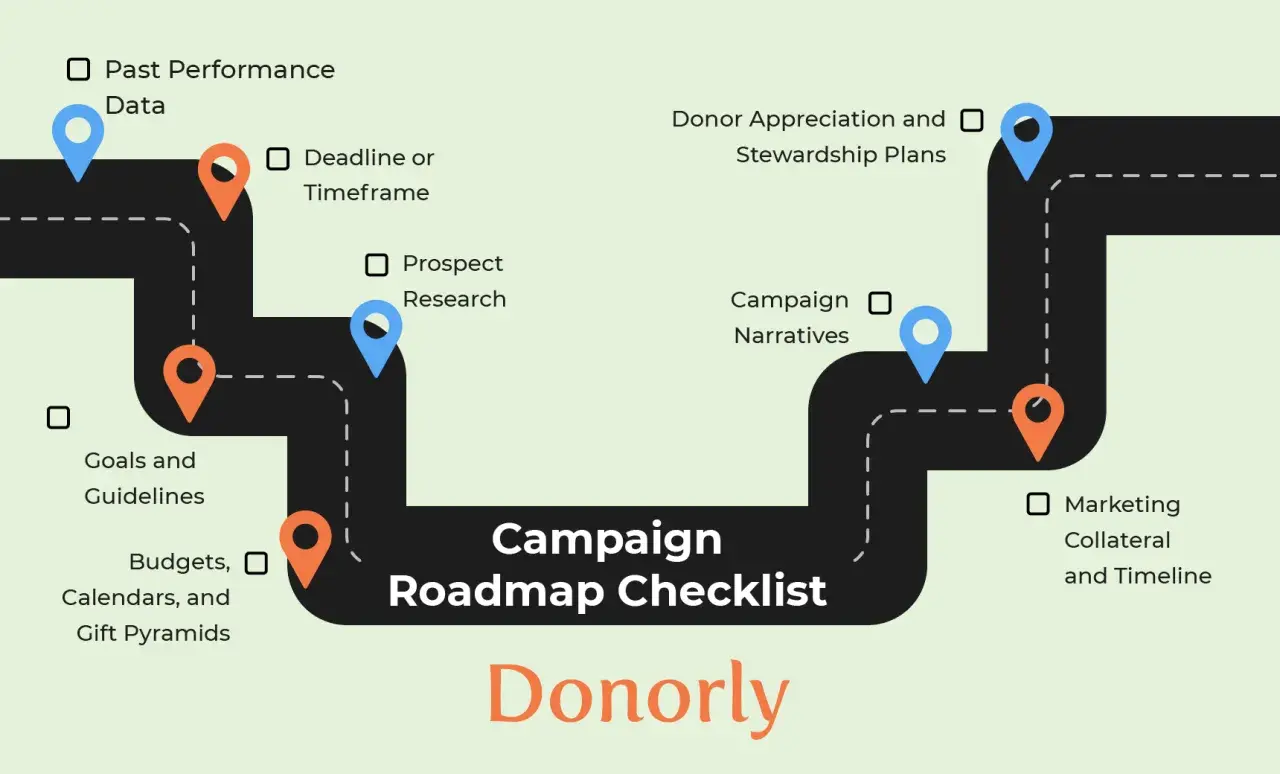
A fundraising plan template works best when it does three jobs at once: it clarifies the revenue target, shows who owns each task, and keeps the year from turning into a scramble. For mission-driven organizations, that matters because effective fundraising is less about repeating asks and more about choosing the right donor segments, messages, channels, and timing. In this guide, I break down what belongs in the document, how to set realistic goals, how to map campaigns across the year, and how to keep the plan useful after the first draft.
Key points to keep in front of you
- Start with the funding gap, not the campaign tactic.
- Build the plan around donor segments, because different supporters need different asks.
- Put every action on a calendar with an owner, deadline, and budget.
- Track retention, average gift, response rate, and cost per dollar raised instead of vanity metrics.
- Review the plan quarterly so you can adjust before the year drifts off track.
What the document should actually do
I treat a fundraising plan as a working operating document, not a polished PDF that gets filed away after board approval. Its job is to translate mission into revenue, and revenue into actions the team can execute without guessing. If a section does not change a decision, it probably does not belong in the plan.
| Section | What I put in it | Why it matters |
|---|---|---|
| Revenue goal | Exact amount to raise, plus the gap it must close | Gives the team a clear finish line |
| Funding mix | How much should come from individuals, grants, events, and recurring gifts | Prevents overdependence on one source |
| Audience map | Donor segments, prospect tiers, and board roles | Turns a generic ask into a specific one |
| Calendar | Monthly and quarterly campaign milestones | Stops good intentions from collapsing into last-minute work |
| Budget | Staff time, software, creative, mail, events, and contingency | Keeps the plan financially honest |
| Metrics | The numbers you will review and when you will review them | Makes the plan measurable instead of aspirational |
| Ownership | Names, roles, and approval steps | Prevents tasks from floating between departments |
For community organizations, I especially like to link each fundraising stream to a real-world outcome: meals delivered, youth programs staffed, counseling hours funded, or neighborhood services expanded. That keeps the plan grounded in social impact, which is usually what supporters want to see. Once the structure is clear, the next question is much more practical: how much money does the plan actually need to raise?
Set the funding target before you pick tactics
The easiest mistake is to start with a tactic you like, such as a gala or a giving day, and only later ask whether it can realistically raise enough money. I start with the funding gap. If your organization needs $250,000 to deliver a program and already has $90,000 committed, the fundraising target is not abstract; it is the remaining gap plus the cost of raising it.
A simple way to think about it:
- Program need = what the work will cost.
- Confirmed revenue = grants, renewals, pledges, and recurring gifts already secured.
- Funding gap = program need minus confirmed revenue.
- Campaign cost = the money and staff time required to raise the rest.
I also like to build two versions of the target. A base-case target assumes ordinary conversion rates and normal donor behavior. A stretch target assumes a few larger gifts come through or a campaign outperforms expectations. That gives the team a realistic floor and a ceiling without pretending uncertainty does not exist.
In the United States, I would be especially careful with year-end timing. December can carry a lot of weight in annual giving, so the plan should back up from that moment instead of treating it like an afterthought. If the campaign ends in December, the work usually starts months earlier: the case statement, the donor list, the approval path, and the stewardship plan all need to be in place first. With the target set, the next move is matching each donor group to the right ask.
Match channels to donor segments
Not every supporter should receive the same message or the same request. A strong plan recognizes that first-time donors, recurring donors, major prospects, board members, and grantmakers each respond to different forms of proof and different levels of personal attention. That is where segmentation becomes more than a marketing buzzword; it becomes the difference between a generic appeal and a relevant one.
| Segment | Best ask | Best channels | Why it works |
|---|---|---|---|
| First-time donors | Thank them quickly, then invite a second gift | Email, postcard, short follow-up call | The second gift is where retention starts to improve |
| Monthly donors | Upgrade the gift by a small amount | Email, member portal, personal note | These donors already trust you, so small increases are easier than new asks |
| Mid-level donors | Invite support for a specific project or outcome | Email plus one-to-one outreach | They often want clearer linkage between dollars and impact |
| Major donors | Make a specific, outcome-based ask | Meeting, call, tailored follow-up | Large gifts are usually relationship-driven, not volume-driven |
| Grantmakers | Submit a focused proposal with measurable outcomes | Proposal, report, stewardship email | They need evidence, fit, and reporting discipline |
| Board and volunteers | Ask for introductions, peer asks, and matched giving | Personal outreach, meeting agenda, internal toolkit | People give more readily when the ask comes through a trusted relationship |
I have found that retention improves when the plan makes a clear distinction between acquisition and stewardship. Recent sector data shows why that matters: first-time donors are much harder to keep than repeat donors, so your template should include a second-gift strategy instead of stopping at the initial thank-you. The right channel is the one that makes giving feel easy and specific, which is why the calendar matters so much.

Turn the plan into a calendar people can follow
A fundraising plan that is not tied to dates usually turns into a wish list. I prefer a calendar built around deadlines, content production, approvals, and follow-up windows. That is how the plan becomes executable instead of theoretical.
- 90 days out: finalize the case, revenue goal, donor list, and ownership.
- 60 days out: build landing pages, draft emails, prepare scripts, and design creative.
- 30 days out: test donation forms, brief board members, and load the campaign into your systems.
- During the campaign: review results weekly and adjust messaging if response lags.
- Within 24 hours of a gift: send thanks immediately.
- Within 30 days after the campaign: report results and impact.
For U.S. organizations, I would protect the final stretch of the year as a distinct work block. Giving activity often clusters there, and year-end campaigns can get crowded quickly. If you wait until November to think about December, you are already behind. The same logic applies to spring appeals, grant deadlines, and event seasons: the plan should show what gets built when, not just what gets launched. Once the timeline is visible, the budget is the next reality check.
Budget for capacity, not just ambition
Strong plans are expensive in quiet ways. There is staff time, donor research, graphic design, postage, software, event production, and follow-up work that rarely makes it into the first excited draft. I like to budget the plan as if it were already real, because hidden costs have a way of draining results after the campaign has already started.
My rule of thumb is simple: do not budget only for the public-facing part of the campaign. Budget for the full system that supports it. That includes:
- Staff hours for planning, execution, and reporting.
- Creative production, including copy, design, and landing page work.
- Software and processing fees.
- Mailing, printing, and list work if direct mail is part of the mix.
- Event costs if you are hosting one.
- A contingency line, usually around 10%, for last-minute needs or overruns.
I am also skeptical of tactics that look impressive but do not net enough money after expenses. An event can feel successful and still be a poor use of time if it consumes weeks of staff effort for a thin margin. In practice, I would rather run fewer channels well than five channels poorly. If the budget is honest, the metrics become much easier to trust.
Measure the numbers that reveal real momentum
I do not think of metrics as a scoreboard for their own sake. I use them to decide whether to keep, cut, or adjust a tactic while there is still time to do something about it. The wrong metric can make a campaign look healthy when it is actually just generating noise.
| Metric | What it tells you | What to do if it slips |
|---|---|---|
| Donor retention rate | Whether stewardship is working | Improve thank-yous, follow-up, and impact reporting |
| Average gift | Whether your ask levels make sense | Refine amounts and segment more carefully |
| Response rate | Whether the message reached the right people | Test subject lines, copy, and audience fit |
| Cost per dollar raised | How efficient the tactic is | Reduce expensive or low-yield channels |
| Recurring-gift share | How stable the revenue base is | Promote monthly giving more aggressively |
| Lapsed donor reactivation | Whether old relationships can still be recovered | Run a targeted win-back sequence |
Recent sector reporting has shown a wide gap between new and repeat donors, which is one reason I pay so much attention to retention. In one recent update, new donor retention was far lower than repeat donor retention, which is exactly why the second-gift journey matters. If you only track opens, clicks, or attendance, you are watching activity rather than revenue. The real question is whether the plan is building stronger giving behavior over time. Before I close, there are a few mistakes I would fix immediately if I saw them in a draft.
What I would fix before calling the plan finished
Most weak fundraising plans fail for familiar reasons, and the good news is that they are all fixable.
- Too many goals: one plan cannot prioritize everything equally.
- No named owner: if nobody owns a task, the task will drift.
- Campaigns without stewardship: asking without follow-up burns trust.
- Overreliance on one revenue stream: a healthy plan spreads risk.
- Unrealistic event economics: gross revenue is not the same as net revenue.
- No review cadence: a plan that is never revisited stops being a plan.
If I were using this document for a community-focused nonprofit, I would make one final check: does every major ask clearly connect to a visible impact outcome? That single test usually tells me whether the plan is strong enough to use. A good fundraising plan does not need to be fancy. It needs to be specific enough that a staff member can run it on a busy Tuesday, and clear enough that the board can support it without confusion.
