
What this agenda needs to accomplish
- Keep the board focused on governance, not day-to-day management.
- Group routine approvals into a consent agenda so time is saved for real discussion.
- Put at least one strategic question on every regular meeting agenda.
- Label items clearly as information, discussion, or approval.
- Leave room for compliance, conflict-of-interest handling, and executive session when needed.
- Make follow-up actions easy to capture in the minutes and task list.
What a strong board agenda has to accomplish
The first job of the agenda is to give the board a reason to meet. Too many nonprofit meetings become long reporting sessions where directors hear what happened instead of deciding what happens next. The better model is simpler: the board checks whether the organization is healthy, reviews the mission, and decides which risks or opportunities deserve attention now.
In practice, that means the agenda should support three governance duties: oversight of finances and operations, stewardship of mission and public trust, and strategic direction. The IRS encourages boards to review mission regularly, and the National Council of Nonprofits recommends building agendas around strategic priorities. I think that combination matters because it keeps the board focused on exempt purpose instead of letting the meeting drift into routine administration.
- Directors know what decisions are expected before they walk into the room.
- Staff knows what belongs in a report and what belongs in a decision memo.
- The chair can keep the meeting moving without cutting off important discussion.
Once that purpose is clear, the agenda blocks become much easier to choose. From there, the real work is deciding what belongs on the page at all.
The agenda blocks every board should recognize
I usually think of a nonprofit board agenda in four layers: opening, consent and reporting, strategic and governance decisions, and closing business. That structure works because it gives the meeting rhythm without forcing every board into the same script.Opening and housekeeping
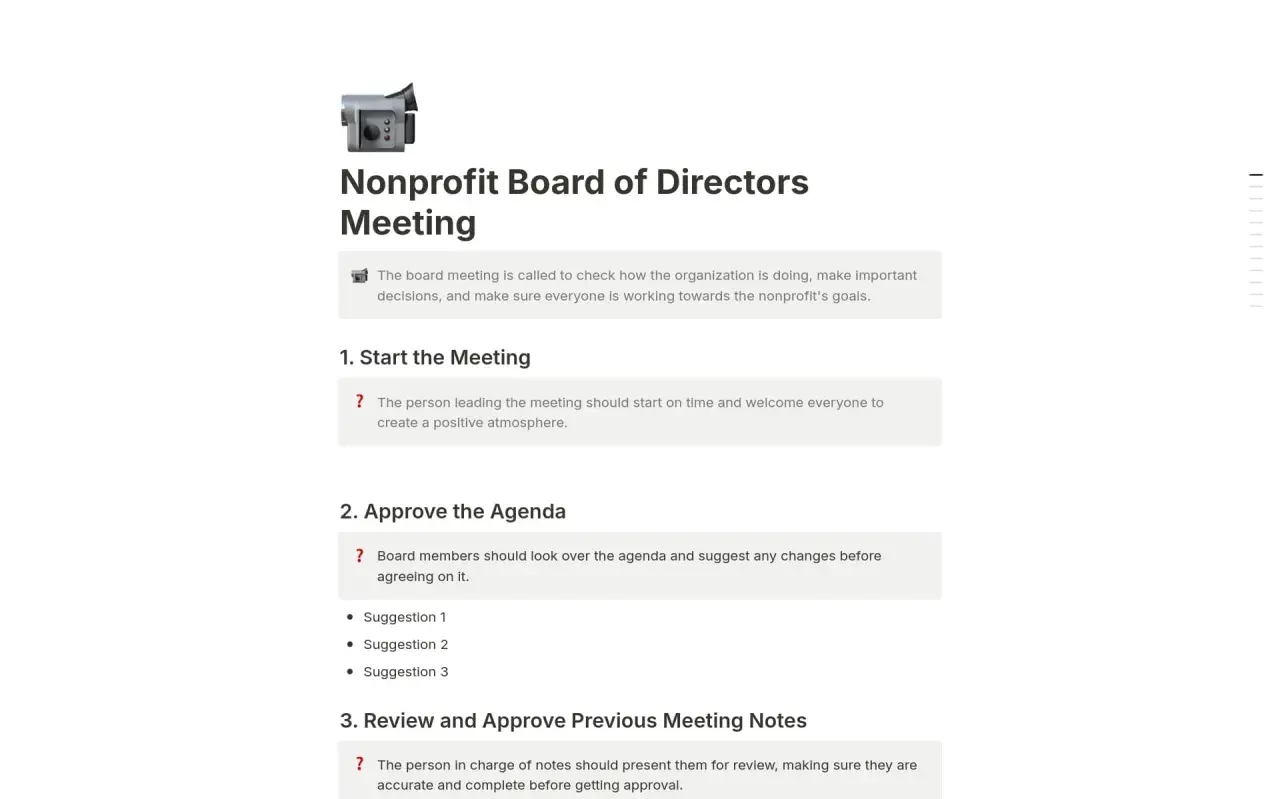
This is where the chair calls the meeting to order, confirms quorum, approves the agenda, and accepts the prior minutes. If the board uses a consent agenda, this is the place for routine approvals to move quickly through one vote instead of eating up the meeting. The point is not to rush; it is to reserve energy for the decisions that actually need discussion.
Reporting without the dead weight
Financials, committee notes, and the executive director’s report should be short enough to read before the meeting and sharp enough to discuss in the room. I prefer written reports because they create a record and stop the meeting from turning into a spoken newsletter. If a report does not lead to a question, a vote, or a risk check, it probably needs trimming.
Decisions and strategic discussion
This is the core of board governance. Reserve time for at least one meaningful board-level question, such as whether fundraising is keeping pace with program growth, whether the board’s composition still matches the organization’s needs, or whether a new partnership serves the mission. That kind of agenda item helps directors think like stewards, not spectators.
Closed or sensitive business
If you need executive session, say so explicitly in the agenda and keep the reason narrow. Common examples include personnel matters, legal issues, donor confidentiality, and certain real estate or compensation questions. In the United States, some organizations also have to account for sunshine laws or open-meeting rules, so I would never assume a closed session is acceptable without checking the bylaws and applicable law first.
Once those blocks are in place, the meeting can be timed with much more precision, which is where a sample agenda becomes useful.

A usable 60-minute agenda for a regular meeting
Here is the version I would hand to a small or midsize board for a standard one-hour meeting. It is compact enough to respect directors’ time, but it still leaves room for one real governance conversation.
| Time | Agenda item | Why it is there | Lead |
|---|---|---|---|
| 0-5 min | Call to order, quorum, agenda approval | Confirms the board can act and aligns everyone on priorities | Chair |
| 5-10 min | Consent agenda | Clears routine approvals quickly, including minutes and standard reports | Chair |
| 10-20 min | Executive director report | Highlights outcomes, risks, and the few topics that need board attention | Executive director |
| 20-35 min | Strategic issue | Focuses the board on one mission-critical decision or question | Chair or facilitator |
| 35-45 min | Finance and compliance | Reviews budget performance, cash position, and any filing or policy items | Treasurer |
| 45-55 min | Governance and board development | Handles recruitment, conflicts, committee structure, or policy updates | Governance chair |
| 55-60 min | Executive session and adjournment | Addresses sensitive items without letting them take over the meeting | Chair |
The exact split will change, but I would be cautious if more than half the meeting is reserved for passive reporting. If the board is not being asked to decide, the agenda is probably too long or too managerial. That is why the next question is not just what to include, but how to adapt the structure when the meeting itself changes.
How to adapt the agenda for annual, committee-heavy, and urgent meetings
Not every board meeting should look the same. A regular monthly meeting needs discipline; an annual meeting needs more compliance; a retreat needs more room for strategy; and an emergency meeting should be stripped down to one decision if possible.
| Meeting type | What to add | What to trim | Watch out for |
|---|---|---|---|
| Annual meeting | Officer elections, budget approval, board slate, and a named Form 990 review | Long committee updates and repetitive staff reports | Letting ceremonial items crowd out actual governance decisions |
| Committee-heavy meeting | Only the recommendations that need full-board action | Oral reading of routine committee minutes | Letting committees become a substitute for the full board |
| Retreat | Future scenarios, mission alignment, board culture, and priority setting | Routine approvals that can be handled elsewhere | Turning the retreat into an unstructured chat with no outcomes |
| Emergency meeting | One clear motion, a short background memo, and the legal or financial context | Anything not tied to the decision at hand | Ambiguity about authority, documentation, or next steps |
For annual meetings, I would not hide a Form 990 review deep in “new business” if the board is expected to look at it. For committee-heavy meetings, I would push written reports harder than usual and reserve the floor for recommendations only. The common thread is simple: the agenda should match the job of the meeting, not force every meeting into the same mold.
The governance mistakes that make meetings feel passive
When a board says its meetings are too long, the problem is usually not time alone. It is almost always structure. A weak agenda hides that problem by making everything look equally important.
- Turning the agenda into a staff report log. If every item is informational, the board has no real work.
- Failing to label decisions clearly. Directors should know whether an item is for information, discussion, or approval.
- Skipping time boxes. Without them, one long topic can consume the entire meeting.
- Reading committee reports aloud. If the board already has the written report, the meeting should focus on questions and action.
- Pushing strategy to the end. Strategic items deserve protected time, not leftover minutes.
- Ignoring action tracking. If nobody knows who owns next steps, the board will repeat the same conversation next month.
I also see boards make the mistake of assuming compliance equals governance. Compliance matters, but it is only the floor. Good board leadership also asks whether the agenda is helping directors think, challenge assumptions, and keep the organization aligned with its mission. Once those habits are clear, the final review before sending the packet becomes much easier.
What I would check before the packet goes out
Before I send a board packet, I run one last pass against a few practical questions. This is the part that usually separates a polished agenda from one that actually works in the room.- Does every major item have a clear outcome attached to it?
- Is there at least one mission-level or strategy-level discussion on the agenda?
- Have routine approvals been moved into a consent agenda where appropriate?
- Are the financials summarized in writing, not only explained aloud?
- Is there enough room for executive session if sensitive issues come up?
- Are action items from the last meeting visible and easy to track?
- Would a director understand the meeting in under one minute by reading the agenda alone?
