
The template should turn discussion into decisions and follow-up
- Use one repeatable structure so members know where to find attendance, approvals, reports, and action items.
- Keep the agenda tight enough for real governance work instead of padding it with status updates.
- Build in space for motions, deadlines, owners, quorum checks, and conflict disclosures.
- Send the packet early so people read the material before the meeting starts.
- Adapt the same base format for finance, audit, governance, fundraising, and executive committees.
Why the format matters in board governance
Committee meetings sit in a strange middle ground. They are smaller than full board meetings, but they still carry governance weight, especially when the committee is preparing recommendations or acting on behalf of the board. If the agenda is vague, the meeting drifts into a long conversation with no clear outcome; if the format is too rigid, it becomes a paperwork exercise that nobody uses. I treat the template as a control system, not a decoration.
That matters because committee minutes are not just notes for memory. The National Council of Nonprofits treats committee minutes as legal documents too, which is exactly why I would keep them clean, dated, and easy to audit later. In the U.S., the committee’s authority should also line up with the bylaws, the quorum rule, and any voting threshold the organization has adopted. Once that role is clear, the next question is what actually belongs on the page.
The core sections I would include every time
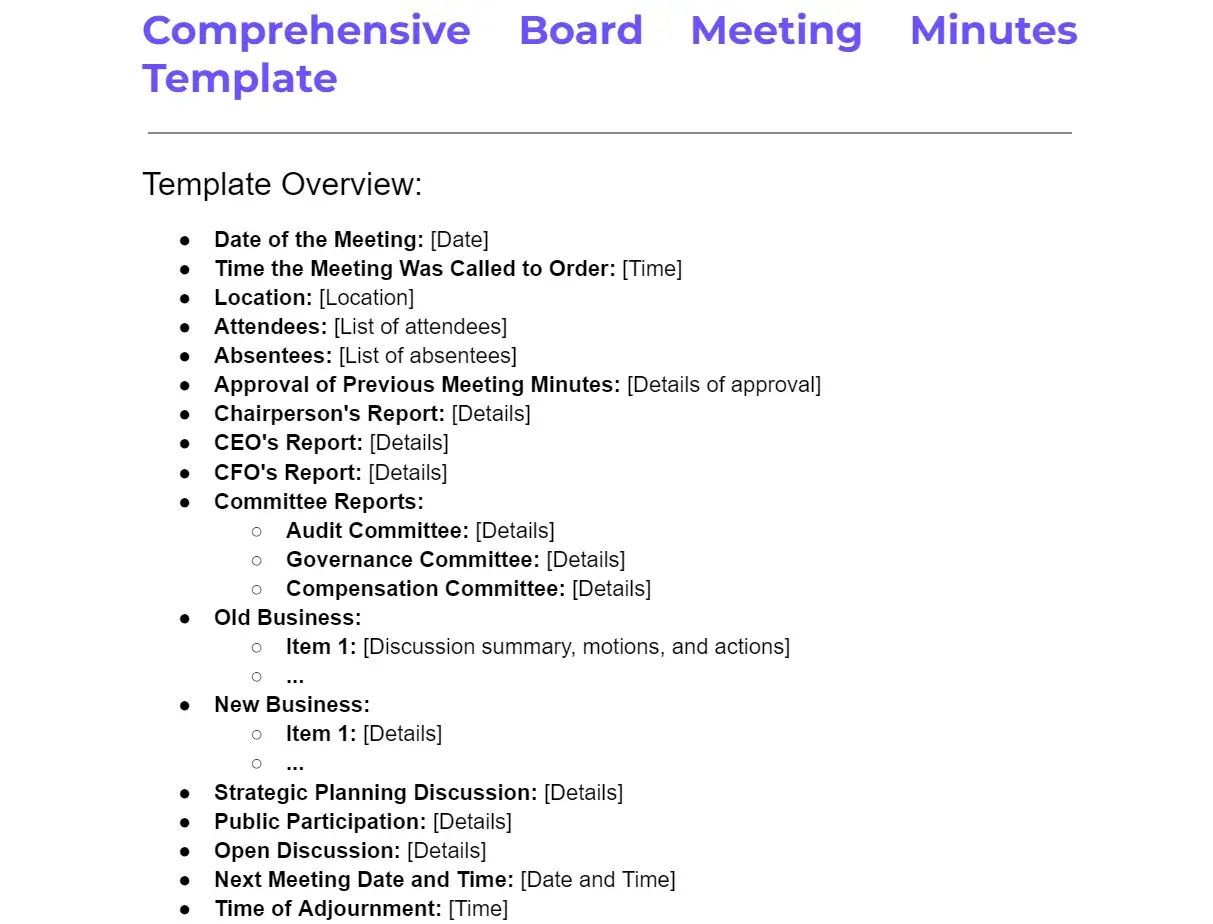
When I build a template, I want it to answer a few basic questions before the chair even opens the meeting: Who is here? Is there quorum? What needs approval? What decisions are we making? Who owns the next step? A reliable committee format should answer those questions in the same order every time.
| Section | What it captures | Why I keep it |
|---|---|---|
| Meeting header | Committee name, date, time, location or virtual link, facilitator, and recorder | Sets the record cleanly and makes the document easy to file later |
| Attendance and quorum | Present, absent, guests, and whether quorum is met | Confirms the committee can legally act if a vote is needed |
| Agenda approval | Any edits, additions, or reordered items | Keeps the meeting aligned with what members actually need to decide |
| Prior minutes and action review | Corrections, approvals, and unresolved follow-up items | Prevents old work from disappearing into the next meeting cycle |
| Reports and updates | Financials, program metrics, staff reports, or committee updates | Useful for context, but should not swallow the whole meeting |
| Decision items | Questions that need a motion, recommendation, or vote | Forces clarity about what the committee is being asked to do |
| Action log | Owner, deadline, and status for each next step | Makes follow-through visible instead of buried in the minutes |
| Adjournment and next meeting | Time closed and the next scheduled meeting | Closes the record and keeps the committee on rhythm |
I also leave room for a consent agenda, which is just a grouped block of routine, non-controversial items that do not need discussion. That keeps the committee from spending 15 minutes on material everyone already agreed with in advance. With the pieces in place, it becomes easier to see how a real meeting should flow.

A reusable agenda pattern for a 60-minute committee meeting
If I were drafting the actual agenda from scratch, I would keep the flow simple and repeatable. For many committees, a 60-minute structure is enough as long as the packet is sent in advance and the chair keeps people from re-litigating routine items. A longer meeting is not automatically better; it usually means the committee is carrying too much, or the pre-work was weak.
- Call to order and quorum check - 5 minutes. Confirm attendance, note guests, and verify that the committee can act.
- Approve the agenda and prior minutes - 5 minutes. Handle corrections first so the record is clean.
- Consent agenda - 5 minutes. Approve routine items that do not need discussion.
- Reports and key metrics - 15 minutes. Keep this section factual and short.
- Decision items and recommendations - 20 minutes. This is the heart of the meeting, where the committee should deliberate and decide.
- Action items, owners, and deadlines - 5 minutes. Capture exactly who is doing what next.
- Next meeting and adjournment - 5 minutes. Confirm the next date and close the record.
BoardSource recommends sending the agenda at least one week before the meeting, and that timeline is one of the easiest ways to improve preparation and reduce wasted time. I agree with that approach because a committee meeting works best when members come ready to discuss, not read. From there, the format needs to change depending on which committee is sitting at the table.
How to adapt it for different committees
One of the most common mistakes I see is treating every committee like a clone of the board as a whole. That creates bloated agendas and shallow conversations. A better approach is to keep the same base template, then adjust the emphasis based on the committee’s purpose and authority.
| Committee type | What the agenda should emphasize | What to document carefully |
|---|---|---|
| Finance committee | Budget variance, cash flow, reserve levels, forecast updates, and board-facing recommendations | Financial assumptions, approvals, and any recommendation to the full board |
| Audit committee | Internal controls, auditor questions, risk issues, and review of findings | Questions asked, responses received, and any executive session discussion |
| Governance or nominating committee | Board composition, recruitment, onboarding, term limits, policy review, and self-assessment | Candidate decisions, policy changes, and board development actions |
| Fundraising or development committee | Campaign progress, donor pipeline, stewardship plans, and revenue strategy | Targets, outreach ownership, and any board asks |
| Program or impact committee | Mission outcomes, service quality, community feedback, and strategic alignment | Program recommendations and any risks affecting service delivery |
| Executive committee | Urgent issues, board coordination, and matters that can be handled between full board meetings | The exact authority used and whether the bylaws allow the action |
For mission-driven organizations, I always bring the discussion back to impact. A committee can get lost in policy detail, but the real question is whether the work helps the board govern better and helps the organization serve people more effectively. The next problem is not design, but execution.
The mistakes that waste time and weaken records
Most weak committee meetings fail for ordinary reasons, not dramatic ones. The agenda is overloaded, the packet arrives late, nobody is clear on the decision needed, and the minutes become an afterthought. That combination creates the illusion of progress without the substance of it.
- Too many updates, too few decisions. If an item only informs the committee, make sure it does not crowd out decision work.
- No clear owner for each follow-up item. Every action should have one person attached to it, even if several people helped shape the decision.
- The packet arrives too late. If members have not had time to read, the meeting turns into a reading session.
- Minutes are either too thin or too detailed. Good minutes capture the motion, the vote, and the outcome without turning into a transcript.
- Conflicts of interest are never recorded. If a member recuses, the note belongs in the record.
- The same agenda gets reused for every committee. A finance committee and a governance committee are not solving the same problem.
- Routine items are treated like open debate. Use the consent agenda for non-controversial business and save the discussion for work that actually needs it.
When I clean up an agenda, I usually rewrite each item as a question: What decision do we need? What information is essential? Who must act next? That simple shift forces clarity and makes the meeting easier to chair. Good execution also depends on what happens before and after the room itself.
What to do before, during, and after the meeting
I like to think of the template as part of a workflow, not a standalone document. A committee packet should make the meeting easier to run before it starts, not just prettier once it is over. The best-run committees use the same rhythm each time so people know where they are in the process.
- Before the meeting: Send the agenda and key materials early, label items as informational or decision-ready, and attach the prior minutes and any reports the committee needs.
- During the meeting: Confirm quorum, keep the chair anchored to the agenda, and capture motions, decisions, and dissent in real time instead of reconstructing them later.
- After the meeting: Circulate draft minutes promptly, update the action log, and archive the packet so the next meeting can build on it.
I also keep an action tracker separate from the minutes. That way, the record stays formal while the follow-up list stays practical. It is a small process choice, but it makes a noticeable difference once committees start meeting regularly. Even then, a few governance details are easy to overlook.
The details I would never leave out of the final version
There are a handful of small items that make the template board-ready instead of merely organized. They do not take much space, but they save time later when someone needs to confirm what happened or why a decision was made. If I were designing a reusable version, I would include these every time:
- A quorum field so the chair can confirm whether the committee can legally act.
- A motion and vote section with space for the exact wording, the mover, the seconder, and the result.
- A conflict-of-interest note for disclosures and recusals.
- An executive session marker for sensitive issues that should be discussed separately.
- A sign-off area for the chair or secretary if your organization approves minutes that way.
- A version and distribution line so the board portal or shared drive stays organized.
A committee template is not about making meetings look formal. It is about making governance easier to trust, easier to review, and easier to act on. When the format is disciplined, the meeting feels lighter because everyone can see what was decided and what still needs work, and that is the standard I would aim for every time.
