
A thoughtful non profit board committee structure helps a board move faster without blurring accountability. The goal is not to create more meetings; it is to route the right work to the right people so the full board can stay focused on mission, risk, and long-term decisions. In practice, the best systems are simple, explicit, and easy to explain to a new director.
Key points at a glance
- Committees should extend board oversight, not replace the full board or mirror staff jobs.
- Most nonprofits can operate well with a small set of standing committees, especially governance, finance, and development.
- Every committee should have a clear charter that defines purpose, authority, scope, and reporting lines.
- The right structure depends on board size, revenue complexity, staff depth, and regulatory risk.
- Task forces work best when they are temporary and tied to one specific deliverable.
- The strongest boards review committee usefulness at least once a year and remove anything that no longer earns its keep.
Why committee design matters for board governance
I think of committees as the board’s decision-routing layer. They let a smaller group do the preparatory work, test assumptions, and bring back a recommendation, while the full board keeps the final fiduciary and strategic responsibility. That distinction matters because committees become a problem the moment they start behaving like mini-management teams.
BoardSource frames committee design the same way: structure should help the board do its work more efficiently, not create extra ceremony. The IRS has also been clear for years that committee work should support governance rather than duplicate staff functions. When you keep that boundary visible, committees reduce drag instead of adding it.
Delegation is not abdication. The board still owns the outcome, but the committee does the deeper preparation. That is the core idea that should shape every choice you make about scope, membership, and reporting. Once that is clear, the next question is which committees are worth having at all.

The committees most nonprofits actually need
Most boards do not need a large committee map. They need a few well-defined groups that cover governance, financial oversight, fundraising support, and mission-related review. The right mix depends on the organization, but the table below captures the usual starting point.
| Committee | Primary job | Best use case | Common pitfall |
|---|---|---|---|
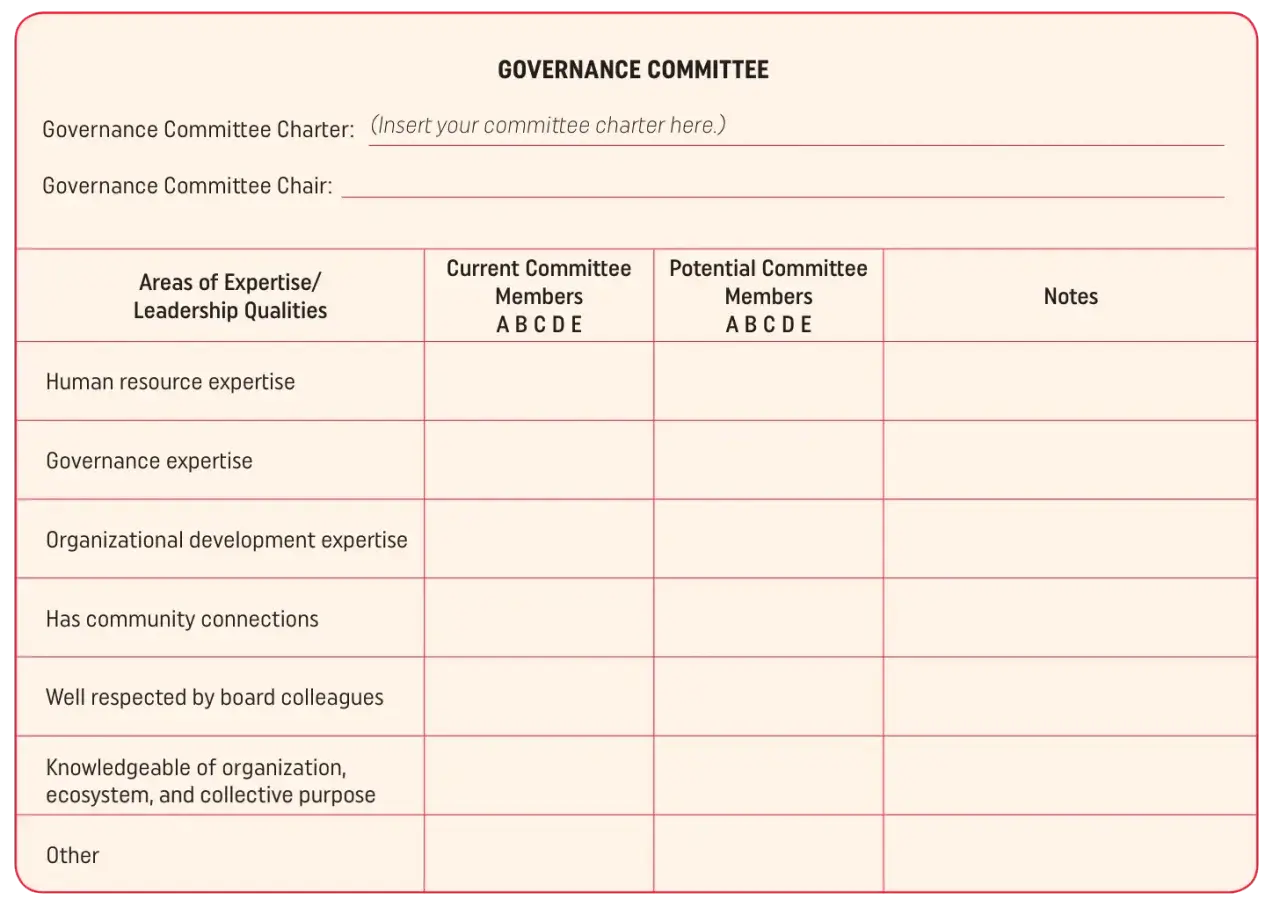
| Governance or nominating | Board recruitment, orientation, evaluation, succession, bylaws, and policy review | Nearly every nonprofit board, especially when director turnover matters | Turning it into a paperwork committee with no real influence on board quality |
| Finance or audit | Budget review, internal controls, audit oversight, financial risk, and reporting discipline | Any nonprofit with outside funding, grants, reserve management, or audit exposure | Letting it drift into bookkeeping or detailed staff supervision |
| Development or fundraising | Board giving expectations, donor strategy, campaign support, and relationship cultivation | Organizations where earned revenue is limited and philanthropic support is essential | Expecting the committee to replace a real fundraising plan |
| Executive | Handle urgent matters between board meetings when the bylaws allow it | Larger boards or situations where timing occasionally matters | Becoming a shadow board that bypasses the full board too often |
| Program or impact | Review mission outcomes, service quality, community feedback, and strategic priorities | Mission-driven organizations with complex programs or multiple service lines | Micromanaging program staff instead of reviewing outcomes and learning |
| Task force | Work on one issue and disband when finished | Bylaws updates, strategic planning, CEO search, capital campaign launch, or merger exploration | Letting temporary groups live forever after the assignment is done |
Not every nonprofit needs every committee. A small organization may combine governance and nominating, fold audit oversight into finance, and keep development work at the full-board level. That is not a compromise; in many cases, it is the cleanest way to avoid overloading a limited number of directors. The real test is whether the committee adds clarity, not whether it sounds impressive on paper.
Once that baseline is set, the practical question becomes how much structure your board can support without creating unnecessary friction.
How to choose the right mix for your board
The right mix depends less on tradition and more on three variables: organizational risk, board capacity, and how much staff infrastructure you already have. A seven-person board with one part-time executive director does not need the same committee map as a statewide nonprofit with multiple grants, audited statements, and a large staff.
- Board size. Fewer directors means fewer standing committees before people get overextended.
- Financial complexity. Restricted funding, grants, debt, or reserves justify tighter finance oversight.
- Fundraising load. If board fundraising matters, development work needs a home.
- Regulatory exposure. Audit, compensation, and policy reviews need clearer assignment when scrutiny is higher.
- Staff depth. If staff can prepare the work, committees should review and challenge it, not recreate it.
A useful rule of thumb is that smaller boards do best with fewer standing committees, while larger boards can support more specialization. For a board of roughly five to nine directors, two standing committees is often enough: governance and finance. For a board in the ten to fifteen range, adding development or program oversight can make sense. For larger or more complex nonprofits, a separate audit function, compensation review, or program committee may be justified. The numbers are not laws; they are pressure points. If the structure is exhausting the board, it is too heavy.
That leads naturally to the next issue: the charter. Without a clear charter, even a sensible committee mix can drift into confusion.
What to write into a charter before you assign members
I always want the charter before I want the roster. If the board cannot explain why a committee exists, what it can decide, and what it must escalate, the committee is not ready for people yet. A good charter keeps the work disciplined and protects the board from vague expectations.
- Purpose. One sentence that explains why the committee exists.
- Authority. Whether the committee recommends, reviews, or can act within defined limits.
- Scope. The topics it owns and the topics it must avoid.
- Membership. How many directors serve, whether staff attend as liaisons, and who appoints the chair.
- Terms and rotation. How long members serve and how leadership succession works.
- Cadence and quorum. How often it meets and how many members are needed to take action.
- Reporting. What the full board receives and when it receives it.
- Review date. When the board will reassess whether the committee still serves a real purpose.
When I assign members, I look for a mix of subject matter expertise, independence, and willingness to do real work. The finance chair should not be the person who drafts the numbers. The governance chair should understand board culture, not just policy language. And for audit oversight, the cleaner the separation between preparation and review, the stronger the process feels.
A charter gives the structure; operating discipline gives it life. That is the bridge to the everyday rhythm of committee work.
How to keep committees useful between board meetings
A committee is useful only when it produces movement the full board can see. My preferred rhythm is simple: pre-read, focused discussion, recommendation, then a board-level handoff that is short enough to use. If a committee meeting is mostly a recap of information everyone already had, the structure is leaking time.
- Set the annual calendar around budgeting, audit, fundraising cycles, board recruitment, and strategic planning.
- Send pre-reads three to five days before the meeting so the meeting is for judgment, not first-time reading.
- Keep the agenda anchored to decisions, risks, and unresolved questions.
- End with a clear deliverable: approve, recommend, revise, or escalate.
- Report back to the board in a concise format that highlights what changed and why it matters.
For a light committee, quarterly meetings may be enough. Finance and development often need more attention during budget and campaign season, while task forces should dissolve as soon as the assignment is done. A standing group that never ends usually means the board has not defined what success looks like.
The structure works best when the board can see a clean handoff from committee work to full-board decision-making. The next risk is that committees start mutating into something less helpful.
The mistakes that quietly weaken oversight
This is where I see the most avoidable damage. The board does not usually fail because it lacks committees; it fails because the committees it has are vague, overloaded, or too close to staff operations.
- Too many standing committees. Directors spend more time coordinating committees than governing the organization.
- Shadow management. Committees drift into vendor checks, staff supervision, or operational approvals.
- One-person dependency. The committee works only because one experienced director carries it.
- Executive committee overuse. The full board becomes passive because the executive group handles everything urgent.
- No board-level reporting. The committee meets, but the board never sees a decision-ready summary.
- Stale charters. A committee keeps existing long after the problem it was created to solve has changed.
IRS guidance has been blunt on one point: board committees should reinforce governance, not duplicate management. When a committee starts approving routine transactions or redoing staff tasks, it is usually a sign that the structure needs to be simplified. The board should protect its time for judgment, not absorb operational noise.
If the committee system is adding friction instead of clarity, the answer is not more process. It is a cleaner design.
The annual check that keeps the structure useful
Once a year, I would ask the board to review the committee system with no sentiment attached. The point is not to preserve tradition; the point is to see whether the structure still fits the organization’s reality. A committee that made perfect sense when the nonprofit had one program and a small budget may be the wrong tool after growth, merger, or staff expansion.
- Can we explain each committee’s purpose in one sentence?
- Does every standing committee produce a board-level output?
- Have we merged or retired any committee that no longer adds value?
- Is there a path for new directors to join without overloading the same few people?
- Do the committees still match the organization’s size, revenue, and risk?
If I had to reduce the whole topic to one practical rule, it would be this: keep the structure lean enough to be usable and strong enough to protect the mission. When directors know where a question belongs, staff know who is advising versus deciding, and the full board still owns the big calls, the committee system is doing its job.
