
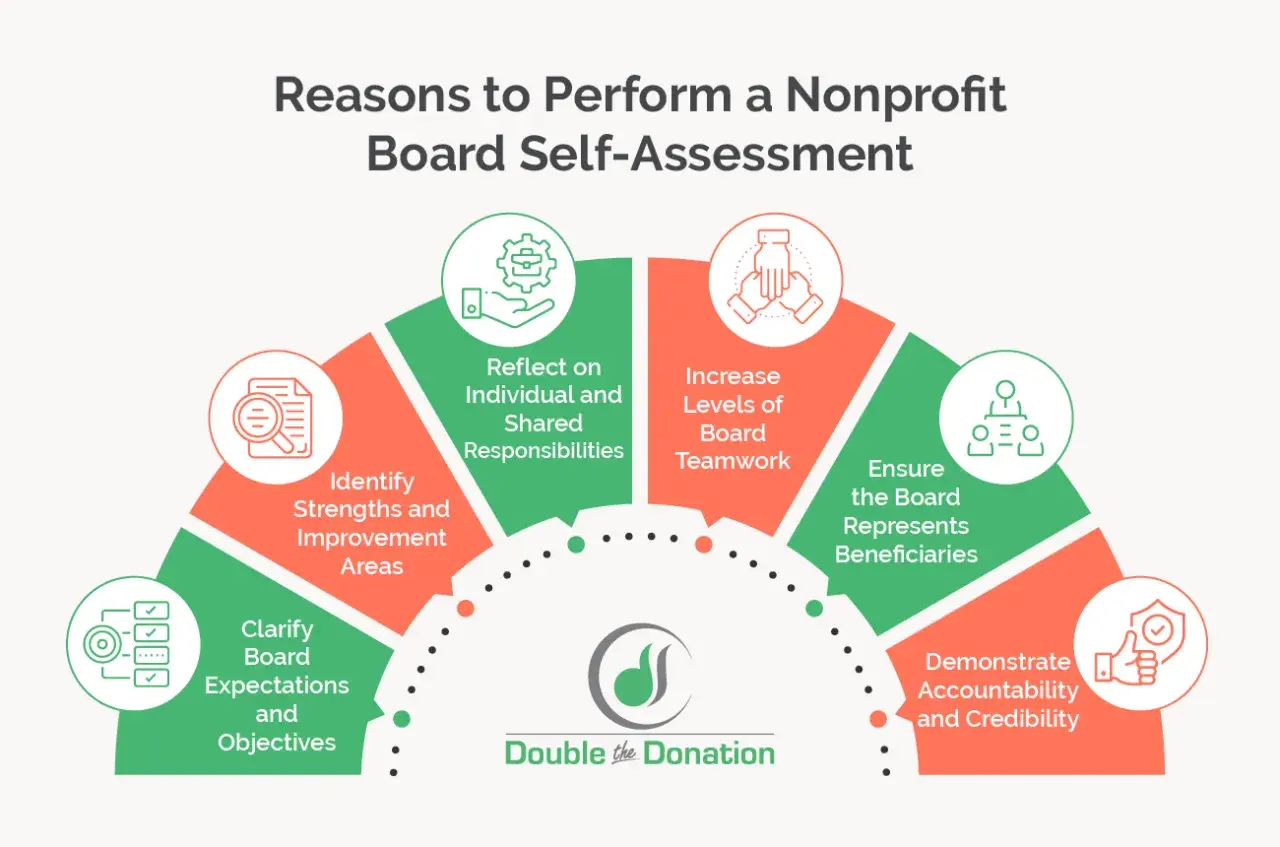
What this review should help the board answer
- Are we clear on our mission, scope, and decision-making role?
- Do directors prepare, participate, and challenge one another constructively?
- Are the chair, committees, and full board working as a coherent system?
- Do we have the right mix of skills, perspectives, and community representation?
- Are we turning feedback into visible action, not just collecting opinions?
What a board self-evaluation really measures
At its best, this process measures far more than meeting attendance or whether the agenda ran on time. I think of it as a test of the board’s governance capacity: its composition, dynamics, discipline, and judgment. A strong review looks at whether directors understand their role, whether the board is getting the right information at the right time, and whether the group can move from discussion to decision without confusion or politics.
For a nonprofit or community-focused organization, the scope should be even broader. The board also has to ask whether it still reflects the community it serves, whether it understands the lived realities behind the mission, and whether its oversight supports long-term impact instead of short-term comfort. That is where the review stops being ceremonial and starts being useful.
In practical terms, I usually group the evaluation around a few core questions: Are we strategically focused, are we functioning well as a team, are our committees adding value, and are we challenging management in the right way? Once those basics are clear, the board can move on to the harder part: deciding what needs to change. That leads naturally into why the process matters so much for mission-driven boards.
Why mission-driven boards need the process more than they think
Boards that work in social impact, philanthropy, education, health, or other public-serving spaces often carry extra accountability. They are expected to steward trust, not just money. They have to balance strategy with ethics, community voice with operational realism, and ambition with restraint. When that balance slips, the organization usually feels it before the board does.
This is why BoardSource recommends a formal self-assessment every two years for many nonprofit boards. In practice, that cadence gives a board enough time to implement changes, but not so much time that weak habits harden into culture. I still like lighter annual check-ins between fuller reviews, especially when the board is growing, recruiting new directors, or managing a difficult transition.
The context in 2026 makes this even more important. Boards are dealing with more visible stakeholder scrutiny, faster technology change, sharper expectations around risk oversight, and more pressure to show that they understand AI, cyber risk, and scenario planning. A board that does not evaluate itself against those realities is reviewing yesterday’s job description. The next step is to design the process so it produces honest input instead of polite noise.

How to run the review without wasting people's time
The easiest way to make a board review fail is to treat it like a spreadsheet exercise. The better version is simple, structured, and confidential. When I work through this kind of process, I start with a clear owner, a clear scope, and a clear promise that the results will lead to action.
- Assign ownership to the governance committee. The board should own the process, not the CEO or an overextended chair. That keeps the exercise credible and reinforces that the review is about governance, not performance theater.
- Decide what you are evaluating. Full board, committees, individual directors, the board-chair relationship, or all of the above. Smaller boards often start with the full board and one or two committees, then expand later.
- Use a short, concrete instrument. The best questions are specific enough to answer honestly. Vague prompts invite vague answers, and vague answers produce no change.
- Protect confidentiality. If directors think comments will be traced back to them, you will get diplomacy instead of candor. Aggregate reporting is usually the right standard.
- Include a facilitated discussion. A survey alone is not enough. The real value often comes when the board sees the pattern in the answers and talks through what it means.
- End with a small number of commitments. Three priorities with named owners beat twelve recommendations that disappear into the next board packet.
When the board wants a more candid read, an outside facilitator can help. NACD’s guidance is useful here because a third party can surface tensions that insiders often soften, especially around culture, succession, or individual director behavior. I see that option as a practical tool, not a status symbol. It is worth the cost when trust is uneven, the board is split, or the stakes are high. With the process set, the next question is what the board should actually ask.
The questions that actually reveal board performance
Good questions do not ask whether directors “feel good” about the board. They ask whether the board is doing the work it exists to do. I prefer to organize the review around a few dimensions that cut across most governance models.
| Area | Better questions | What weak answers usually mean |
|---|---|---|
| Mission and strategy | Are we spending enough time on strategy, impact, and long-range tradeoffs? | The board may be stuck in reporting mode. |
| Board culture | Do directors prepare, speak honestly, and challenge ideas without making it personal? | The room may be too passive or too political. |
| Composition and succession | Do we have the skills, perspectives, and community representation we need for the next phase? | The board may be overreliant on a few people. |
| Committee effectiveness | Are committees doing real work, or just moving documents? | Committee charters may be outdated or unclear. |
| Board-management relationship | Are roles clear, respectful, and appropriately independent? | The board may be drifting into operations or staying too far away. |
| Risk and oversight | Are we keeping up with financial, reputational, cyber, legal, and technology risks? | The board may be too comfortable with old assumptions. |
| Individual contribution | Do every one of us prepare, participate, and follow through? | Low accountability may be tolerated. |
I also like to include one question that is often skipped: whether the board still understands the community it serves. That matters especially for associations, nonprofits, foundations, and advocacy groups. If the board cannot explain how its decisions connect to real-world impact, it is probably governing in an abstract way. Once the questions are clear, the board has to choose the right format for the review.
Internal, external, or hybrid reviews
There is no single best format. The right choice depends on trust, complexity, and how much candor the board can handle in-house. The cleanest way to compare the options is below.
| Approach | Best for | Strengths | Limits |
|---|---|---|---|
| Internal review | Boards with strong trust and a good governance committee | Lower cost, faster to launch, easier to repeat | Can soften criticism and miss power dynamics |
| External review | Boards with tension, major transitions, or a need for deeper candor | Neutral facilitation, more honest feedback, stronger pattern recognition | Higher cost and more coordination |
| Hybrid review | Boards that want structure plus outside perspective | Balanced cost, good credibility, easier adoption | Only works well if both sides trust the process |
For most boards, I think hybrid is the sweet spot: internal ownership, external support if needed, and a clear expectation that the results will lead to action. If the board is healthy and cohesive, internal review is often enough. If the board is defensive, fragmented, or under pressure, external help is usually worth it. That choice matters because the next set of problems is not about format; it is about execution.
The mistakes that make evaluations feel performative
Most weak board reviews fail for predictable reasons. They are not mysterious, and they are not rare.
- They are too broad. If the survey tries to measure everything, it usually measures nothing well.
- They confuse politeness with honesty. A board that avoids hard truths may feel harmonious, but it is often just under-informed.
- They ignore the follow-up. Collecting feedback without assigning next steps teaches directors that the process is symbolic.
- They focus only on group behavior. Individual director contribution matters too, especially if a few people dominate or disappear.
- They treat the review as punishment. The point is improvement, not public shaming.
- They never revisit the results. Without a later check-in, the board cannot tell whether anything changed.
What happens after the report matters more than the report itself
The real value shows up after the results are shared. This is where many boards lose the benefit of the exercise. The meeting ends, the notes are filed, and nothing changes. I would rather see a board make three concrete improvements and track them than try to fix fifteen things at once.
- Prioritize the top issues. Pick the few items that have the highest leverage, such as meeting structure, board composition, or committee clarity.
- Assign owners and deadlines. Someone should be responsible for each action item, even if the full board retains oversight.
- Build the changes into board work. Update committee charters, agendas, onboarding materials, or retreat plans instead of leaving ideas in a memo.
- Report progress openly. A quick check-in at a later meeting keeps momentum alive and reinforces accountability.
- Use the next cycle to test change. The follow-up review should ask not just what improved, but what actually stuck.
For mission-driven boards, this is also the right moment to connect governance back to impact. If the review showed weak community representation, that should affect recruitment. If the board lacks digital fluency, that should affect recruitment too. If committees are weak, that should change how work is distributed. In other words, the review should reshape the board’s habits, not just its language. That is what makes the process worth repeating.
How honest reflection builds better governance over time
The most effective boards treat this as a discipline, not an event. A board that evaluates itself honestly becomes better at succession, sharper in meetings, and more realistic about its blind spots. It also becomes easier to trust, because people inside and outside the organization can see that the board takes accountability seriously.
If the board is starting from scratch, I would keep the first cycle simple: one confidential survey, one facilitated discussion, and three action items with owners. That is enough to create momentum without overwhelming the group. Over time, the review can expand to include individual director feedback, committee assessments, and even a management view of board performance.In the end, the goal is not to make the board feel judged. It is to help directors govern with more clarity, more discipline, and more connection to the mission. When that happens, the board self evaluation stops being a form and becomes a tool for stronger leadership.
