
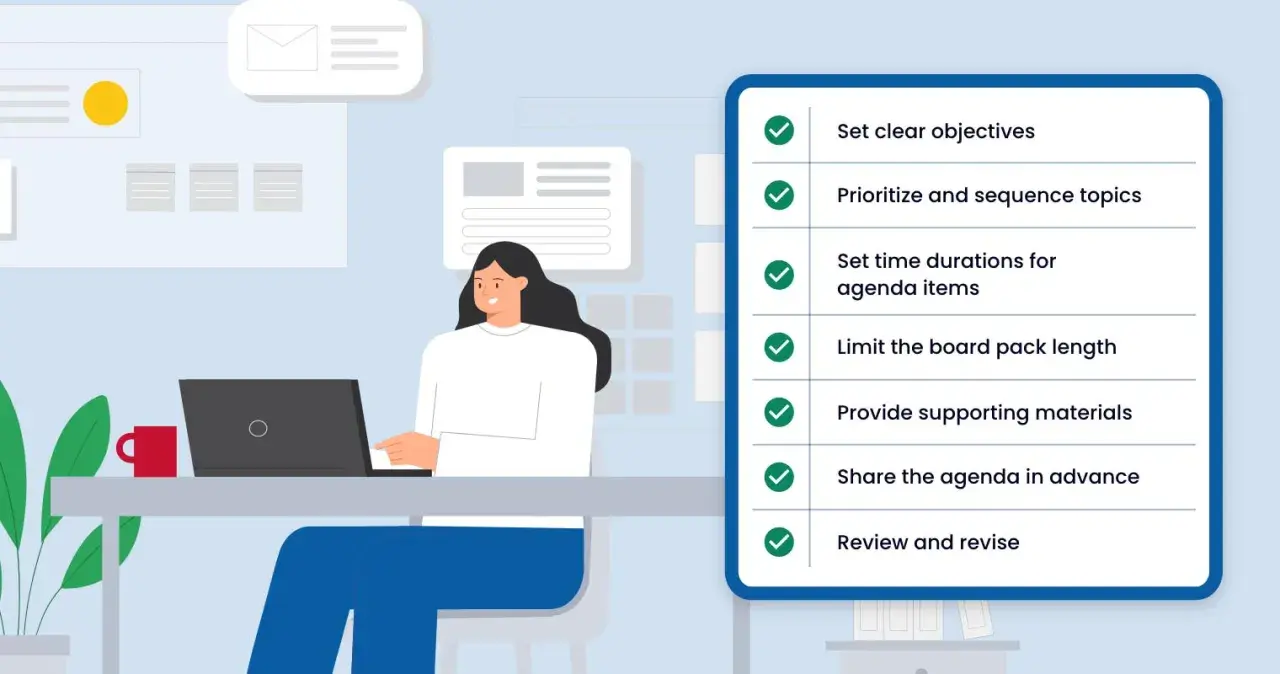
A strong executive board meeting agenda does more than list topics. It tells directors what needs a decision, what needs a discussion, and what should be handled outside the room. In mission-driven organizations, that discipline keeps the board focused on oversight, impact, and accountability instead of letting the meeting drift into status updates.
What a focused board meeting should deliver
- Strategic items first: the board’s hardest decisions should sit where attention is sharpest.
- Routine business bundled: consent agendas help keep the room on governance work.
- Clear ownership: every agenda item should have a name, a time box, and an expected outcome.
- Advance preparation: the board pack should arrive at least 5 to 10 days before the meeting.
- Space for sensitive issues: executive session belongs in the plan, not as an afterthought.
What this meeting needs to accomplish
When I look at a board agenda, I am not asking whether it is complete in the abstract. I am asking whether it helps the board govern. That means three things: it should help directors make decisions, it should surface risk and trade-offs early, and it should create a clean record of what was approved, deferred, or delegated.
A meeting agenda is not the same as a board pack or the minutes. The agenda sets the order and purpose of the meeting; the pack carries the background material; the minutes record the outcome. If those three artifacts blur together, board time usually gets wasted on reading aloud what could have been read in advance.
The simplest test is this: if an item does not require board judgment, it probably does not deserve board time. That is why strong boards move routine updates into writing, use consent agendas for low-risk approvals, and protect discussion time for issues that affect mission, capital, reputation, or compliance. Once that purpose is clear, the sequence becomes much easier to design.
A structure that keeps the board on governance work
I split agenda items into three buckets: decide, discuss, and note. That sounds simple, but it changes the meeting immediately because it forces the chair and the agenda owner to ask what kind of attention each item really deserves.
| Agenda block | Purpose | Typical time |
|---|---|---|
| Call to order and quorum | Confirms the meeting is valid, handles conflicts, and sets the room’s tone. | 5 minutes |
| Consent agenda | Cleans up minutes, routine reports, and standard approvals in one vote. | 10 minutes |
| Strategic decisions | Holds the main issues the board must decide, such as growth, capital, partnerships, or major program shifts. | 25 to 35 minutes |
| Risk, finance, and compliance | Shows the dashboard directors need without turning the meeting into a management review. | 15 to 20 minutes |
| Committee updates | Brings forward only exceptions, recommendations, or matters that need board action. | 10 to 15 minutes |
| Executive session | Creates space for board-only discussion of sensitive legal, personnel, or oversight topics. | 10 to 20 minutes |
| Action items and close | Confirms owners, deadlines, and the next meeting’s priorities before adjournment. | 5 to 10 minutes |
I usually expect a focused meeting to land somewhere between 75 and 105 minutes. If the board is facing a transaction, a major funding decision, or a governance issue with real tension, two hours is often more realistic. What matters is not the total time alone; it is whether the agenda gives the board enough room to think before it votes.
Once that backbone is set, the next step is turning it into a live agenda the board can actually use.

A practical 90-minute agenda that respects board time
I like sample agendas because they show sequencing better than theory does. In a real meeting, the order should make the hardest choices visible early and push background material out of the way.
| Time | Item | Why it is there | Owner |
|---|---|---|---|
| 0:00-0:05 | Call to order, quorum, conflict disclosures | Confirms the board can legally and ethically proceed. | Chair |
| 0:05-0:15 | Consent agenda | Approves prior minutes, routine reports, and standard renewals in one motion. | Secretary |
| 0:15-0:40 | Strategic decision 1 | Uses the board’s freshest attention for the biggest call, such as priorities, expansion, or capital allocation. | Chair and CEO |
| 0:40-0:55 | Dashboard review | Reviews finance, risk, compliance, and KPIs without expanding into a full management presentation. | CFO or relevant lead |
| 0:55-1:15 | Strategic decision 2 | Handles the next governance-level issue, such as a program change, partnership, or resource shift. | Relevant committee or executive lead |
| 1:15-1:25 | Executive session | Reserves private time for sensitive issues, board self-review, or personnel matters. | Chair |
| 1:25-1:30 | Action review and adjournment | Confirms decisions, owners, and deadlines before the room empties. | Secretary |
The sequence is doing the real work here. Strategy comes first, routine approvals are bundled, and sensitive topics are handled deliberately instead of being squeezed into the margins. For mission-driven organizations, I would also reserve at least one discussion slot for outcomes: not just what the organization did, but what changed for the people or communities it serves.
That structure only works if the board receives the right material early enough to prepare.
How I prepare the board pack before the meeting
The board pack should make preparation faster, not harder. I prefer a backward-planned process because it keeps the agenda from becoming a last-minute compilation of whatever happened to land in someone’s inbox.
- Collect proposed items 10 to 14 days before the meeting. That gives the chair and agenda owner time to decide what truly belongs on the board’s table.
- Require a decision memo for every action item. I want a one-page brief that answers the decision needed, the options, the recommendation, the risk, and why the issue cannot wait.
- Move anything routine into writing or consent. If directors only need to be informed, the meeting is probably the wrong place to spend live discussion time.
- Finalize and distribute the pack 5 to 10 days ahead. Less than that often means directors are reading during the meeting instead of arriving ready to engage.
- Set a cutoff for late additions. If a new item appears after the deadline, the chair should decide whether it is urgent enough to displace something else or whether it rolls to the next meeting.
That prep window is not bureaucracy; it is what makes real discussion possible. If directors see the material only a day before the meeting, they will either under-prepare or spend the session reading. Once the pack is in good shape, the next risk is usually the meeting itself.
The mistakes that quietly weaken board governance
The most common agenda problems are not dramatic. They are small design flaws that make the meeting feel busier than it is.
- Turning the agenda into a report dump. If every committee or executive update gets equal time, the board will spend its best energy on information it could have read in advance.
- Putting strategic decisions at the end. Directors are sharpest early. Saving the hard question for the final 15 minutes usually means it gets rushed or deferred.
- Using vague labels instead of outcomes. “Discussion” and “updates” are not enough. Each item should say whether the board is deciding, reviewing, or informing.
- Overloading the pack with attachments. More pages do not create more clarity. A concise memo with the right exhibits is better than a sprawling document dump.
- Letting late additions override priorities. If every urgent email becomes agenda time, the board never gets to govern the work it already agreed to do.
- Treating executive session as an afterthought. That private segment should be planned with the same care as any other item, especially when personnel, legal, or sensitive oversight issues may arise.
The pattern is predictable: the meeting feels full, but the board leaves with less clarity than it brought in. A better agenda does the opposite. It creates a tighter room, a cleaner discussion, and a more useful set of decisions. That becomes even more important when the same template has to serve different kinds of boards.
How the same agenda changes across board types in the United States
The basic structure stays familiar, but the emphasis changes by board type. I would not use the same agenda language for a nonprofit board, a corporate board, and a public board, even if the bones of the meeting look similar.| Board type | What the agenda should emphasize | What to watch out for |
|---|---|---|
| Nonprofit or community board | Mission outcomes, service quality, funding health, stakeholder feedback, and program risk. | Do not confuse activity with impact. One item should ask what changed for the people served. |
| Corporate board | Performance, risk appetite, capital allocation, succession, and strategic growth. | Keep operational detail from crowding out judgment on long-term value creation. |
| Public board | Transparency, policy compliance, public comment, and service delivery. | Check local open-meeting rules before finalizing the sequence or the executive portion. |
For U.S. nonprofit and community boards, I especially like agendas that include one honest question about impact, because that keeps the board connected to the organization’s purpose rather than just its workload. For public boards, local rules matter more than convenience, so the template has to fit the jurisdiction. For corporate boards, the language should be sharper around risk, performance, and decision rights. The format changes, but the governance logic stays the same.
Before the chair opens the meeting, there is one last pass I always make.
The checks I would never skip before the chair opens the meeting
- Does every item truly need board time?
- Is each decision item framed as a decision, not a vague update?
- Have routine approvals been moved into a consent block?
- Is there enough time for the hardest conversation on the table?
- Have conflicts of interest and private-session items been handled cleanly?
- Will someone capture action owners and deadlines before adjournment?
When I build an executive board meeting agenda, I treat it as a decision tool, not a calendar artifact. If it tells directors what to decide, gives them enough context to decide well, and closes with clear ownership, it is doing the job board governance demands.
