
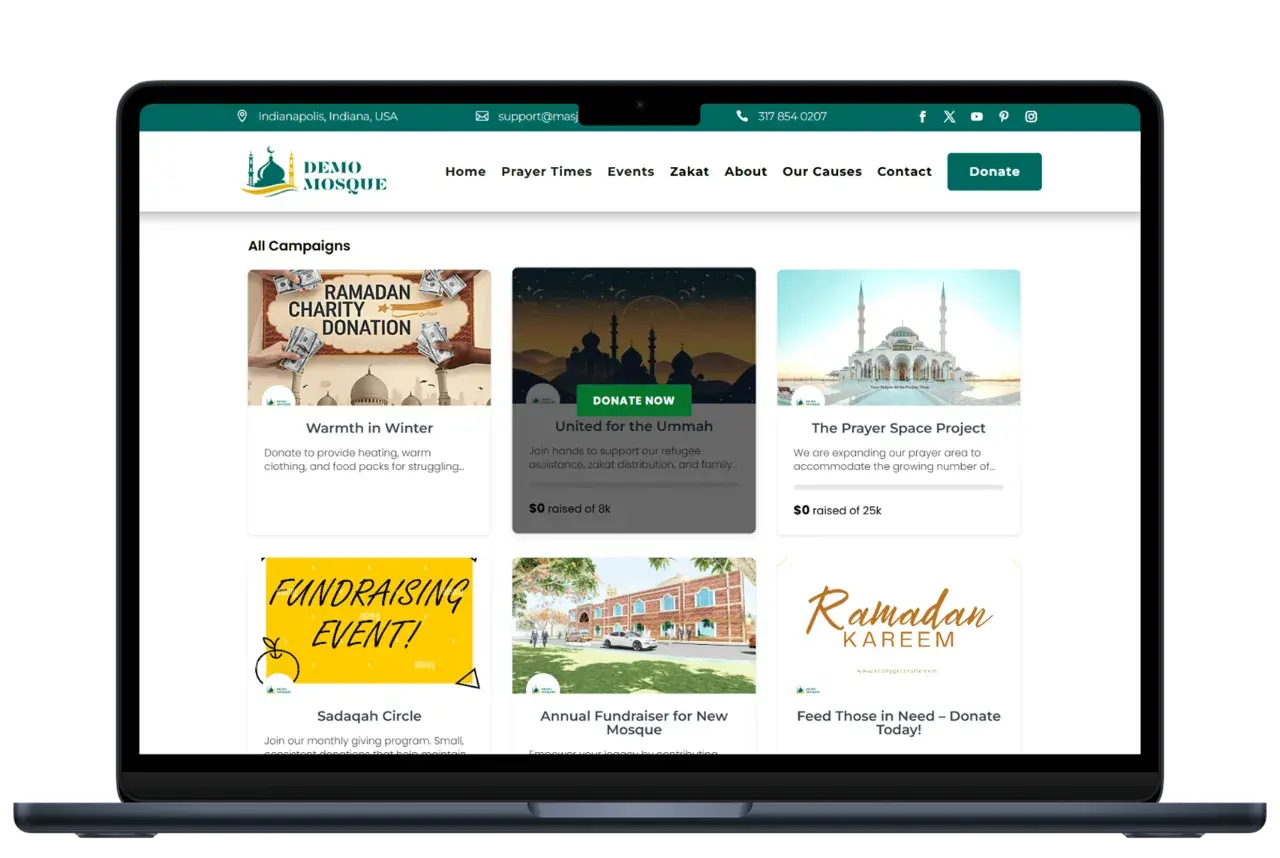
Key points to keep the campaign focused and credible
- Recurring giving usually matters more than a single big appeal because it stabilizes cash flow.
- Ramadan, Friday reminders, and community events work best when they point to one concrete need.
- Donors respond faster when they can see a target, a deadline, and a simple way to give on mobile.
- Transparency is not optional; it is part of the fundraising message itself.
- In the U.S., many mosque gifts can be deductible when the organization meets religious nonprofit rules, so receipts and disclosures matter.
What donors need before they give
I usually start with one simple question: what is the donor actually trying to solve? In practice, the answer is rarely just “support the mosque.” People want to fund a roof repair, a new prayer hall, youth programs, rent, utilities, or a Ramadan campaign that feels spiritually meaningful and visibly useful.
That means the ask has to answer four things quickly: what the money is for, why now, how much is needed, and how the donor can give in under a minute. If any one of those is vague, conversion drops. I have seen otherwise generous communities hesitate simply because the appeal sounded noble but not specific.
For U.S. audiences, convenience matters just as much as intention. Mobile donations, text links, QR codes, and recurring monthly options are no longer extras. They are the default expectation for many donors, especially younger families and professionals who may not carry cash to the masjid. From here, the next step is choosing the campaign mix that fits the community instead of copying whatever worked at another mosque.

The campaign mix that tends to work best
The strongest campaigns rarely rely on one tactic. They combine a steady base of recurring donations with one or two focused pushes during moments when giving is already top of mind. In my experience, that combination beats scattered events every time.
| Campaign type | Best use | Why it works | Main risk |
|---|---|---|---|
| Recurring monthly giving | Operating costs, staffing, utilities | Creates predictable income and reduces pressure on volunteers | Needs a strong onboarding message or people forget to enroll |
| Ramadan appeal | Annual support, capital drives, zakat and sadaqah campaigns | Generosity is already high, so the emotional timing is strong | Can become too seasonal if nothing follows the month |
| Community dinner or iftar sponsorship | Family engagement and mid-size gifts | People give more freely when they feel socially connected | Event costs can eat into the net if pricing is not disciplined |
| Matching-gift weekend | Short bursts to close a funding gap | Creates urgency and social proof | Needs a credible match, not a vague promise |
| Peer-to-peer challenge | Younger donors, alumni, and distant supporters | Turns members into advocates, not just contributors | Needs simple digital tools and clear talking points |
The activities themselves can be simple. Friday prayer appeals, sponsor-an-iftar drives, maintenance weekends, youth-led fundraising challenges, and QR code donation stations all work when they are tied to one story. I would rather run three focused activities well than ten disconnected ones badly.
There is also a strategic point that many teams miss: not every campaign should ask for the same kind of gift. Zakat, the obligatory almsgiving in Islam, belongs in some campaigns; sadaqah, voluntary charity, belongs in others. When the purpose is clear, donors feel more confident about where their money is going. That clarity leads naturally into the trust systems behind the ask.
Trust systems that make donors comfortable
In the United States, many mosques operate as religious nonprofits, and the IRS treats mosques as organizations that can qualify for tax-deductible charitable contributions when the rules are met. That means campaign language, receipts, and disclosures are not just back-office details; they are part of the donor experience.
I would build the trust layer before I built the appeal. At minimum, the campaign should make these points visible:
- What exactly the money will fund, with a narrow use if possible.
- Whether the gift is restricted for a project or unrestricted for general operations.
- Who is responsible for the money, and how often the community will get updates.
- How donors will receive acknowledgments and annual records.
- What happens if the campaign raises more than needed or falls short.
The IRS also requires written disclosures for quid pro quo gifts over $75, and donors generally need written acknowledgment for charitable contributions of $250 or more. If a dinner ticket, auction item, or event benefit is part of the gift, I would separate the fair market value from the charitable portion instead of treating everything as a pure donation. That kind of handling does more than satisfy compliance; it signals seriousness.
Transparency also means reporting back after the drive. A simple “goal, progress, completion” update often does more for future donations than another broad appeal. Once people see that money is handled carefully, the next campaign starts with more trust and less friction.
A simple launch plan that keeps momentum
I would not launch a major campaign without a short plan and one owner for each moving part. Small drives can be built in one to two weeks, while larger renovation or capital campaigns usually need six to twelve weeks of preparation before the first public push.
- Define one target amount and one deadline.
- Choose a primary purpose, then resist the urge to broaden it halfway through.
- Segment donors by relationship: regular attendees, lapsed supporters, young families, major donors, and distant alumni.
- Set up a mobile donation page, QR codes, and recurring gift options before the appeal starts.
- Prepare a short story, a budget line, and one or two proof points that make the need concrete.
- Assign follow-up tasks so thank-yous, reminders, and progress updates happen on schedule.
My rule is simple: if the giving path is clumsy, the campaign is already weaker than it needs to be. People should be able to hear the ask, scan a code, and give immediately if they want to. That kind of ease matters even more when you are asking across multiple channels, from the masjid lobby to email, WhatsApp, and social media.
One more practical point: if a campaign offers a sponsorship or event benefit, build the message around the donation first and the perk second. Once the perk becomes the headline, the charitable purpose gets blurred. That leads straight into the mistakes that quietly drain results.
Mistakes that quietly drain the budget
Most underperforming mosque campaigns do not fail because the community is unwilling. They fail because the structure makes giving harder than it needs to be.
- Asking for too many things at once. If every appeal covers repairs, youth work, operating expenses, and future expansion, donors struggle to decide.
- Relying only on cash or checks. That blocks spontaneous gifts from people who carry little cash and expect digital payment options.
- Skipping recurring giving. Without a monthly base, every month feels like an emergency.
- Using vague language. “Support the mosque” sounds nice, but “replace the HVAC system before winter” converts better.
- Launching without follow-up. A donor who gives once and never hears back is less likely to give again.
- Ignoring the mobile experience. If the donation page is slow or cluttered, many people drop off before completing the gift.
- Waiting for crisis mode. Emergency fundraising can work, but it is a weak long-term model.
There is also a softer mistake that matters a lot: some teams sound grateful only when the money arrives. I would reverse that. Gratitude should show up before, during, and after the appeal, because people are not only funding a building or a program; they are funding a shared purpose. Once that mindset is in place, it becomes much easier to decide what to prioritize first in 2026.
What I would prioritize first in 2026
If I were advising a mosque this year, I would rank the priorities like this:
- Build a recurring giving program before the next major appeal.
- Make mobile giving and QR code donations impossible to miss.
- Pick one visible funding target and tell that story clearly.
- Publish basic financial updates so donors can see movement, not just promises.
- Use Ramadan for a major push, but do not let the rest of the year go quiet.
For mosque fundraising in 2026, the winning formula is still straightforward: one clear need, one easy way to give, one trustworthy reporting system, and one rhythm that keeps donors engaged after the first gift. When those pieces are in place, fundraising stops feeling like a scramble and starts functioning like a stable part of community life.
