
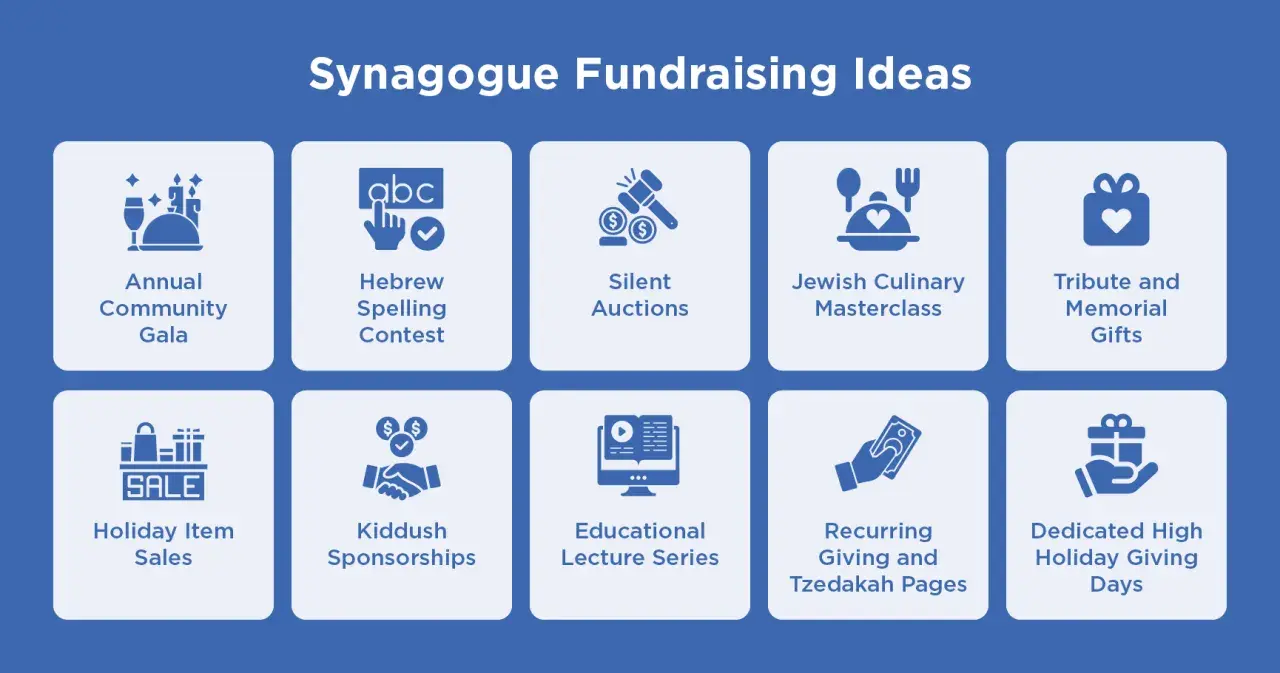
The strongest synagogue campaigns are simple, social, and repeatable
- Start with the need first: operations, security, education, a building project, or program support.
- Use one recurring ask, one event-based ask, and one digital ask rather than many disconnected appeals.
- Keep the story concrete; donors respond better when they know exactly what their gift supports.
- Build in recognition, matching, or sponsorship options so larger gifts feel specific and meaningful.
- Make every campaign easy to give to on a phone, in person, and by pledge.
What congregations usually need from fundraising
The first thing I look at is not the tactic, but the need. A synagogue might be trying to cover recurring operating costs, fund a program, support scholarships, improve security, or raise money for a renovation. Those are different fundraising problems, and they should not all be solved with the same campaign style.
Recurring costs usually fit annual giving or monthly pledges. Program costs are better matched to sponsorships or targeted appeals. Capital needs like roof repairs, accessibility upgrades, or a new learning space usually need a longer campaign with named goals and staged milestones. When the ask is specific, donors can picture the impact, and the conversation becomes much easier.
I also think it helps to name the real emotional question behind the fundraiser: what will the community miss if this money does not come in? Once that answer is clear, the rest of the strategy becomes more disciplined, which is exactly what the next section needs.

Community events that feel worth attending
In-person events still matter, but only when they feel like something people want to attend even before the donation is mentioned. The strongest events create warmth, familiarity, and a reason to gather. They work best when the giving ask is tied to an experience people already value.
- Shabbat dinner sponsorships work because they connect giving with a meal, blessing, and conversation. If the dinner feels meaningful rather than generic, the sponsor is supporting a community moment, not just a catered table.
- Trivia or game nights are inexpensive to run and can bring in younger households that may not attend a formal gala. The revenue usually comes from tickets, small sponsorships, and add-on donations.
- Challah bakes, cooking classes, or holiday workshops work well because people leave with something tangible. I like these for congregations that want a fundraiser that also builds skills and connection.
- Concerts, comedy nights, and cultural evenings can draw a broader audience, especially when local performers are part of the community. These are strongest when the entertainment is truly good enough to stand on its own.
- Volunteer days with sponsor-backed giving are a smart fit for service-oriented congregations. A cleanup day, food-packing day, or neighborhood project can be funded by sponsors who like seeing visible social impact.
- Auctions and raffles can work, but only if the items are actually desirable. Experiences, vacation homes, private tours, and special access usually beat random donated clutter.
The margin on an event depends on overhead. If the space is donated, food is underwritten, and volunteers handle setup, the event can raise a lot without much expense. If the event needs expensive catering, heavy decoration, or a large AV setup, I would be much more selective. A beautiful event that barely breaks even is not automatically a good fundraiser.
That is why I prefer events that feel like a natural part of synagogue life. They build goodwill, and that goodwill makes the annual ask easier to hear.
Annual giving is the engine, not the afterthought
For most congregations, the most reliable fundraising comes from annual giving. I treat this as the financial backbone of synagogue life because it is predictable, it can be planned around the calendar, and it gives members a way to support the community without waiting for a special event.
A strong annual campaign usually has three pieces: a clear message about what the money supports, a suggested pledge level or giving range, and an easy way to choose a recurring monthly gift. Some congregations use a sliding scale or a “give what is meaningful for your household” model, while others prefer a standard pledge with optional add-ons for specific programs. The right choice depends on culture, size, and how much directness the membership can handle without feeling pressured.
I also like annual giving because it can be framed as shared responsibility rather than a one-time transaction. In Jewish fundraising, that matters. When the tone is thoughtful and respectful, people are more willing to give consistently, and the community is less dependent on a few emergency appeals.
If there is one practical rule here, it is this: make the annual ask easy to repeat and easy to remember. Then use digital tools to extend that rhythm outside the building.
Digital campaigns extend the ask beyond the building
Online giving is no longer a backup plan. It is the default path for many households, especially when the appeal is time-sensitive or tied to a specific project. A good giving page should be simple, mobile-friendly, and specific enough that someone can understand the purpose in a few seconds.
I would use digital campaigns in three ways. First, to support a direct donation page for members who simply want to give. Second, to run peer-to-peer fundraising, where supporters create their own pages and ask friends and family to help. Third, to run short campaigns around a deadline, such as a holiday, renovation milestone, or scholarship drive.
Matching gifts can help, but I would not build the whole plan around them. Many employers match donations at a 1:1 rate, sometimes higher, but some companies restrict gifts to religious organizations. When that happens, I usually look for a related community program, like a food pantry, outreach fund, or education initiative, because those are often easier to position for employer matching. The practical move is simple: ask donors to check eligibility before they submit a match request.
- Keep the donation page short and mobile-first.
- Give supporters a script they can forward in one text or email.
- Use a deadline, because open-ended campaigns lose urgency fast.
- Show a progress bar or visible goal so donors can see momentum.
- Thank donors quickly, then follow up with a second ask only after the first gift has been acknowledged.
Sponsorships, honor giving, and auctions make larger gifts easier to say yes to
Big gifts are often easier when they are attached to a clear experience or outcome. That is why sponsorships are so useful for synagogues. They let a donor support something concrete without having to translate a vague operating budget into personal meaning.
Some of the strongest sponsorship categories are easy to understand: a holiday meal, a speaker series, youth scholarships, livestream equipment, safety upgrades, study materials, or a community service project. I also like naming opportunities when they are handled with taste. A donor is much more likely to support “the new family learning room” or “the community security fund” than to write a check toward a faceless general expense line.
Auctions can still work, but I would keep them disciplined. The best auction items are experiences, not leftovers from someone’s garage. I would rather see a curated dinner package, a local getaway, or a private class than a pile of things that nobody really wants. Too many auction items create noise; a smaller number of strong items usually performs better.
This is also where storytelling matters. If the congregation can show how a gift changes the experience of prayer, learning, safety, or belonging, the sponsor is not just buying visibility. They are underwriting community life. That distinction matters, and it leads naturally to the question of which idea fits which kind of synagogue.
How to choose the mix that fits your synagogue
I like to choose fundraising methods based on three things: volunteer bandwidth, donor behavior, and the urgency of the need. A small congregation with limited staff should not try to run a huge gala and a peer-to-peer campaign and a capital appeal all at once. That is how volunteer energy gets burned up before the campaign even reaches momentum.| Method | Best for | Rough launch budget | What I watch for |
|---|---|---|---|
| Annual pledge drive | Operating support and predictable income | $0-$500 | Clear ask, recurring follow-up, and enough transparency to earn trust |
| Community event | Relationship building and moderate revenue | $300-$1,500 for a simple gathering; much more for a formal gala | Food, venue, and staffing can eat the margin if you are not careful |
| Peer-to-peer campaign | Reaching beyond regular attendees | $100-$800 | Supporters need a story and a simple link they can share fast |
| Sponsorship drive | Specific programs, holidays, or named needs | $0-$250 | The sponsored item has to feel real and meaningful, not generic |
| Online matching push | Small to mid-size gifts with employer participation | $0-$300 | Eligibility is uneven, especially for direct gifts to religious organizations |
For many congregations, the best mix is one annual campaign, one signature event, and one digital push. That combination is manageable, and it keeps donors from feeling that every week brings a new ask. If the synagogue has a larger donor base or a major capital need, I would add sponsorship tiers and a limited number of major-gift conversations.
What I would avoid is trying to make every fundraiser do every job. The clearer the lane, the better the results. With that in mind, the final step is simply execution.
A 30-day launch plan that keeps momentum moving
If I had to launch a synagogue campaign quickly, I would keep the first month very focused. The goal is not perfection. The goal is to make the ask visible, easy to support, and easy to repeat.
- Week 1: Define the need in one sentence, set a target amount, and pick one campaign owner.
- Week 2: Choose two giving paths only, usually a donation page and one live or in-person ask.
- Week 3: Recruit a small group of ambassadors who can share the message in their own words.
- Week 4: Send the first reminder, thank every donor promptly, and report the early progress back to the community.
The campaigns that perform best are usually the ones with the clearest purpose and the least confusion. If the need is specific, the story is honest, and the giving path is simple, a synagogue can raise money without losing the warmth that makes people want to belong in the first place.
