
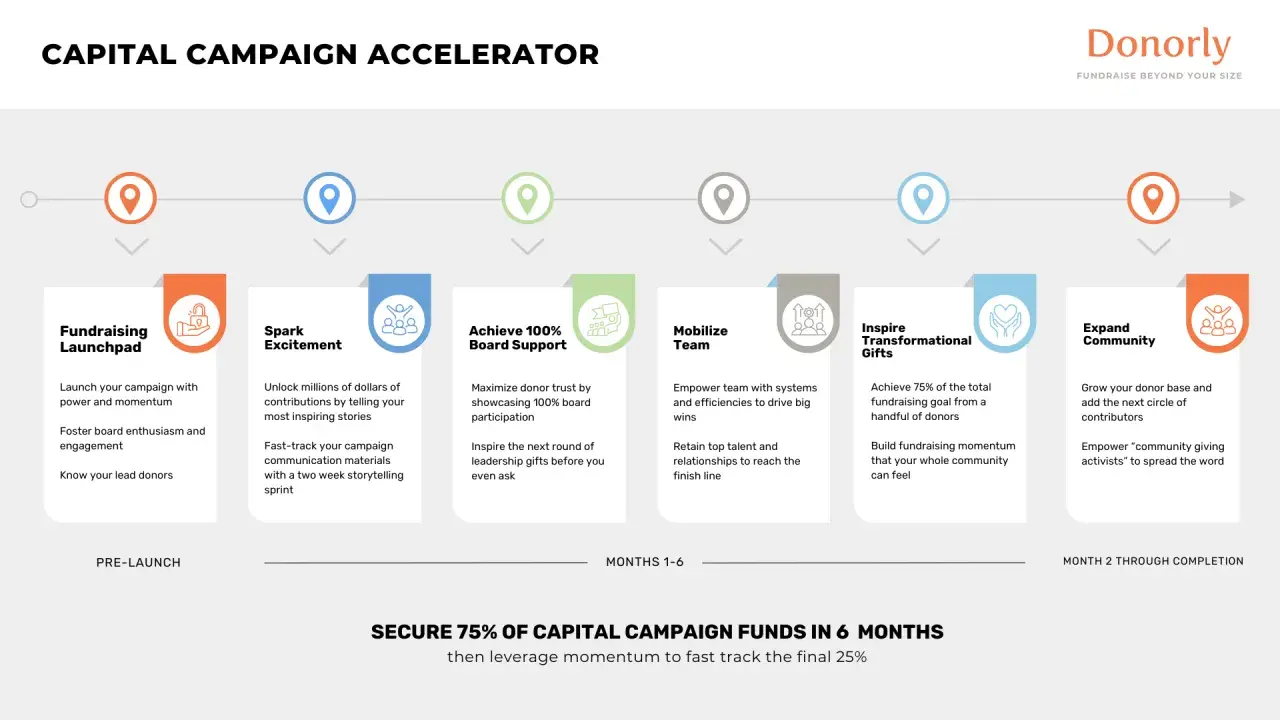
A strong capital campaign toolkit is not a pile of templates. It is the operating system for a major fundraising effort: the files, decisions, and working habits that keep a board, staff, and volunteers moving in the same direction. In this article I break down what the toolkit should contain, how it supports each campaign phase, how to judge readiness, and where campaigns usually go off course.
The fastest path from planning to fundraising action
- Think of the toolkit as a working system, not a document archive.
- The essentials are a case for support, donor list, gift chart, timeline, pledge tracker, and stewardship plan.
- The quiet phase usually carries the hardest fundraising work before any public launch.
- U.S. nonprofits should check state registration rules before broad solicitation.
- If the case, leadership, or donor data are shaky, slow down before asking for money.
What a toolkit should do before money is ever asked for
Before I look at templates, I look at decision-making. A good toolkit clarifies the project, the target amount, the lead-gift strategy, and who is responsible for each step. If those pieces are fuzzy, the campaign will feel busy but not controlled.I also want the toolkit to answer three questions quickly: Why this project? Why now? Why us? That answer becomes the case for support, and everything else should reinforce it, not compete with it. A polished brochure without that logic is decoration, not strategy.
In the strongest campaigns, the toolkit keeps the organization honest. It makes it harder to launch on enthusiasm alone and easier to make decisions that donors can trust. Once that backbone is clear, the actual contents of the toolkit become much easier to judge.

What belongs in a capital campaign toolkit
I like toolkits that are built around use, not volume. A massive folder of loose files is harder to work with than a smaller set of documents that each have a clear job. These are the pieces I would keep in the core set for almost any campaign.
| Asset | What it does | Why I keep it in the core set |
|---|---|---|
| Case for support | Tells the story of the project, the need, and the impact | Every ask should flow from one clear narrative |
| Gift range chart | Turns the goal into realistic ask levels | It keeps major-gift outreach grounded in math, not guesswork |
| Prospect list and qualification notes | Ranks households, capacity, and relationship strength | It focuses the lead-gift phase on the right people first |
| Campaign calendar | Maps preparation, asks, launch, and stewardship deadlines | It shows whether the campaign is actually moving or just talking |
| Board and volunteer talking points | Gives everyone the same language for the project | It prevents mixed messages in donor conversations |
| Pledge form and acknowledgment templates | Standardizes commitments and thank-yous | It reduces errors when gifts start coming in quickly |
| Budget and expense tracker | Tracks campaign costs, revenue, and commitments | It stops the team from underestimating what the campaign itself costs |
| Stewardship log | Records promises, updates, and reporting dates | It protects trust after the gift is made |
| Progress dashboard or CRM view | Shows who was asked, who pledged, and what comes next | It gives the team one source of truth |
I usually treat the case for support, prospect list, gift chart, and stewardship log as non-negotiable. The rest can flex by organization size and project type, but those four are what stop the campaign from becoming improvised. Once the core documents are in place, the next question is how they should work across the campaign itself.
How the pieces line up across the campaign phases
A common benchmark, reflected in Givebutter’s practical guidance, is to secure about 50-70% of the goal during the quiet phase through lead gifts. That is not a magic rule, but it is a useful reality check: if the early money is not coming in, the public launch will not fix it.
| Phase | Main job | Materials that matter most |
|---|---|---|
| Readiness and feasibility | Test the project, the case, and donor appetite | Feasibility interview notes, decision memo, preliminary budget, prospect research |
| Quiet phase | Secure lead gifts and build momentum before the public sees anything | Gift chart, ask scripts, pledge forms, one-on-one follow-up tracker |
| Public phase | Broaden participation and make the campaign visible | Launch plan, ambassador talking points, progress updates, event run sheet, web copy |
| Closeout and stewardship | Honor commitments and report impact | Thank-you workflow, reporting template, pledge schedule, final evaluation |
I think of the quiet phase as the proof of concept. If the lead gifts are weak, you do not have a publicity problem yet; you have a strategy problem. That is why the toolkit has to support the early conversations before it supports the public celebration. Once the phases are connected, readiness becomes the real gatekeeper.
How to know whether your organization is truly ready
Readiness is less about excitement and more about evidence. I would want to see these signals before a launch:
- The project scope is specific and costed.
- The board can explain the ask in under 30 seconds.
- A feasibility study has pressure-tested donor appetite, timing, and naming opportunities.
- The annual fund has a protection plan so regular giving does not get blurred with campaign gifts.
- The organization can comply with state solicitation rules where it will fundraise; AFP notes that many states require registration before fundraising there.
- One person owns the master data file, so updates do not fragment across spreadsheets.
A feasibility study is simply a structured set of interviews with major donors and stakeholders that tests the idea, the amount, and the timing. It is useful precisely because it can surface doubts early, when they are still cheap to fix. If more than one of the items above is missing, I would slow down.
A campaign launched too early usually costs more in staff time than a delayed one, and it creates awkward conversations with donors who expected a cleaner process. Once those basics are in place, the bigger risk shifts from readiness to execution.
Mistakes that quietly drain momentum and trust
Most campaign failures are not dramatic. They are small process mistakes that compound over months.
- Building materials before the case is approved. Then every revision creates more confusion.
- Launching the public phase too early. Public excitement cannot substitute for lead-gift traction.
- Mixing campaign money with annual support. Donors need to know what is extra and what is ongoing.
- Letting the data live in too many places. If the board report, CRM, and spreadsheet disagree, trust drops fast.
- Ignoring stewardship until the end. The thank-you process is part of the campaign, not cleanup.
The fastest way to lose confidence is to tell different stories to different people. Campaigns need one narrative, one number set, and one rhythm of follow-up. That leads to the next decision: build the system yourself, or bring in help where it matters most.
When to build it yourself and when to bring in outside help
For a small, focused project, an internal team can get far with disciplined templates and a shared folder. For a first-time or complex campaign, I would bring in a consultant sooner rather than later, because the cost of a weak feasibility study or a sloppy ask strategy is usually larger than the fee. And once the team grows, software matters because follow-up is where pledges are won or lost.
| Approach | Best for | Strength | Limitation |
|---|---|---|---|
| DIY internal toolkit | Smaller campaigns and experienced teams | Low cost and highly flexible | Easy to miss sequencing and accountability |
| Campaign consultant | First-time campaigns or major, complex asks | Stronger feasibility work, ask strategy, and training | Requires budget and staff willingness to follow the process |
| CRM or campaign platform | Teams managing many donors, pledges, and reminders | One place for data, tasks, and reporting | Still depends on good discipline and clean inputs |
I usually recommend a hybrid approach. Keep the strategy and the relationship work close to the mission, but do not pretend every organization needs to reinvent the workflow from scratch. Whether you outsource pieces or keep the whole thing in-house, the real test is whether the documents stay useful under pressure.
The documents I would keep live long after launch
For community-focused organizations, the best campaign assets do more than raise money. They sharpen the story, strengthen relationships, and leave behind cleaner systems for the next major initiative. If I were starting from zero, I would keep these five files visible long after the first public celebration:
- One-page case for support
- Master prospect and ask tracker
- Gift range chart with ownership notes
- Pledge and stewardship calendar
- Final impact report template
A toolkit that gets archived too early was never really a toolkit; it was just a temporary folder. The organizations that do this well treat the campaign materials as part of their fundraising infrastructure, not as short-lived event paperwork, and that is what makes the next campaign easier than the last.
