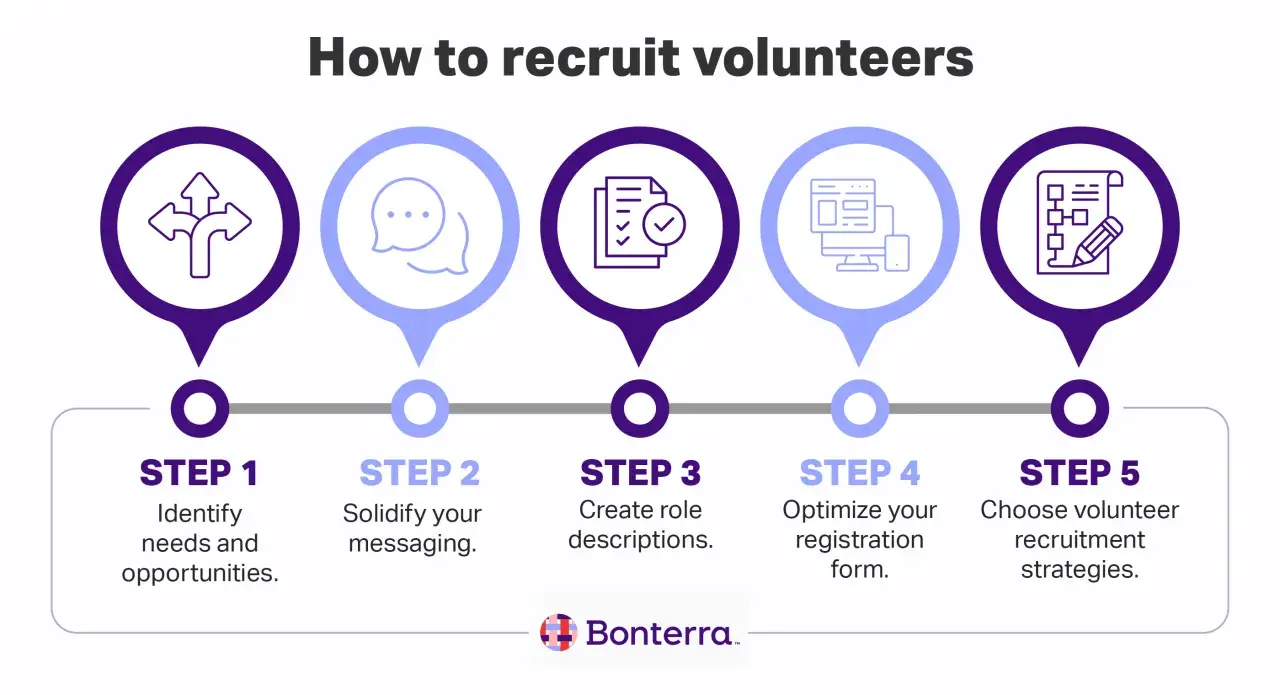
The practical answer to how to get volunteers for nonprofit work is rarely a single outreach blast. It starts with a clear role, a believable promise, and a path from interest to first shift that does not waste people’s time. In the U.S., the nonprofits that recruit consistently are usually the ones that make volunteering feel specific, useful, and easy to join.
What you need to know before recruiting volunteers
- Start with a volunteer needs assessment so you know which tasks truly belong with volunteers and which ones need staff or contractors.
- Write roles people can picture quickly, with the mission, time commitment, location, support, and a named contact.
- Use more than one channel: your site, email, social media, community partners, and employer volunteer programs each play a different role.
- Reduce friction with short forms, fast replies, and simple scheduling. Interest cools fast when the next step is unclear.
- Keep volunteers by thanking them well, giving them feedback, and making the next opportunity easy to accept.
- Track views, applications, show-up rates, and repeat participation so you can see what is actually working.
Start by defining the work volunteers should actually do
I usually start here, because recruitment gets messy when the role is fuzzy. Before you ask anyone to help, decide which tasks are appropriate for volunteers and which ones need staff, paid contractors, or licensed professionals. That matches the basic advice I see repeated by Idealist and Points of Light: begin with a volunteer needs assessment, not with a generic appeal for help.Ask a few blunt questions:
- Can this task be done safely after a short orientation or light training?
- Can it be broken into clear pieces instead of one vague assignment?
- Does it connect directly to the mission, not just to internal convenience?
- Is the time commitment realistic for a person who is giving you spare hours, not a full workweek?
A food pantry, for example, may need separate volunteers for sorting donations, greeting guests, restocking shelves, and data entry. That is much easier to fill than a catch-all request for “general help.” If a role requires sensitive access, complex judgment, or professional credentials, it should be screened carefully or kept off the volunteer track altogether. Once I know the work, I can write a role that people actually want to claim.
Write volunteer roles people can understand in one glance
The fastest way to lose a good volunteer is to make the opportunity sound vague, long, or bureaucratic. I prefer to write volunteer listings the way a busy person reads them: fast. For the public version, I keep the description under about 100 words and make the next step obvious. If the role needs more detail, I add a fuller internal brief behind the listing.
A strong role description should include:
- A descriptive title, not just “Volunteer.”
- The mission impact, stated in plain language.
- The time commitment, including whether it is one shift, weekly, monthly, remote, or on-site.
- Any training, supervision, or support the volunteer will receive.
- Any age, mobility, safety, or screening requirements.
- A clear call to action and a real contact person.
Put the opportunity where volunteers already spend time
I rarely rely on one channel. The strongest recruitment mix is usually a combination of an always-on website page, recurring email to supporters, social posts for reach, and community partnerships for trust. One channel creates visibility; several channels create momentum.
| Channel | Best for | Why it helps | Watch out for |
|---|---|---|---|
| Website or sign-up page | Always-on recruiting | Catches people the moment they are ready to act | Needs traffic and a very clear call to action |
| Existing supporters | Reaches people who already know your mission | Can be ignored if every message sounds the same | |
| Social media | Awareness and urgency | Visual, shareable, and quick to update | Interest fades fast if the post does not lead anywhere |
| Community partners | Local credibility | Brings warm referrals from trusted groups | Takes relationship-building before it pays off |
| Corporate volunteer programs | Group shifts and skills-based help | Can fill many slots at once and often brings reliable attendance | Needs advance planning and a project that fits a group schedule |
If I had to choose one principle here, it would be this: make the sign-up path obvious wherever the opportunity appears. A person should be able to move from curiosity to action without hunting for a second page, a buried form, or a vague inbox address. Warm introductions and direct invitations usually beat broad promotion when I need a steadier pipeline. That becomes even more powerful when you use the people and institutions that already trust you.
Use partners and warm introductions to multiply reach
Some of the best volunteers never arrive from a public post. They arrive because someone they trust personally brought the opportunity to them. In the U.S., that often means board members, current volunteers, donors, staff, alumni networks, faith communities, schools, libraries, local chambers, and employer volunteer programs.
I would start with three easy levers:
- Ask current volunteers to invite one friend who shares their availability or interests.
- Ask board members and staff to share the opportunity in their own networks with a short personal note.
- Offer employers a specific, self-contained project such as a one-day cleanup, a meal-packing shift, or a skills-based service day.
The reason this works is simple: trust lowers hesitation. A warm referral answers the first question before the volunteer even asks it. If a company is involved, shape the pitch around the benefit that matters to them, whether that is team bonding, community visibility, employee volunteering time off, or a skills-based contribution. And make the ask easy to pass along: one paragraph, one image, one date, one link. All of that still fails if the sign-up path is clumsy, so the next job is to remove friction.
Remove the friction that kills good intentions
People rarely quit because they dislike the mission. They quit because the process feels slow, confusing, or too demanding. If someone fills out a form and hears nothing for days, the momentum is gone. If the form is long, the role is unclear, or the schedule is hard to decode, they will move on to something easier.
I try to make the first step almost effortless:
- Keep the form short and mobile-friendly.
- Use an obvious call to action, not a vague “submit” button.
- Send an automatic confirmation immediately.
- Follow up with a human response within 24 hours when possible.
- Explain the next step in plain language, including where to go, what to bring, and who will meet them.
Screening should be proportional to the role. For child-facing, client-facing, or otherwise sensitive work, early screening protects everyone. For lower-risk roles like event setup or sorting donations, a lighter process is usually better than a heavy one that scares people away. Scheduling matters too. Offer short shifts, one-off options, and virtual roles when the work allows it. Volunteers are not staff, and they should not have to decode internal systems just to help. That is what turns a one-time helper into someone who comes back.
Treat the volunteer experience like something worth returning to
Recruitment gets easier when people have a reason to stay. A volunteer who feels useful, seen, and informed will often recruit the next volunteer for you. I have seen that pattern hold up again and again: the best retention strategy is usually a good first experience, followed by steady communication.
There are a few simple habits that make a real difference:
- Thank people quickly and mention the specific impact of their shift.
- Share a short follow-up message with photos, results, or a concrete outcome.
- Ask what was confusing, slow, or unexpectedly helpful after the first shift.
- Offer a next step that feels natural, such as a monthly shift, a lead role, or a specialized task.
- Recognize repeat volunteers in ways that fit your culture, not just with generic praise.
The more a person feels that their time mattered, the less you have to “sell” the next opportunity. I also like to build tiny leadership lanes into the program. Some volunteers want a bigger role but do not want staff-level responsibility. Give them something to own, even if it is small. That keeps the program human and keeps your pipeline warm. What gets measured gets improved, and in volunteer recruitment the first wins usually show up there.
Track the numbers that reveal whether recruiting is improving
If a nonprofit wants more volunteers, it needs to know where the process is breaking. I do not think every program needs a complex dashboard, but it does need a short list of numbers that show whether the message, the channel, and the follow-up are working together.
| Metric | What it tells you | What a weak result usually means |
|---|---|---|
| Views or reach | Whether people are seeing the opportunity | The channel is too small or the promotion is too limited |
| Clicks to sign-up | Whether the opportunity is compelling enough to invite action | The title, image, or call to action is not convincing enough |
| Applications started vs. completed | Whether the form is manageable | The form is too long or confusing |
| Confirmed volunteers who show up | Whether the communication and scheduling are solid | The reminders, instructions, or timing are weak |
| Repeat participation within 60 to 90 days | Whether the experience felt worth repeating | The role fit, onboarding, or recognition needs work |
If I had to prioritize the first fixes, I would start with role clarity, response speed, and scheduling. Those three changes usually outperform another round of generic outreach because they make saying yes feel safe and worthwhile. Once those pieces are in place, recruitment stops feeling like a scramble and starts feeling like a system.