
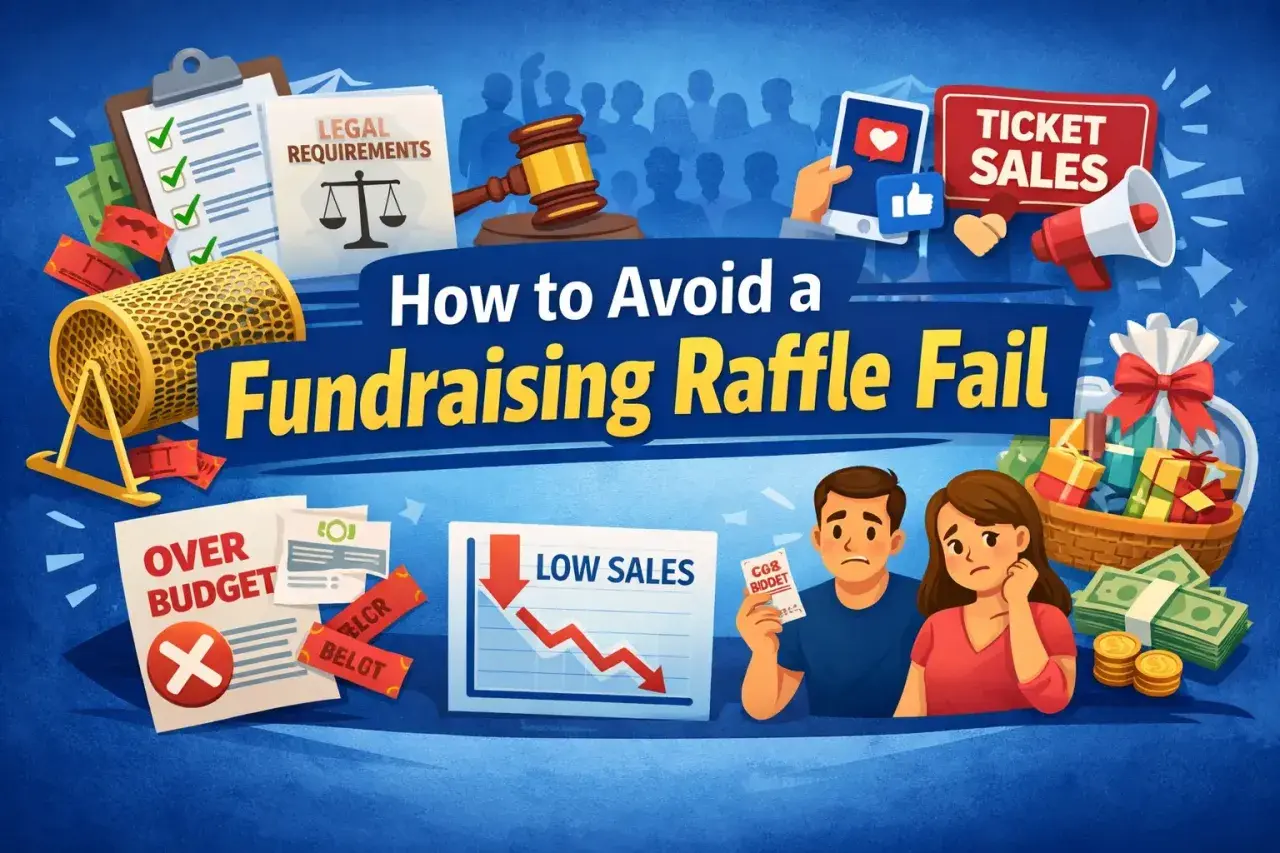
A well-run raffle fundraiser can do three things at once: raise money, bring new people into the cause, and give existing supporters an easy reason to participate. I treat it as a community trust exercise as much as a revenue tactic, because the best events are simple, transparent, and worth talking about after the drawing. This article breaks down the legal guardrails, prize and ticket strategy, promotion, execution, and the tradeoffs between raffles and auctions.
The fastest way to keep the event simple and credible
- Check state and local rules first; raffles are regulated games of chance in the United States.
- Expect tax reporting and possible withholding for larger prizes, and plan for that before selling tickets.
- Pick one prize or a tight prize set that feels easy to understand and genuinely desirable.
- Use a ticket price your audience can absorb, then offer bundles to lift average spend.
- Promote the drawing with a deadline, a clear prize image, and a simple reason to act now.
- Prepare the drawing script, winner paperwork, and follow-up before the event starts.
Why this format works so well for community fundraising
I like this format when the crowd is broad, the cause is familiar, and the event needs to feel easy rather than formal. Unlike a silent auction, it does not ask supporters to bid strategically or stand around waiting for a closing time; it gives them one clear decision: buy in or not. That simplicity is why it works so well at school events, community dinners, church gatherings, and benefit nights where attendance can vary.Where it falls short is just as important. A raffle is weaker when the audience is small, when the prize has niche appeal, or when the organization needs each attendee to spend a large amount. In those cases, a ticket draw may underperform compared with an auction or a sponsorship-heavy campaign. I usually ask one question before choosing it: will the average supporter understand the prize and the rules in ten seconds? If the answer is yes, the format probably fits. Once you know why the format fits your audience, the next question is whether you are actually allowed to run it the way you want.
The U.S. rules that can make or break the event
In the United States, the legal layer matters more than the marketing layer. State law decides who can run the event, whether a license or registration is needed, whether tickets can be sold online, and sometimes even how much a ticket can cost. I would never assume that a well-meaning community event is automatically allowed; that assumption is where many organizers get into trouble.
- Check whether your organization qualifies as a nonprofit or charitable group under state rules.
- Confirm whether the state requires registration before ticket sales, not just before the drawing.
- Verify whether online advertising is allowed even if online ticket sales are not.
- Plan for tax paperwork if the prize is large enough to trigger reporting or withholding.
- Keep a copy of the rules with the event file so volunteers give the same answer every time.
The IRS treats raffle winnings as gambling income in qualifying cases, and for reportable prizes, Form W-2G reporting generally applies when the net winnings are at least $600 and at least 300 times the ticket cost; if net winnings exceed $5,000, federal withholding can apply at 24%. California’s Attorney General, for example, requires at least 90% of gross receipts from nonprofit raffles to go directly to charitable purposes, which shows how different one state can be from another. I never recommend printing tickets before I know whether the state wants a permit, a registration, or both. With the rules mapped, the real design work starts: picking a prize and a ticket price that feel exciting without shutting buyers out.
Choosing prizes and ticket prices that people will actually buy
I start with the prize, not the price. A prize that is easy to explain in one sentence beats a complicated basket every time, because buyers need to understand the upside instantly. A donated package, a local experience, or a high-appeal gift card often performs better than a pile of small items that only the donor knows how to value.
- Best prizes are simple to describe. “Weekend getaway,” “local restaurant package,” or “signed team jersey” is easier to sell than an overstuffed basket.
- Best prizes have broad appeal. If only one niche audience cares, ticket volume usually suffers.
- Best prizes are easy to redeem. The less friction after the drawing, the better the supporter experience.
- Best prizes have a clear value story. Donated items are stronger when you can explain their real market value and how the donation helps the cause.
For pricing, I use a simple formula: (fundraising goal + direct costs) ÷ realistic ticket sales = minimum ticket price. In practice, many community events land in the $1-$25 range, with lower-priced bundles such as 3 for $10 or 5 for $20 helping people buy more than one entry. If the ticket price feels high, I would rather lower the sticker price and offer bundles than force a single expensive ticket that people hesitate to touch. After that, the job shifts from product design to message discipline, because even a strong prize can stall if nobody hears about it often enough.
How to promote the drawing without burning out supporters
I think about promotion in three waves: launch, midpoint, and the final 72 hours. That cadence keeps the event present without turning into noise, and it gives supporters a reason to act before the window closes. For a small community event, 3 to 4 weeks can be enough; if you need sponsor outreach, permit approval, or prize collection, I usually plan for 6 to 8 weeks.- Use one main visual. A clear prize image beats a generic flyer full of text.
- Repeat the deadline. People delay ticket purchases until the last moment unless you make the cutoff obvious.
- Let partners do some of the work. Local businesses, schools, congregations, and club sponsors can share the same message and widen reach.
- Connect the prize to the mission. Supporters buy faster when they can see what the funds support, not just what they might win.
- Offer bundles where allowed. It raises average spend and makes it easier for a buyer to say yes.
I also like to pair the event with one short cause story, because that turns a transaction into participation. Use email and owned social channels first, and use text only if your list is already opted in. Promotion gets people in the door; execution is what makes them trust the result.
How to run the drawing so people trust the result
If people have to guess how the winner was selected, you have already lost some trust. The drawing should feel ordinary in the best sense: numbered tickets, one clear method, one recorded result, and no improvisation once the tickets are sold.
- Use consecutive ticket numbers and keep a sales log.
- Publish the drawing date, time, and location on the ticket or rules sheet.
- State whether the winner must be present and what happens if they are not.
- Prepare a script for the drawing so the same steps happen every time.
- Collect winner details in advance if the prize may require tax paperwork or identity verification.
- Keep an internal file with permits, sales totals, expenses, and winner records.
That last point matters more than people expect. Clean records make the next event easier, help answer questions from board members or auditors, and give you a real basis for deciding whether the format was worth repeating. Once the event format is clear, it becomes easier to decide whether a raffle or a silent auction is the better fit.
When a raffle makes more sense than a silent auction
I treat raffles and silent auctions as different tools, not rival ideas. A raffle works when the audience wants a simple, low-friction chance to win; an auction works when donors are willing to compete over items with clearly rising value. If you want a fast decision rule, use the comparison below.
| Format | Best when | Main advantage | Main limitation |
|---|---|---|---|
| Raffle | Broad audience, modest ticket price, one or a few high-appeal prizes | Easy to explain and scalable for large groups | Lower per-person revenue unless the audience is large |
| Silent auction | Smaller audience with higher willingness to bid on unique items | Can produce strong revenue from a few motivated bidders | More setup, more item sourcing, and more pricing guesswork |
| 50/50 drawing | Event crowd that likes instant simplicity and cash-like prizes | Very easy to understand and often quick to run | Works only if attendance is strong enough to build a meaningful pot |
I choose a raffle when the prize is easy to want, the audience is broad, and I need the event to stay lightweight. I choose an auction when the items are unique enough to inspire bidding wars. If neither condition is true, I usually rethink the fundraiser before I spend time on ticket design. The useful part is not picking the flashiest format; it is matching the format to the people who will actually show up.
The small habits I would keep for the next event
When these events work well, the same habits show up again and again. I would keep the prize list short, the rules readable, the ticket price easy to explain, and the drawing visible. I would also keep one person responsible for compliance and one person responsible for the public-facing story; when those roles blur, mistakes multiply.
- Keep the prize offer focused instead of padding it with minor extras.
- Write the rules in plain English and print them where buyers can see them.
- Plan the thank-you message before ticket sales start.
- Track costs separately so you know the real net revenue, not just the gross.
- Close the loop by showing supporters exactly what their participation helped fund.
That last step is where community impact becomes tangible. A raffle is not just a draw for prizes; it is a small trust test between an organization and its supporters, and the organizations that treat it that way usually get a better result the next time too.
