
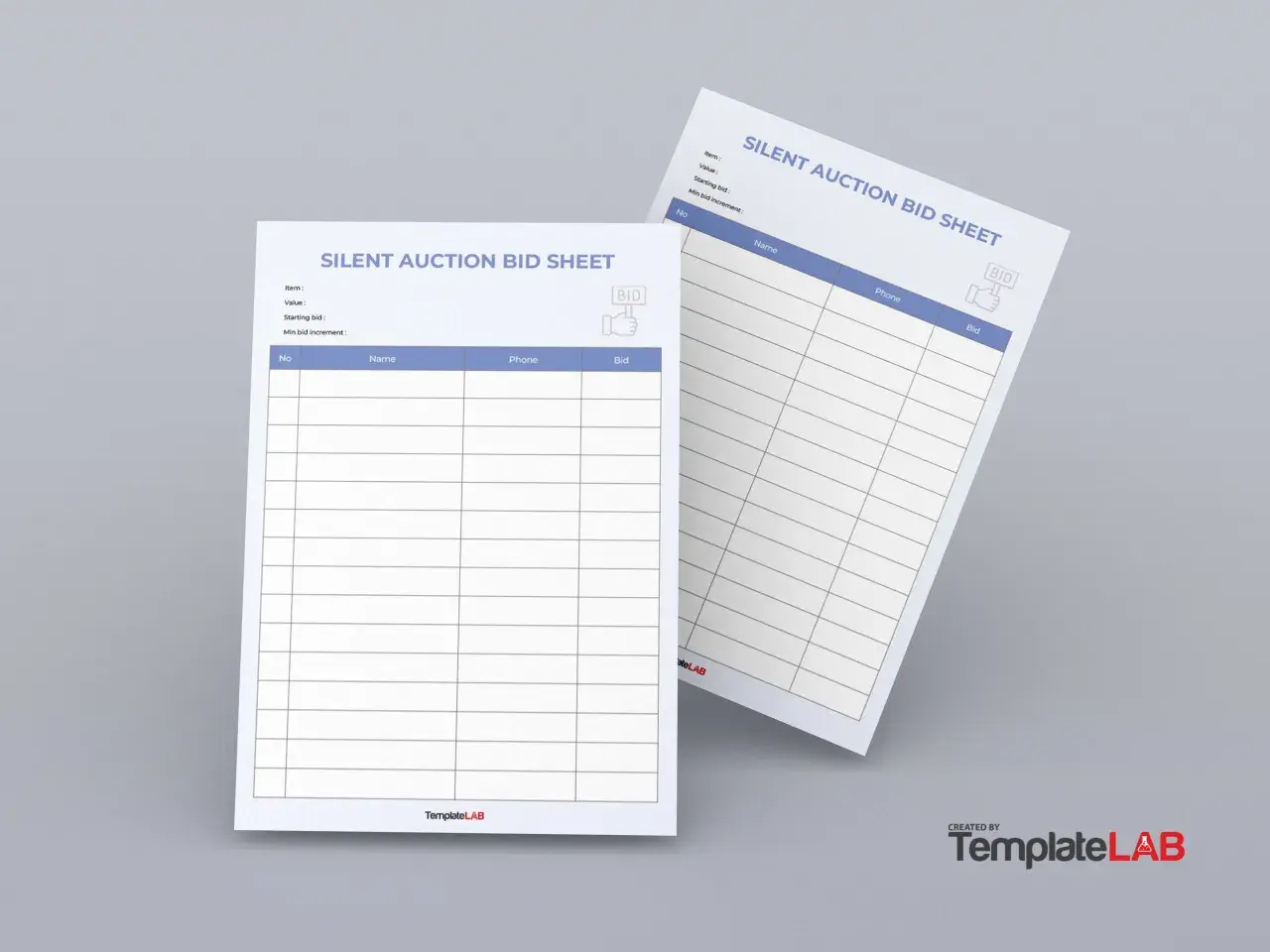
A good silent auction bid sheet template does more than hold a few bids. It tells guests what the item is worth, how the next bid should move, and who wins when the table closes. When I build one for a fundraiser, I focus on clarity first, because a clean sheet keeps bidding active, reduces volunteer mistakes, and speeds up checkout.
Key points to get the sheet right the first time
- Keep one sheet focused on one item, with a clear lot number and bidder ID.
- Show fair market value, starting bid, and minimum raise where people can see them immediately.
- Use large, readable type and enough spacing for handwritten bids.
- Match the sheet to your checkout process so volunteers can identify winners fast.
- Decide in advance whether the item allows a buy-it-now option or only open bidding.
- Choose paper or mobile bidding based on event size, crowd comfort, and staffing.

What a useful bid sheet actually includes
I like to think of the sheet as a tiny control panel for the whole auction. It should answer four questions instantly: what is this item, what is it worth, where does bidding start, and who owns the winning bid if the table closes right now?
A lot is simply the item or package listed as one auction unit. I keep that unit easy to identify, and I separate the display information from the bidding record so the page does not turn into clutter.
| Field | What to include | Why it matters |
|---|---|---|
| Item number | A unique lot number that matches the catalog and signage | Prevents confusion when bidders move between tables |
| Item title and short description | A clear name plus one concise sentence about the item | Helps bidders know what they are evaluating in seconds |
| Fair market value | The approximate U.S. retail value in dollars | Gives bidders a frame of reference before they commit |
| Starting bid | The first acceptable bid amount | Sets the floor without making the item feel out of reach |
| Minimum raise | The smallest allowed jump between bids | Stops awkward pricing and keeps the bidding orderly |
| Bidder name or number | A bidder ID, and a name if your event needs it | Makes checkout faster and avoids unreadable handwriting problems |
| Bid history lines | Room for bid amount, initials, and time if needed | Creates a clean trail for the final winner |
| Close time | The exact moment bidding ends | Reduces disputes and volunteer guesswork |
| Buy-it-now option | A fixed purchase price, if your rules allow it | Can close a hot item quickly, but it also caps upside |
If I had to strip the sheet to the essentials, I would keep item number, item value, starting bid, minimum raise, and bidder identifier impossible to miss. Those fields do the real work, and everything else should support them. Once that skeleton is in place, the next question is how to price the bids so people actually keep writing on the page.
How I set starting bids and increments
The numbers matter more than the decoration. If the starting bid is too high, people hesitate; if the increments are too large, the table goes quiet. I usually start by looking at fair market value and then shaping the bids around the crowd I expect in the room. For a family-friendly or community-centered event, smaller steps usually work better than aggressive jumps.
A recent nonprofit auction report found that 90% of attendees placed bids, auctions averaged 5.36 bids per item, and items raised 134.5% of their value. That tells me the template should make repeat bidding easy, not force people to decode the page every time they come back.
| Item value | Starting bid range | Typical increment | Best fit |
|---|---|---|---|
| Under $50 | 25% to 35% of FMV | $1 to $5 | Gift cards, baskets, small local donations |
| $50 to $150 | 30% to 40% of FMV | $5 to $10 | Restaurant packages, family outings, service vouchers |
| $150 to $500 | 30% to 40% of FMV | $10 to $25 | Premium baskets, experiences, midrange travel items |
| $500 and up | 25% to 35% of FMV | $25 to $50 | High-demand packages with a strong donor audience |
I treat those ranges as working points, not laws. The crowd decides the final shape. A school auction can usually handle lower increments because parents want to stay involved without doing mental math. A gala with high-value travel packages can handle larger jumps because the bidders already expect a more serious floor. I reserve buy-it-now pricing for items that are clearly in demand, because it can speed up revenue, but it can also shut down a bidding war too early if the number is too tempting. Once the pricing feels balanced, the page itself has to be easy to read in a real room.
A layout that prints cleanly in the U.S.
For paper events, I prefer one Letter-sized page per item. That format fits standard U.S. printers, is easy for volunteers to handle, and gives enough room for a readable header plus several bid lines. If the item description is long, I move the storytelling to a separate display sheet and keep the bid sheet stripped down to the essentials.
The bid sheet and the display sheet are not the same thing. The display sheet sells the item; the bid sheet records the bidding. Keeping those jobs separate usually makes both pages better.
- Put the lot number at the top where it can be matched quickly to the catalog.
- Use a large item title and a short supporting line instead of a dense paragraph.
- Leave enough bid lines for the likely traffic at that table, usually 6 to 10 for popular items.
- Keep the event rules in a footer, not in the middle of the bidding space.
- Use strong contrast and avoid light gray text that disappears under event lighting.
- Print a spare master copy so you can replace a damaged page without rebuilding the file.
I also pay attention to readability from standing height. If a guest has to lean over the table to understand the item, the template is doing too much. When the layout is clean, volunteers can keep the event moving instead of answering the same basic question all night.
How to run the bidding table without losing momentum
The best sheet still fails if the room is chaotic. I set up the table so a volunteer can answer the same questions all night without improvising: which item is this, what bid wins now, and what happens when time runs out?
- Assign a unique item number before the event and use it on the catalog, signage, and sheet.
- Place the sheet next to the item, but not so close that guests block each other while writing.
- Check that every bid line has the correct amount and bidder ID, and add time stamps if your rules require them.
- Announce the closing time clearly and close items in a consistent order.
- Circle the winner and move the sheet to checkout immediately so staff do not have to hunt for it later.
If you have enough volunteers, I would assign one person to watch the numbers and another to watch the flow of people. That tiny split of labor prevents most of the expensive mistakes: missing initials, skipped increments, unreadable bidder numbers, and winners who cannot be found when payment starts. After that, the bigger decision is whether paper is still the right system or whether digital would do the job better.
Paper works, but mobile bidding changes the equation
In 2026, I would not treat paper as the default for every event. It still makes sense for small galas, school fundraisers, church auctions, and neighborhood events where guests like a simple table and the team wants low overhead. But once the item count grows, the room gets crowded, or your supporters expect faster updates, mobile bidding becomes a stronger fit.
| Situation | Paper is the better fit when | Mobile bidding is the better fit when | My read |
|---|---|---|---|
| Small community event | You have a modest item count and a friendly, low-tech audience | You still want outbid alerts and faster checkout | Paper usually wins on simplicity |
| Mid-size fundraiser | You want low setup cost and can staff the tables well | You need cleaner tracking and less manual sorting | Either can work if the process is disciplined |
| Large gala | The event is already comfortable with paper and volunteers are strong | You need speed, visibility, and less crowding | Digital usually saves more time than it costs |
| Remote or hybrid bidding | Guests are physically present and the auction stays on site | You want people to bid off site or get notifications | Digital is the practical choice |
The choice is not ideological. I choose the system that best matches the crowd and the staffing plan. Paper gives you control and familiarity. Digital gives you speed and better visibility. If your team is stretched thin, I would lean toward the option that reduces manual reconciliation, because the sheet only helps if staff can actually keep up with it.
The details I would not skip if I were printing this tomorrow
Before I send a sheet to print, I run a short checklist. It is basic, but it catches the problems that hurt auctions most: weak readability, mismatched numbering, and too little space for actual bidding.
- Test one printed copy on the exact paper you will use.
- Read the item title from a few feet away; if it blurs, enlarge it.
- Keep bidder IDs consistent with registration and checkout.
- Leave spare copies and a clean master file ready for reprint.
- Make sure the rules at the bottom match the way volunteers are trained.
For organizations raising money for schools, shelters, clinics, and other community causes, that kind of precision matters. It keeps the focus on the mission, not on fixing avoidable auction problems while guests are ready to give. If the sheet is clear, the bidding feels easier, and the event has a better chance of turning attention into real support.
