
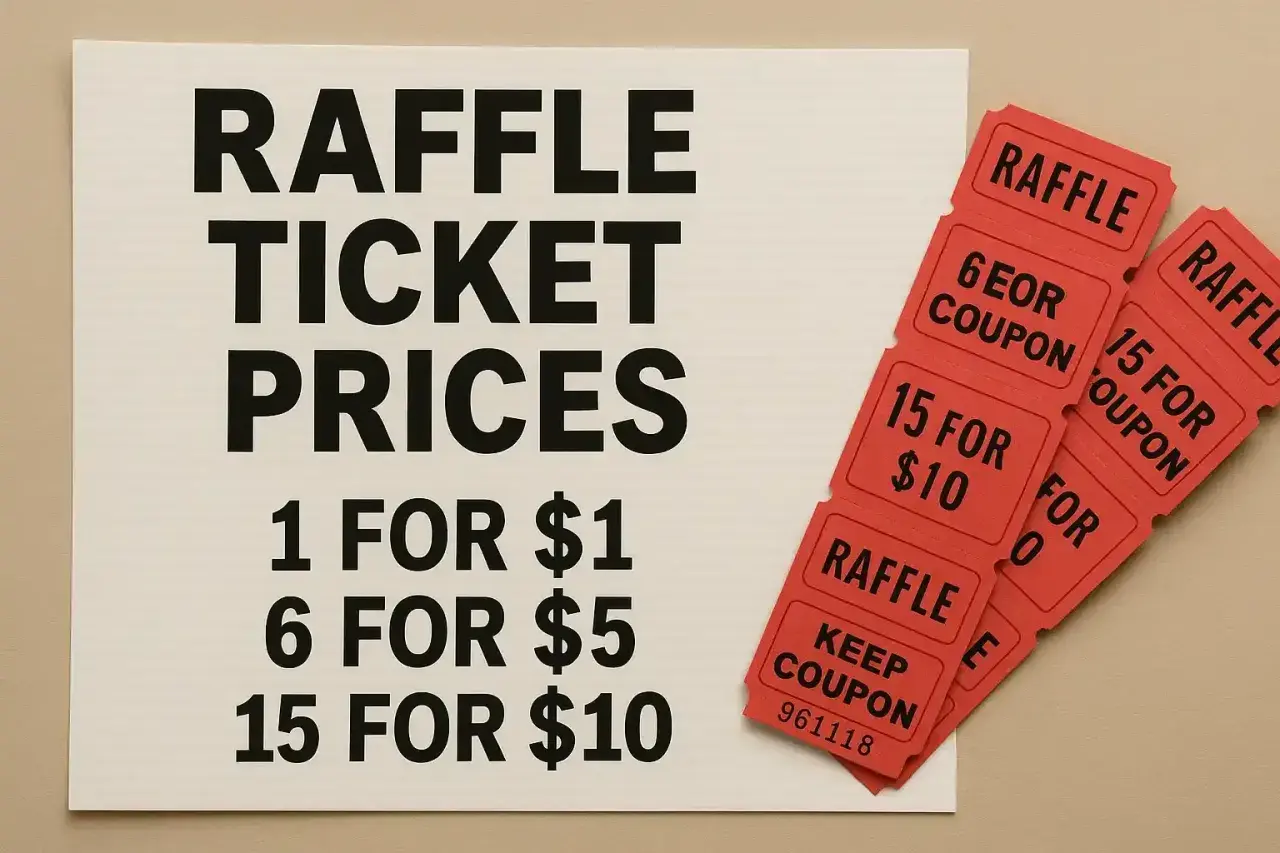
Raffle ticket prices are not random, and they should not be copied from last year without checking the audience, the prize, and the event’s actual fundraising target. I usually treat ticket cost as part fundraising math, part psychology, and part compliance, because the best price is the one people will actually pay without hesitation. This article breaks down realistic price bands in the United States, how to set the number from your goal, and the mistakes that usually suppress sales.
The quickest way to choose a price that people will actually pay
- For most U.S. community raffles, low entry points such as $1, $5, or $10 work better than a premium ask.
- Higher-value prizes can support a higher ask, but only when the audience already trusts the cause and understands the prize.
- The cleanest formula is: fundraising goal + direct costs, divided by realistic ticket volume.
- Bundles like 3 for $10 or 5 for $20 often raise average spend without scaring off casual buyers.
- State raffle rules can affect whether you can sell online, who can host the raffle, and what paperwork you need.

What the ticket price is really doing
When I price a raffle, I am not just choosing a number. I am deciding how easy it is for someone to join, how much confidence the offer creates, and how much revenue the event can realistically produce.
A low price can be the right move when the goal is reach. It lowers friction, encourages impulse buying, and makes it easier for volunteers to sell tickets one by one. A higher price can work when the prize is unusually attractive or the audience is already highly engaged, but it raises the bar for persuasion.
- Accessibility affects how many people enter on first contact.
- Revenue per sale affects how quickly the fundraiser reaches its goal.
- Perceived fairness affects whether people feel the cause is serving the community or squeezing it.
For community and social-good events, I usually favor a price that feels easy to justify in one sentence. That framing makes the next step simpler: finding the price bands that match the kind of raffle you are actually running.
The price bands that make sense for U.S. raffles
In current U.S. fundraising practice, most raffle entry prices cluster in a fairly narrow range. The right number depends on the prize, the audience, and the scale of the event, but these bands are a practical starting point rather than a guess.
| Raffle type | Typical price per ticket | When I would use it | Why it works |
|---|---|---|---|
| Small community raffle | $1 to $5 | School, church, neighborhood, or club events with broad participation | Low barrier, fast decisions, strong volume potential |
| Standard nonprofit fundraiser | $5 to $10 | Local charitable events with a warm audience and a clear cause | Still affordable, but enough margin to matter financially |
| Stronger prize raffle | $10 to $20 | Trips, premium baskets, signed items, or donated packages with real perceived value | The prize can justify a higher ask without feeling out of reach |
| Premium or specialty raffle | $25 to $50+ | Gala add-ons, limited-audience draws, or very high-value prizes | Fewer buyers are needed if the prize is compelling and the audience is committed |
Those ranges are not legal limits, and they are not a promise of sales. They are a map of where price tends to feel natural in the United States. Once you move outside them, the event usually needs a stronger prize story, a more committed audience, or both. That is why I always connect price to a simple calculation instead of relying on instinct alone.
From here, the real question is how to choose the exact number without underpricing the event or pricing out the people you want to include.
How I choose a price that fits the event
My starting point is simple: I work backward from the money the event needs to raise. The ticket price should cover the fundraising goal, the direct costs, and any payment or printing friction that will otherwise quietly shrink the margin.
Working formula: fundraising goal + direct costs + processing fees, divided by realistic ticket volume. The important word there is realistic. I do not use best-case sales. I use the number I think the event can actually reach with normal promotion and normal volunteer effort.
For example, if I want to net $2,000, expect to sell 500 tickets, and face $250 in printing, payment, and prize-related costs, the rough price point is a little above $4.50 per ticket. In practice, I would likely round to $5 and then add a bundle such as 3 for $12 so the average order value can rise without pushing the single-ticket buyer away.
Read Also: Read-a-thon Success - Simple Rules for Max Impact
Bundle pricing can do more than a low sticker price
Bundles are one of the easiest ways to make the math work. A single ticket at $5 feels approachable, but 3 for $12 or 5 for $20 usually creates a better average sale while still feeling affordable. I use bundles when I want casual buyers to participate without making the event feel cheap or overly commercial.
The point is not to make the pricing look clever. The point is to give people an easy yes at more than one spending level. That becomes even more important when the event has a mixed audience, because not everyone has the same budget or the same appetite for risk.
Once the price is grounded in math, I look at the factors that can push it up or down in the real world.
What can push the number up or down
In practice, I see five things change the price more than anything else.
- Prize value matters, but only when the audience sees that value clearly. A donated basket worth $300 and a private dinner for ten are not priced the same way.
- Audience trust matters just as much. Supporters who already know the mission will accept a higher ask than a cold audience at a street fair.
- Sales channel changes behavior. Online checkout is easier to scale, but it can add fees; in-person sales can work well at events, but they need simple, fast pricing.
- State rules can shape the model. Some states still restrict online ticket sales, require permits, or limit who may run the raffle, so I never finalize pricing before checking the rules.
- Event context matters. A raffle attached to a gala or auction can support a higher ticket cost than a standalone table at a community fair.
That legal piece is the one many people overlook. If the state framework changes how tickets are sold, whether the raffle must be in person, or what paperwork is required, the price structure may need to absorb those costs from the start instead of treating them as an afterthought.
With those variables in mind, the next thing I focus on is what usually goes wrong when people set the price too quickly.
Mistakes that quietly hurt sales
The most common mistake is not the wrong number itself. It is choosing a number without a sales plan behind it.
- Setting the price too high for the audience and expecting the prize to do all the selling.
- Setting the price too low and then struggling to hit the fundraising target even after a decent turnout.
- Ignoring bundles when a tiered offer would raise average spend with almost no extra friction.
- Forgetting transaction fees on card payments, online platforms, or ticket printing.
- Pricing for the organizer’s comfort instead of the buyer’s willingness to participate.
- Making the offer hard to understand with vague wording, hidden deadlines, or unclear drawing details.
I also see organizers overestimate how much a donor will tolerate purely because the cause is good. A strong mission helps, but people still make a quick economic decision. If the ticket feels expensive relative to the prize or the event’s emotional pull, they hesitate. If it feels easy and clearly connected to impact, they buy.
That is why the best pricing discussions are not abstract. They get easier when I test them against real event types and real outcomes.
A few realistic pricing scenarios
Here is how I would think about a few common U.S. fundraising setups.
| Scenario | Sample price | Why I would choose it | What to watch |
|---|---|---|---|
| School basket raffle | $2 to $5 | Families need a low-cost way to participate, and volume matters more than a high individual spend | Keep the prize story simple and the checkout fast |
| Community arts fundraiser with a donated weekend getaway | $10 to $20 | The prize has stronger perceived value, so buyers accept a higher ask if the cause is well explained | Use bundles and visible promotion to support the higher entry point |
| Gala add-on raffle | $25 or more | The audience is already in a giving mood, and the raffle is part of a broader event experience | Do not assume every attendee wants the same ticket count |
| 50/50 draw | $1 to $5, often with bundles | The appeal is simple cash value, so low-friction entry and repeated purchases matter more than a fancy prize | Check state rules carefully because 50/50 structures can be regulated differently |
These examples are useful because they show the real tradeoff. The cheapest ticket is not always the strongest fundraiser, and the highest ticket is not always the most profitable. What matters is the fit between price, prize, and the people you expect to reach. That is the lens I use in the final check before anything gets printed or posted.
The last check before tickets go on sale
Before I lock in a price, I ask myself five things.
- Can I explain the offer in one sentence without sounding defensive?
- Does the number still work if only part of the audience buys in?
- Have I covered printing, platform fees, and any other direct costs?
- Do I have at least one bundle that makes the average order larger?
- Have I confirmed the state and local raffle rules that affect sales, licenses, and drawing format?
If the answer is yes, the price is usually ready to test. I prefer a workable ticket cost that can move quickly over a perfect-looking number that slows the event down. For community fundraisers, the strongest pricing is usually the one that feels accessible, transparent, and aligned with the cause, because that combination helps both turnout and trust.
