
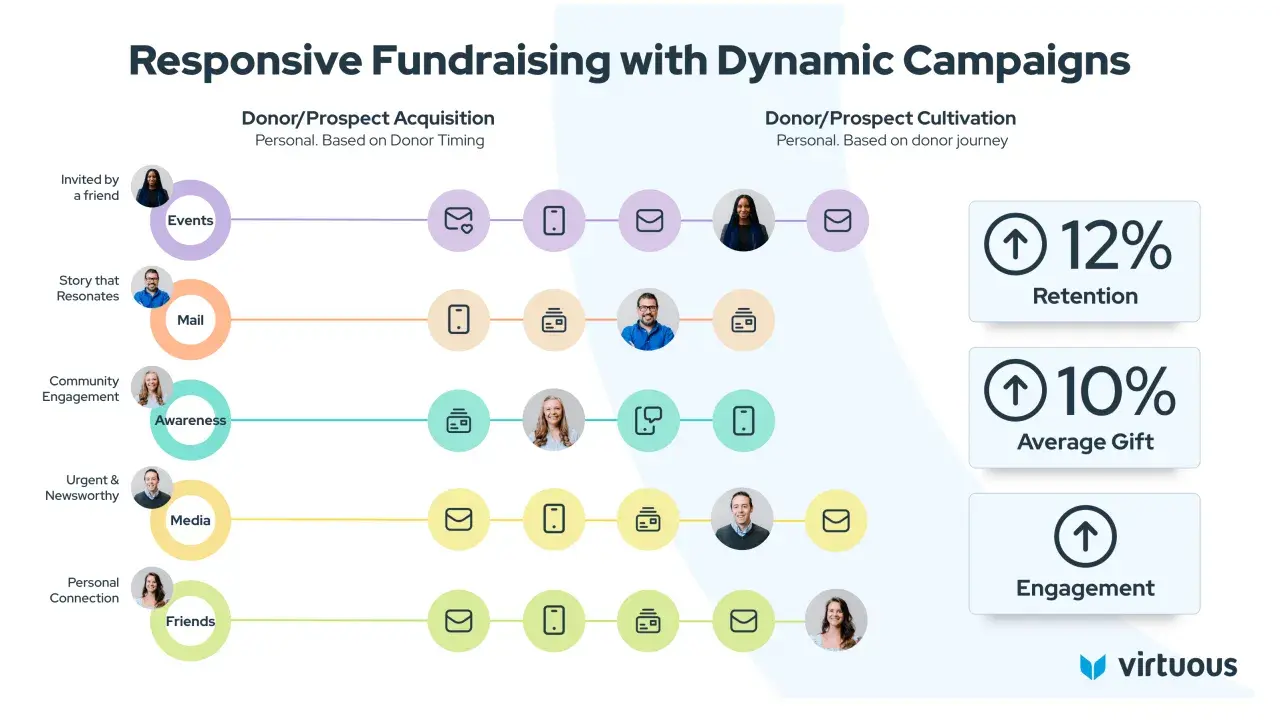
The practical takeaways at a glance
- Measure retention as seriously as revenue. A rising total can hide a shrinking donor base.
- Make one clear ask. Donors respond faster when the appeal points to one outcome and one action.
- Use multiple channels with one message. Email, mail, phone, and the donation page should reinforce the same story.
- Thank fast. The first 48 hours after a gift are a retention window, not an admin task.
- Design for the next gift. The campaign is not finished when the donation lands.
What makes a yearly giving drive work
In practice, an annual fund is the broad-based revenue stream that supports current programs, scholarships, services, and other everyday needs. It is not built to finance one building or one splashy project. It is built to keep the mission moving, which is why I judge it less like a one-time event and more like a system that deepens trust over time.
The distinction matters because it changes how you plan. A capital campaign usually revolves around a fixed goal and a finite deadline. A yearly drive, by contrast, has to do three things at once: bring in unrestricted or lightly restricted dollars, keep existing donors engaged, and create a pipeline for deeper giving later.
| Element | Yearly giving drive | Capital campaign |
|---|---|---|
| Purpose | Support current mission work and daily operations | Fund a specific large project or long-term asset |
| Timeline | Repeats every year, often in waves | Finite, usually multi-year |
| Success metric | Retention, participation, upgrades, recurring gifts | Dollar goal and pledge completion |
| Main risk | Donor fatigue and weak follow-up | Scope creep and a long cycle time |
That is why the strongest version of this work feels steady rather than dramatic. It is built on consistency, not theatrics, and the next section is where that consistency starts to become measurable.
Set goals that track behavior, not just dollars
The first number I watch is retention, not total revenue. According to the Fundraising Effectiveness Project, total charitable dollars grew by 5.0% in 2025 while donor counts fell by 3.6%. That is the central tension in the current environment: revenue can look healthy even as the base narrows.
For context, the sector-wide donor retention rate for 2024 was 42.9%. I do not read that as a reason to panic, but I do read it as a reminder that a gift is only the beginning of the relationship. If your campaign only chases dollars, you can win the quarter and lose the next two years.
I usually set four kinds of goals:
- Revenue goal based on program needs, inflation, and realistic growth.
- Donor count goal so the list grows, not just the average check size.
- Retention goal for repeat donors, because keeping people is cheaper than finding them again.
- Recurring-gift goal so part of the revenue becomes predictable instead of purely seasonal.
If I had to choose one discipline that most smaller organizations skip, it would be segmentation. New donors, repeat donors, lapsed donors, and mid-level donors should not get the same ask, the same timing, or the same follow-up. The next step is to turn that strategy into a message donors can understand quickly.
Shape the message around one clear outcome
The cleanest appeals sound simple because they do the hard thinking upfront. I want the donor to understand three things in less than a minute: what is needed, why now, and what their gift changes. When those three pieces are clear, response rates usually improve without needing flashy language.
My rule is to build the message around one outcome, not five. If the appeal is trying to fund a program, fix a gap, recognize a crisis, and recruit volunteers all at once, it usually loses force. The donor does not need a full organizational map. They need a reason to act.
- Lead with the need. State the problem in plain language.
- Translate dollars into impact. Show what a gift does in real terms, not vague aspiration.
- Use a short proof point. One data point or one brief story is usually enough.
- Offer clean giving levels. Three to five options are enough for most audiences.
- Keep the call to action singular. Ask for one primary action before you ask for anything else.
I also treat matching gifts with care. A real match can help, but only if the terms are easy to understand and the deadline is credible. Fake urgency backfires. Donors can tell when the campaign is borrowing excitement instead of earning it. Once the message is clear, the next question is where and when to deliver it.

Choose channels and timing that fit donor habits
I usually plan the channel sequence before I write the first appeal. One message rarely converts on its own. A sequence does. Most donors need to see the same request more than once, in more than one place, before they act, and the order of those touches matters.
| Channel | Best use | What it does well | Where it falls short |
|---|---|---|---|
| Fast outreach, reminders, and last-call touches | Low cost, easy to test, easy to measure | Easy to ignore in a crowded inbox | |
| Direct mail | Loyal donors, older supporters, and house files | Tangible, more deliberate, often more trusted | Slower and more expensive to produce |
| Phone | Major donors, lapsed donors, and high-touch stewardship | Personal, flexible, good for upgrades | Labor-intensive and hard to scale |
| Social media | Awareness, peer proof, and campaign momentum | Extends reach and adds social validation | Rarely closes the gift by itself |
| Donation page | Actual conversion | Controls friction and closes the loop | Only works well if traffic reaches it easily |
| Peer-to-peer | Trust transfer and ambassador-led growth | Lets supporters recruit other supporters | Needs volunteer energy and clear structure |
The weakest plans I see usually depend on one channel and one send. The stronger ones create a rhythm: awareness, ask, reminder, final push, thank-you, then follow-up. For a U.S. audience, I also insist on a mobile-responsive donation page, because a donor who has to pinch, zoom, or hunt for the giving button is a donor you can lose in seconds. If you have room for only one operational improvement, fix the donation flow before you spend more on promotion.
Timing matters too. A fall build-up, a year-end push, and a January thank-you or renewal phase usually works better than a single burst in December. The donor should feel guided, not chased. That difference is often what separates a decent result from a dependable one.
Stewardship should start before the first gift lands
Receipts are compliance; stewardship is retention. Once a gift arrives, the real question is whether the donor feels noticed, informed, and useful enough to come back. I would build the thank-you plan before launch, not after the campaign has already started.
Giving USA notes that first-time donors only give again about 20% of the time, but once a donor makes a second gift, the chance of continued giving rises to about 60%. That is why I treat the first follow-up as part of the campaign itself. The second gift is not an afterthought. It is the real test of whether the relationship is forming.
- Thank within 48 hours. Fast, human acknowledgment matters more than polished language.
- Report impact within 30 to 60 days. Show where the money went or what it helped make possible.
- Invite a next step. Ask donors to volunteer, reply, share feedback, or set up recurring support.
- Build a second-gift path. Do not wait a full year to re-engage a new donor.
I also like to separate stewardship by segment. New donors need onboarding. Repeat donors need recognition and momentum. Lapsed donors need a reason to trust again. Mid-level donors often need more context and more direct contact. When stewardship is this deliberate, the next campaign starts from a stronger place instead of a colder one.
Measure the right metrics and adjust fast
If the campaign is live, I review the numbers often enough to make decisions, not just collect reports. Open rates and click rates are useful, but they are not the whole story. A campaign can look lively in email and still underperform at the donation step.
| Metric | Why it matters | What to watch for |
|---|---|---|
| Retention rate | Shows whether the donor base is holding | Revenue up while donor count falls |
| Average gift | Reveals how strong the response is | One large gift masking weak broad support |
| Recurring-gift share | Adds stability to future cash flow | Only one-time gifts growing |
| Upgrade rate | Shows whether donors are deepening their support | Mid-level donors staying flat |
| Cost per dollar raised | Checks whether the plan is efficient | Spending outrunning the gain |
I also test small changes instead of redesigning everything. A/B testing means sending two versions of a message to small samples and keeping the better performer. That can reveal whether the issue is the subject line, the suggested gift amount, the image, or the placement of the donate button. If one segment responds and another stays quiet, I adjust the ask or the timing rather than blasting everyone again with the same message.
The most important discipline is to read the pattern, not just the headline number. If donor count is weak, do not comfort yourself with a healthy average gift. If engagement is high but giving is low, the message or the page probably needs work. The data should push you toward a clearer decision, not just another report.
What I would keep on the next campaign calendar
If I had to reduce the whole plan to four non-negotiables, I would keep it simple: a realistic goal, a segmented list, one clear story, and a stewardship workflow that begins the same day the gift arrives. Everything else is useful only if those pieces are already in place.
- Start with retention, not just dollars.
- Write for one donor at a time, even when you are sending to thousands.
- Use channels in sequence, not isolation.
- Thank, report, and invite the next step before the year closes.
That is how a yearly fundraising effort turns from an annual scramble into a dependable habit. The organizations that do this well do not simply ask more often. They make it easier for people to stay connected, give again, and see their support as part of something larger than a transaction.
