
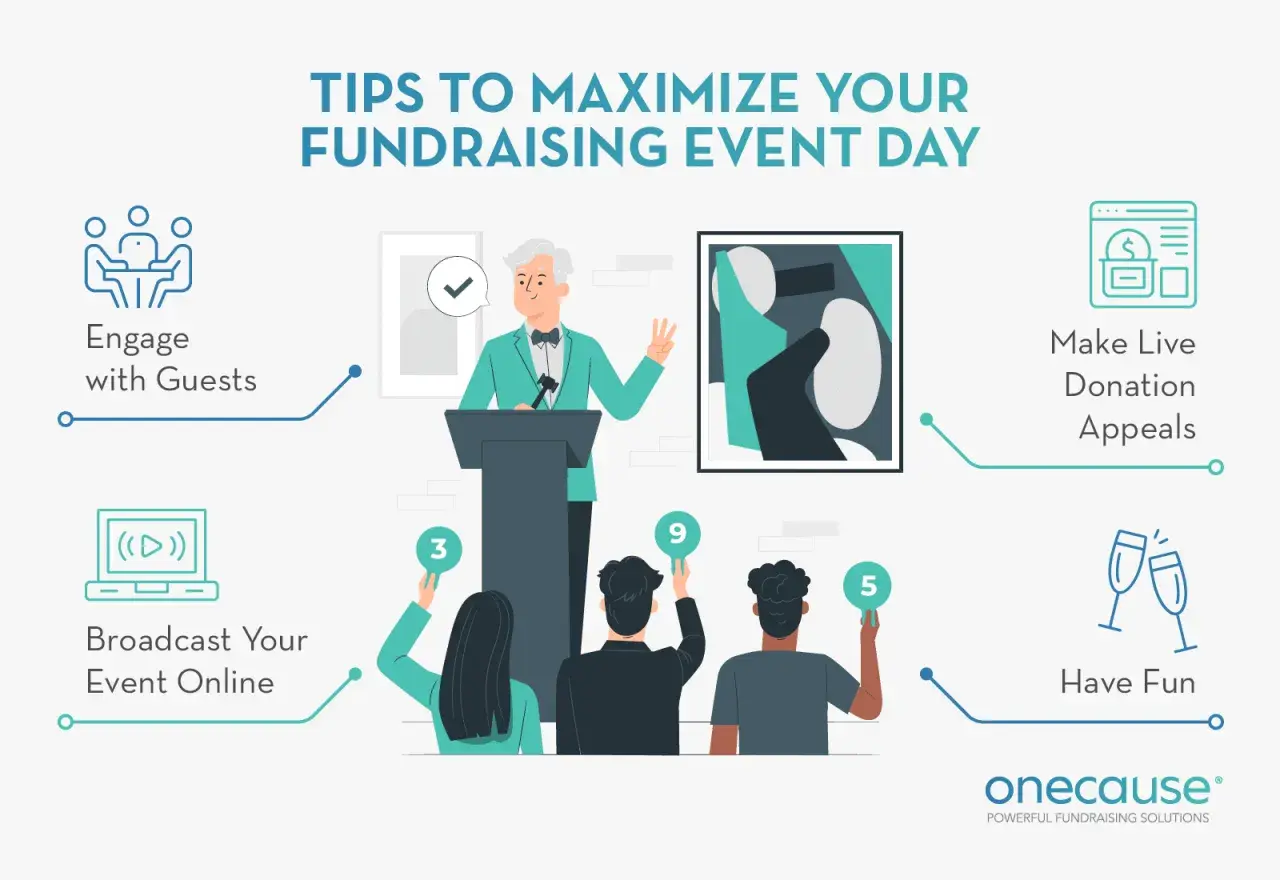
In this article, I break down what these events are meant to accomplish, which formats tend to work best, how I would plan the budget and promotion, and the legal details that can quietly change the math. The goal is simple: help you design an event that raises money without wasting energy on the wrong kind of spectacle.
What matters most before you book anything
- Choose one primary goal first, because revenue, awareness, and donor acquisition do not always come from the same format.
- Match the event to the audience you already have, not the trend you wish would work.
- Build the budget before setting ticket prices, so the numbers do not become wishful thinking.
- Use sponsorships and in-kind support to cover fixed costs before you rely on ticket sales.
- In the U.S., ticket value, auction benefits, and raffle rules can change what is deductible or even allowed.
What these events need to achieve
I think of a benefit event as a tool with three possible jobs: raising cash, recruiting future donors, or building community visibility. Most organizers want all three at once, but that is where projects drift. If you do not choose a primary outcome, you end up measuring success by applause instead of results.
For a gala, the real value may be donor cultivation and major gifts, not just ticket sales. For a walk or run, the upside is often participation and reach, because supporters can invite friends, family, and coworkers. For a peer-to-peer campaign, the event itself matters less than the network effect. Peer-to-peer simply means each participant gets a personal page and raises money through their own circle.That is why I always ask one blunt question before planning starts: what should this event change for the organization six weeks later? If the answer is "more cash in the bank," the structure should be different from one designed to expand the mailing list or strengthen local goodwill. Once that goal is clear, the next decision is format, and that choice should be driven by audience fit, not habit.

Choosing the right format for your audience
The best format is the one your supporters will actually complete, afford, and enjoy sharing with others. I would rather see a modest event that fits the room than a polished concept that looks impressive on paper and flatters no one in practice.
| Format | Best when | Strength | Main limitation |
|---|---|---|---|
| Gala or dinner | You have sponsor support and donors who tolerate higher ticket prices | Strong revenue per guest and good donor cultivation | Can become expensive and labor-heavy fast |
| Walk or run | You want broad participation and family-friendly visibility | Accessible and easy to promote through teams | Permits, weather, and logistics can complicate execution |
| Auction | You can secure appealing items or experiences | Fast fundraising potential in one night | Item sourcing can become the bottleneck |
| Concert or talent night | You have local performers and a community that likes live entertainment | Highly shareable and emotionally engaging | Production costs can creep up |
| Virtual auction or giving day | You want lower overhead or a wider geographic reach | Cheaper to run and easier to access | Harder to create urgency without strong messaging |
| Peer-to-peer challenge | Your supporters are willing to recruit others on your behalf | Expands reach beyond your own list | Needs simple tools and steady coaching |
I would not pick the most popular format just because other organizations use it. A $250 gala ticket makes sense only if sponsorships or a strong donor base can support that price. A $40 community event may outperform a fancy dinner simply because more people can say yes without hesitation. The right answer is not the most glamorous one, it is the one whose cost structure matches the likely audience.
From here, the real work is planning the event so the format can actually deliver on its promise.
How I would plan one from the ground up
The cleanest event plans start with numbers, not decorations. I usually build them in this order:
- Set one primary outcome, such as net revenue, new donor acquisition, or sponsor retention.
- Define the audience in plain language, because a family community event and a major donor dinner need very different appeals.
- Choose the date and venue around accessibility, parking, season, and weather backup.
- Assign owners for sponsorship, marketing, logistics, registration, and donor follow-up.
- Decide how money will flow, including ticketing, donation pages, auction checkout, and receipting.
- Write the run of show early, so the live program supports the fundraising ask instead of distracting from it.
For a smaller community event, I usually want at least 8 to 12 weeks of lead time. For a larger gala, run, or multi-part program, 4 to 6 months is safer. That extra time is not about perfection, it is about giving sponsors, volunteers, and attendees enough room to commit before the calendar fills up.
The biggest mistake I see is designing the evening before the ask. People spend weeks arguing about centerpieces and stage flow, then discover too late that the program does not actually make it easy to give. Once the operating plan is clear, the budget can finally be set with some honesty.
Budgets, pricing, and sponsorships that keep the math honest
As a working planning range, I like to map costs by event type instead of pretending every fundraiser behaves the same. A seated dinner in a major U.S. city can run anywhere from about $50 to $200 per guest before you add marketing or admin overhead. A community walk or run often lands somewhere in the $1,500 to $10,000+ range depending on permits, shirts, water, signage, insurance, and timing gear. Online auctions can be relatively lean, but payment processing and software still deserve a line item.
| Cost category | Useful planning range | What usually drives it |
|---|---|---|
| Venue and catering | $50 to $200 per guest | City, service level, bar package, and guest count |
| Permits and event operations | $500 to $5,000+ | Race permits, street use, security, cleanup, and insurance |
| Program production | $1,000 to $15,000+ | Audio, lighting, stage needs, photography, and decor |
| Marketing and creative | 5% to 15% of direct cost | Email volume, print, video, paid social, and design help |
| Ticketing or event software | $0 to a few thousand dollars | Feature set, payment fees, and registration volume |
My rule of thumb is simple: keep direct costs below 40% of projected gross, and closer to 25% if the event is supposed to scale year after year. If you expect to raise $30,000, I want to see no more than about $15,000 in direct costs, and I would rather that number be lower. That margin is what makes the event repeatable.
Revenue should come from more than one place. Ticket sales cover variable costs, sponsors cover fixed costs, and add-ons such as donation upgrades, auction items, or matching gifts create upside. A practical sponsorship ladder might include community sponsor at $1,000, program sponsor at $2,500, presenting sponsor at $5,000, and title sponsor at $10,000, but the real number should match the audience and local market. Once the budget is grounded, the next job is to get the right people to hear about it.
Getting people to show up and give
Most underperforming fundraisers have a messaging problem before they have a venue problem. People do not buy a ticket because the program is long; they buy because the cause feels clear, the value feels real, and the invitation feels personal.
I usually plan promotion in phases. Eight to twelve weeks out, I announce the date, mission, and one simple reason to attend. Around six weeks out, I push sponsorships, table sales, or early-bird pricing. Two to three weeks out, I add urgency with a deadline, a matching challenge, or a limited-capacity reminder. In the final week, I stop explaining everything and make one clean ask.
- Use one landing page with one primary action, not three competing paths.
- Recruit board members and volunteers to share a personal reason for supporting the event.
- Write impact-led copy that tells people what their ticket or donation actually does.
- Offer an early-bird deadline when you need commitment before the crowd is ready.
- Use matching gifts or sponsor challenges to create a real deadline, not a vague sense of urgency.
I would rather send four focused reminders than twelve unfocused blasts. The best campaign feels coordinated, not noisy, and it gives people a reason to act now instead of "someday." Once attendance is moving, the final challenge is making sure the event is handled correctly on the tax and compliance side.
The U.S. rules that quietly change the math
This is the part teams often ignore until it causes friction. The IRS treats many ticketed charity events as quid pro quo contributions, which means the deductible amount is only the portion that exceeds the value of what the donor receives. In the IRS example, if someone pays $100 for a ticket to an event where the meal is valued at $40, the deductible portion is generally $60. That is also why written disclosures matter once the payment is over $75.
In practical terms, I always tell organizers to track what attendees receive, especially for dinners, receptions, gala packages, and auction items. If you offer a VIP ticket with a gift bag, premium seating, or a plated meal, record the fair market value of those benefits. If you run an auction, make sure item descriptions and receipts are clean enough that donors understand what they bought and what portion, if any, may be deductible.
Sponsorships need the same care. Qualified sponsorship payments are not the same thing as advertising, and that distinction matters for tax treatment. Raffles are another area where teams get burned, because state rules can vary widely and some states require registration or restrict online sales. I do not treat raffle planning as an afterthought. I treat it as a compliance task.
When the compliance basics are handled early, the event feels cleaner for everyone involved, and the final step becomes much easier: turning one night into a stronger fundraising pipeline.
How to turn one good night into next year’s donor base
The real return on a benefit event often arrives after the room is empty. The organizations that improve fastest are the ones that document what happened, thank people quickly, and move attendees into the right follow-up path.
- Send thank-you messages within 24 hours, while the event still feels fresh.
- Separate attendees, bidders, sponsors, volunteers, and no-shows so follow-up is specific.
- Ask first-time attendees for a smaller second gift within 7 to 14 days, not six months later.
- Review five numbers: gross revenue, direct cost, net revenue, attendance, and first-time donor count.
- Save the photos, stories, and sponsor wins so next year starts with proof instead of guesswork.
I think that is the part many teams miss. A strong event is not only a single night of giving, it is a way to build a warmer list, cleaner data, and a better understanding of what your community actually responds to. If you treat the event as a one-off performance, you leave value on the table. If you treat it as the beginning of a relationship, the fundraising gets easier the next time around.
