
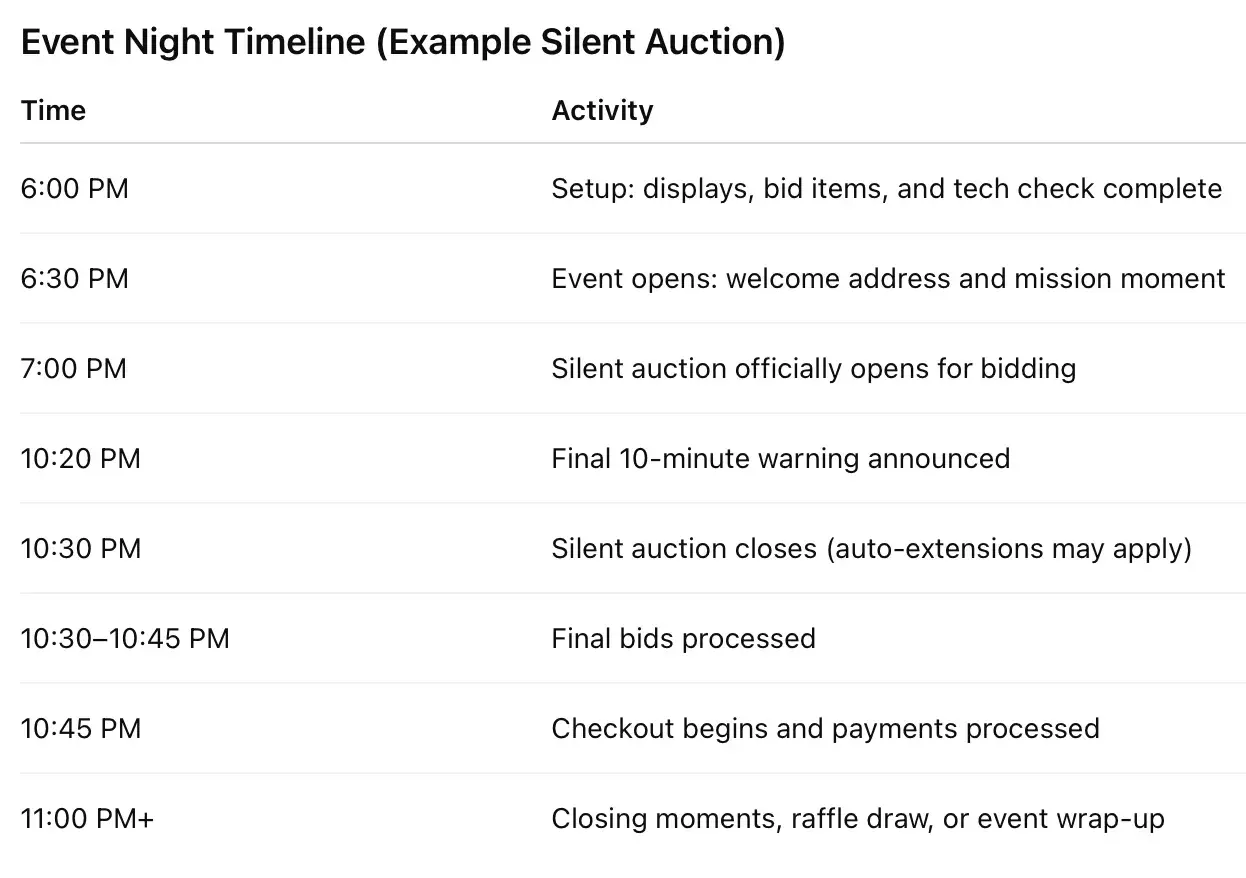
An effective silent auction is less about keeping bidding open as long as possible and more about matching the window to the room. The best duration gives people enough time to browse, compare, and act, while still creating a clear finish that pushes the final bids upward. In practice, the answer to how long should a silent auction last depends on format, audience size, and how much attention you can realistically hold.
The fastest way to choose the right auction window
- In-person events usually work best with bidding open during the event and a close 30 to 45 minutes before the program ends.
- Online auctions usually need 10 to 14 days, while many hybrid setups perform well in 5 to 10 days.
- The close matters as much as the length: a visible deadline and repeated reminders almost always improve the final stretch.
- The right window is the shortest one that still feels fair to bidders and gives them time to return, reconsider, and increase their bids.
- Longer is not automatically better; once attention drops, revenue usually flattens with it.

The practical answer by auction format
If I had to choose one default for a U.S. nonprofit fundraiser in 2026, I would start with the format. The guidance I reviewed from OneCause and GalaBid points in the same direction: open early, keep the runway long enough for browsing, and close with a visible countdown. That pattern is simple, but it works because it respects how people actually behave at events.
| Format | Recommended window | Why it works | When I would use it |
|---|---|---|---|
| In-person gala or community dinner | One evening, with the auction closing 30 to 45 minutes before the program ends | Guests are already in the room, urgency is visible, and winners can pay before they leave. | School auctions, church fundraisers, charity dinners, and other events where most bidders are physically present. |
| Hybrid event with mobile bidding | 5 to 10 days | Remote supporters get time to participate, but the auction still feels active and current. | Events that need both in-room energy and online reach. |
| Online-only auction | 10 to 14 days | There is enough time for discovery, reminders, and repeat visits without letting momentum fade. | Community campaigns, seasonal fundraisers, and auctions built for a broad donor base. |
| Pre-event warm-up auction | 1 to 2 weeks before the live event, then a close during the event or shortly before it | It builds early energy and gives supporters something to talk about before the main night. | Large galas where you want the auction to support the bigger fundraising program. |
If I am unsure, I usually start with 10 days for an online auction and shorten only when the audience is tightly local or the event itself is highly structured. Once you choose the format, the real question becomes what shifts it shorter or longer.
What changes the right duration
The right auction length is shaped by more than convenience. I look at five variables before I decide whether an auction needs a few hours, a full evening, or more than a week.
- Audience reach: If most bidders are already in the room, a long window is usually unnecessary. If supporters are spread across neighborhoods, cities, or time zones, they need more time.
- Item count: More items create more browsing time, but a huge catalog can also dilute bidding. A tighter list often outperforms a bloated one.
- Item value and variety: Experiences and premium packages usually need more attention than simple gift cards because people compare them more carefully.
- Promotion capacity: A longer auction only works if you can keep reminding people. Without repeat visibility, extra days become dead space.
- Checkout logistics: If payment, pickup, or winner confirmation will be slow, the close should be designed to leave enough operational breathing room.
In practice, I think many organizers overestimate how much time bidders want and underestimate how much repetition they need to stay engaged. Those variables also shape the close, which is where many auctions lose momentum.
How to design the close so urgency works for you
A silent auction does not need a dramatic ending to be effective, but it does need a believable one. I prefer a hard, clearly advertised close over a vague finish that drifts because the room gets busy or the schedule runs late. If remote bidders are involved, the published close time should be treated as fixed; if only in-room guests are participating, I have a little more flexibility when the program overruns.
- Announce the close time in more than one place, including signage, item pages, and opening remarks.
- Use reminders before the final hour so bidders have time to return, not just react.
- Show a countdown or leaderboard if your software supports it, because visible urgency usually lifts the final bids.
- Keep high-interest items easy to find near the end so people do not lose time hunting through the catalog.
- Do not close during a distracting segment like dancing, an awards presentation, or a live-auction spotlight.
What matters here is not theatrics; it is focus. A short countdown can work very well, but only when the room is still paying attention. The next risk is not the close itself, but letting the auction window drift past the point of useful attention.
Mistakes that make a silent auction drag on too long
I see the same timing mistakes again and again, and they usually cost more than people expect. The problem is not always the calendar; it is the way the calendar interacts with bidder behavior.
- Running an online auction too long without fresh promotion: After a while, people stop checking back unless they are reminded.
- Ending when attention is already gone: If guests have moved on to music, dessert, or socializing, the final push disappears.
- Leaving the close time soft: A close that feels negotiable trains bidders to wait instead of act.
- Using quantity instead of quality: Too many items can create a browsing burden instead of a bidding opportunity.
- Ignoring the handoff after the auction ends: Slow checkout turns a good close into a frustrating exit.
I would rather see a well-promoted 8-day auction than a 21-day auction that nobody remembers to revisit. The timing should support the fundraiser, not stretch it until the final hours feel empty. With those pitfalls in mind, the last step is deciding what timeline you can actually run without improvising.
A timing plan I would use for a community fundraiser
For a mission-driven event, I like simple timelines that staff and volunteers can actually execute. The more complicated the close, the more likely the team will miss reminders, weaken the finale, or create confusion for bidders.
- Small in-person fundraiser: Open when guests arrive, keep bidding active through dinner and social time, then close 30 to 45 minutes before the formal program ends.
- Hybrid fundraiser: Open 5 to 10 days before the event, send reminders at launch, 48 hours before close, 24 hours before close, and in the final few hours.
- Online community campaign: Run it for 10 to 14 days, with one mid-campaign push and a strong final 24-hour message.
- Large gala with heavy programming: Start early if the catalog is strong, then close while attention is still concentrated and before the room loses momentum.
That framework keeps the auction manageable, but the bigger goal is making the timing feel respectful to donors rather than arbitrary. The duration choices that protect both revenue and donor goodwill are usually the ones that make the final hour feel focused, not rushed.
The duration choices that protect both revenue and donor goodwill
For community-focused events, I do not think the longest possible auction is the best one. The strongest auctions usually sit in the middle: long enough to let people discover items, short enough to keep interest alive, and clear enough that nobody wonders when bidding really ends.
- Choose a shorter window when your audience is local and the event already has a built-in crowd.
- Choose a longer window when you need remote participation or several reminder cycles.
- Keep the close visible and final, because urgency usually lifts the last bids.
- Protect checkout time, because a smooth finish is part of the guest experience.
My rule of thumb is simple: choose the shortest auction window that still lets supporters notice the items, revisit them, and bid again without feeling rushed. That balance is usually what produces the strongest close and the best experience for the people giving.
