
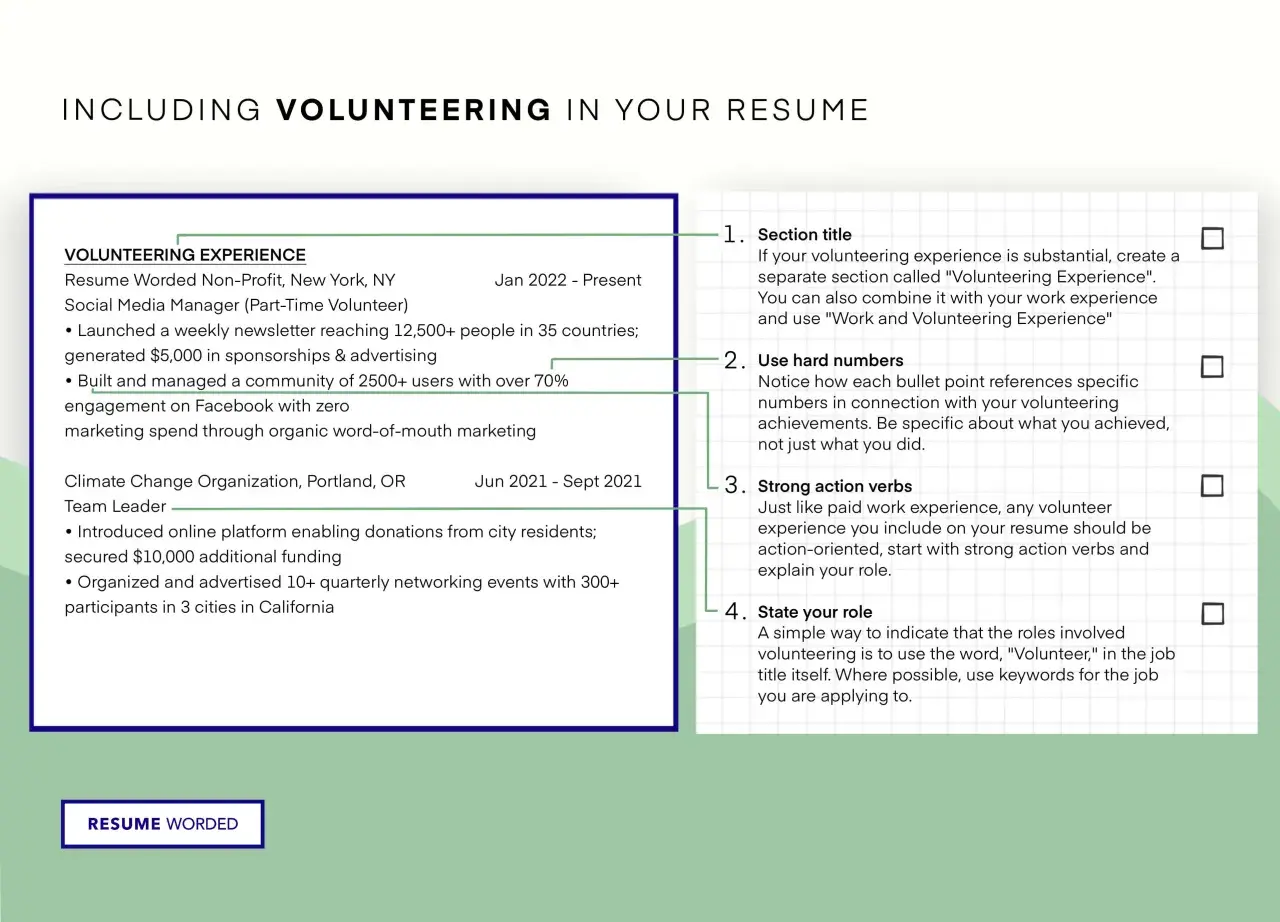
Volunteer work can make a resume feel more complete when it shows real responsibility, not just goodwill. The challenge is deciding what belongs, where it should sit, and how to describe it so a hiring manager sees evidence of skills instead of a list of nice things you did. In this article, I break down exactly how I handle service experience, what to emphasize, and where it helps most in a U.S. job search.
The practical rule is simple: include service that proves skills, impact, or fit
- Put volunteer roles in your main Experience section when they are closely tied to the job.
- Use a separate Volunteer Experience or Community Service section when the work is meaningful but secondary.
- Write each bullet around scope, action, and result, not around duties alone.
- Keep only the entries that strengthen the story you want the employer to remember.
- Tailor the language to the posting so the role reads like credible experience.
When volunteer work belongs on a resume
I treat volunteer experience on resume as evidence, not decoration. It belongs when the work shows transferable skills such as leadership, coordination, fundraising, client service, teaching, research, event planning, or community outreach.
That usually means one of four things: you are early in your career and need more proof of capability, you are changing fields and need to translate old strengths, you have a gap you want to explain honestly, or the employer values public service. I also keep it when the volunteer role is unusually strong, such as organizing a food drive, serving on a board, coaching a team, or running a recurring program with clear outcomes.
What I do not include is casual helping that has no clear scale or relevance. If the line would force me to cut a more important paid role, I usually leave it out. Service should earn its place on the page, not take it by default.
Where to place it so recruiters notice the right thing
There is no single correct location. The best placement depends on what the volunteer work is doing for your story.
| Placement | Best when | Why it works | Watch out for |
|---|---|---|---|
| Main Experience section | The role is relevant, substantial, or directly demonstrates job skills | It gives volunteer work equal weight with paid experience and keeps the resume focused | Do not do this if it crowds out stronger paid accomplishments |
| Separate Volunteer Experience or Community Service section | You have several service roles or you want to highlight civic involvement without mixing it into paid work | It keeps the page organized and signals that the work was consistent, not incidental | Do not bury your best examples at the bottom if they are highly relevant |
| Skills or additional experience section | The volunteer work supports a skill but is not strong enough for a full entry | It adds context without overclaiming | Keep it brief so it does not read like filler |
Harvard Law School’s career guidance treats significant volunteer work as part of Experience, and that is the right instinct when the role is substantial. I like that approach because it sends a simple message: unpaid does not mean irrelevant.
If the page starts to feel crowded, I reduce noise before I reduce meaning. That usually means keeping the strongest roles, not the oldest ones, and moving lighter service into a cleaner support section. Once placement is set, the wording matters just as much.
How to turn service into bullet points that read like work experience
The strongest bullets follow a simple pattern: action, scope, outcome. I normally write them in that order because it makes the value obvious fast.
- Start with a strong verb such as coordinated, launched, mentored, raised, organized, or streamlined.
- Add scope so the reader understands scale: number of people, events, hours, dollars, clients, or locations.
- Show the result in plain language, ideally with a number or a concrete change.
- Echo 2 or 3 keywords from the job posting when they are true to the work.
That is where many resumes improve immediately. Compare these:
Weak: Helped at a community pantry.
Stronger: Coordinated 18 volunteers for a weekly community pantry, reducing check-in delays and supporting 250 households per month.
Weak: Tutored students after school.
Stronger: Developed weekly tutoring sessions for 12 middle school students and improved homework completion across the group.
I usually aim for 2 to 4 bullets per volunteer role. If I need a fifth bullet, that is often a sign the entry is carrying too much weight or the resume itself needs trimming. The point is not to document every task; the point is to show proof.
Indeed’s current career advice makes the same broad move: it recommends tailoring volunteer descriptions to the role and highlighting measurable impact. I would push that one step further and say the bullet should sound like a result the employer can imagine repeating on the job.
Examples that fit different career situations
The same volunteer role can be framed in different ways depending on what you need the resume to do. Here is how I would think about it.
| Situation | How I would present it | What to emphasize |
|---|---|---|
| Recent graduate | Place the role near education or in the main Experience section if it is substantial | Leadership, consistency, communication, and initiative |
| Career changer | Use it to show proof of transferable skills from the new field | Tools, stakeholders, coordination, and outcomes that map to the target role |
| Experienced professional | Keep only the most relevant or impressive service, usually in a separate section | Strategic leadership, board service, fundraising, or specialized expertise |
| Employment gap or caregiving period | Include recurring service if it explains activity and commitment during the gap | Structure, reliability, and ongoing contribution |
If I were applying to a nonprofit, public-interest, or community-facing role, I would be more generous with service detail. In those cases the volunteer story is often part of the fit itself. For a corporate operations role, I would keep only the volunteer work that proves discipline, coordination, or customer-facing ability.
The key is not to make service look bigger than it is. It is to make its value visible in language the employer understands.
Common mistakes that weaken the section
Most weak volunteer entries fail for the same predictable reasons. I usually find one of these problems when I edit a resume:
- They list duties instead of outcomes.
- They include one-off help that adds clutter but no signal.
- They hide relevant service in a vague hobbies line.
- They omit organization names, dates, or location when those details would make the entry credible.
- They exaggerate a small contribution into a bigger role than it really was.
- They ignore the job posting and fail to connect the work to the target position.
The easiest fix is honesty plus specificity. If you only helped at one fundraiser, say that. If you led a six-month program, say that too. Readers can tell the difference quickly, and overstatement hurts more than a modest entry ever will.
One practical rule I use: if the volunteer line does not help a hiring manager understand your fit in 10 seconds, it probably needs to be rewritten or removed. That discipline keeps the resume tight and makes the strongest service work stand out.
The edit test I use before I keep a volunteer entry
Before I keep any service entry, I ask three questions. Does it prove a skill the employer needs? Can I describe a result, not just a duty? Is it stronger than one of the paid or academic lines it would replace?
If the answer is yes to all three, it belongs on the page. If the answer is no to two of them, I cut it or compress it. That approach keeps a resume sharp, credible, and easy to scan, which is exactly what service experience should do when it is presented well.
