
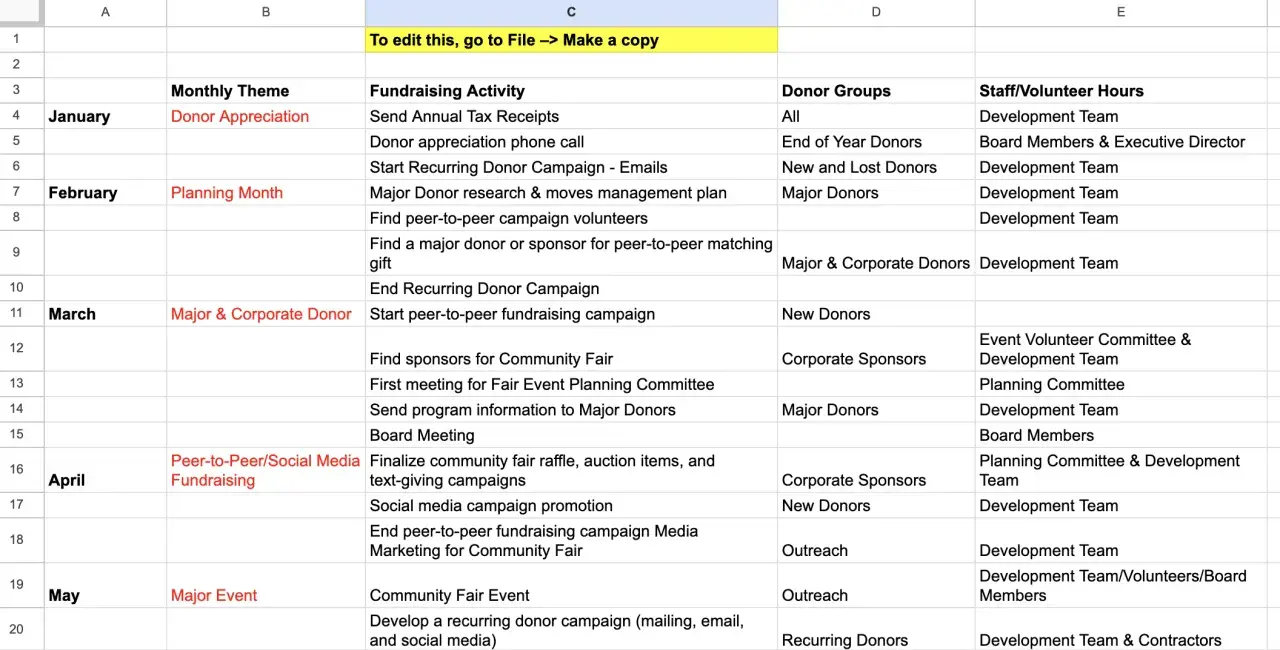
A fundraiser calendar is more than a list of events. I treat it as the operating plan that keeps appeals, stewardship, volunteer asks, and board deadlines from competing with one another. For U.S. nonprofits, it also has to reflect seasonal giving patterns, fiscal-year pressure, and the reality that staff and volunteers have limited attention.
The fastest way to keep fundraising organized all year
- A strong schedule balances multiple jobs. It should cover campaigns, donor care, events, grants, and internal deadlines without crowding everything into the same week.
- Lead time matters. Major appeals usually need 90 to 120 days of runway, while larger events often need 6 to 9 months.
- U.S. timing is seasonal. Year-end giving, back-to-school rhythms, and fiscal-year close should shape the plan.
- Ownership is non-negotiable. Every date should have a person responsible for it and a clear next action.
- Review the plan regularly. Weekly checks keep active campaigns moving; monthly reviews keep the full year honest.
Why a fundraiser calendar changes the way a team works
I like a fundraising schedule because it forces tradeoffs into the open. Without one, teams tend to stack events on top of appeals, then wonder why donor response drops and staff burnout rises. With one, I can see where a campaign needs breathing room, where stewardship is missing, and which months are already overloaded.
- It protects attention. Donors can only absorb so many asks in a short window, even when they support the mission.
- It improves timing. A spring appeal and a gala should not launch on top of each other unless there is a very good reason.
- It makes ownership visible. Every milestone should have one accountable person, not a vague group of helpers.
- It turns fundraising into a sequence. Ask, acknowledge, report, and re-engage become part of one rhythm instead of separate emergencies.
When the schedule is working, it becomes easier to decide what not to do, which is often the real difference between a busy year and a productive one. Once that logic is clear, the next question is what actually earns a place on the calendar.
What to put on the schedule before campaign dates go live
The most useful calendars are broader than event dates. I start by mapping every item that consumes time, attention, or donor trust, even if it does not directly raise money.
| Item type | What to capture | Typical lead time |
|---|---|---|
| Major campaigns | Launch date, creative deadline, donor segment review, landing page, email sequence | 90 to 120 days |
| Events | Venue holds, sponsor asks, volunteer recruitment, run-of-show, follow-up plan | 6 to 9 months for large in-person events; 8 to 12 weeks for smaller ones |
| Stewardship | Thank-you cadence, impact update, donor report, board acknowledgements | 48 to 72 hours for acknowledgements; about 30 days for an impact follow-up |
| Grants | Prospect research, draft, internal review, attachments, submission date | 60 to 90 days before the deadline |
| Compliance and governance | Board meetings, annual report work, tax filings, audit prep, state registrations | As soon as the date is known, then back-plan from there |
If an item depends on raffles, gaming, or charitable solicitation rules, I add it early and verify the state requirements before the public launch. That kind of detail is easy to ignore until it becomes a delay. Once the calendar includes those non-negotiables, the next step is pacing the year so the workload feels deliberate rather than chaotic.

A practical year-round rhythm for U.S. nonprofits
In the United States, the year rarely feels even. December is crowded, summer is slower, and school-based or community organizations often live by a separate rhythm altogether. I build the schedule around quarters first, then fill in the weekly work underneath.
| Period | Primary focus | Why it matters |
|---|---|---|
| January to March | Stewardship, tax receipts, annual reporting, board reset, grant pipeline | It clears the deck after year-end and creates a cleaner base for spring asks. |
| April to June | Spring appeal, event production, sponsorship renewals, fiscal-year close | It captures momentum before summer schedules start to fragment attention. |
| July to September | Major donor cultivation, sponsor outreach, content prep, campaign planning | It is the best time to build the runway for fall and year-end work. |
| October to December | GivingTuesday, year-end appeal, donor segmentation, final stewardship | For many organizations, this is the highest-stakes fundraising window of the year. |
If your fiscal year ends in June, I would shift board reporting and budget review earlier so they do not collide with year-end appeals. If you work with schools or youth groups, summer is not a dead zone; it is often the best planning season because the public-facing calendar is lighter. The rhythm works only if the plan survives contact with real operations, which is where discipline matters.
How to keep the schedule useful after launch
The biggest failure mode I see is not poor strategy; it is calendar drift. Teams build a strong plan in January and then stop updating it once the first campaign gets busy.
- Use one source of truth. A shared Google Calendar, CRM, or project board is fine; what matters is that everyone looks at the same version.
- Assign an owner to every date. If nobody owns a milestone, it will quietly slip.
- Review active work weekly. During a live campaign, a 20- to 30-minute check-in is usually enough to surface blockers before they grow.
- Review the full year monthly. That is often the right cadence for spotting overlaps, missed stewardship, or too many asks in one quarter.
- Track a small set of metrics. Gift volume, average gift, conversion rate, sponsor commitments, and volunteer fill rate are usually enough to reveal whether the plan is working.
I also prefer to separate decision points from execution details. The calendar should show when a draft must be ready, when approvals happen, and when a launch goes live; it does not need to list every social post unless that is the real bottleneck. Once the system is this simple, the next problem is usually not process. It is avoidable mistakes.
Common mistakes that quietly weaken results
Most fundraising schedules do not fail dramatically. They fail by collecting small errors that make the year harder than it needs to be.
- Trying to do too much in Q4. If year-end is your most important work, it should not be fighting for bandwidth with three other launches.
- Leaving stewardship off the map. Thank-yous, impact updates, and donor reports are not extras; they are what make the next ask believable.
- Forgetting internal deadlines. Board meetings, budget reviews, annual reporting, and audit prep can consume more time than the campaign itself.
- Using dates without owners. A campaign without a single responsible person becomes everyone’s job and nobody’s priority.
- Ignoring donor fatigue. Repeated asks without a break or context will usually lower response quality, even when the cause is strong.
- Assuming volunteers will self-organize. If a fundraiser depends on volunteer turnout, I always build reminders and confirmation steps into the schedule.
The pattern is predictable: too many moving pieces, not enough room to breathe, and no shared view of what comes next. The fix is not more activity. It is a tighter operating rhythm that keeps the next 90 days honest.
The next 90 days are where the plan becomes real
If I were building the schedule for a nonprofit today, I would not start with the full 12-month view. I would map the next 90 days, then extend from there. That shorter horizon reveals bottlenecks fast: missing approvals, weak donor segments, unclear ownership, or a campaign that needs more lead time than the team thought.
- Lock one priority campaign. Give it a launch date, a message owner, and a clear success metric.
- Add one stewardship action. Put thank-you and impact follow-up dates on the calendar before the appeal goes out.
- Reserve one internal deadline. Board review, budget sign-off, or compliance work should not appear as a last-minute surprise.
- Work backward. Mark the 90-day, 60-day, 30-day, and 7-day checkpoints so the team sees the real workload early.
A schedule that changes behavior is the one worth keeping. If the next 90 days are visible, owned, and reviewed on time, the rest of the year becomes much easier to manage, and the fundraising work starts to feel less reactive and more aligned with the mission.
