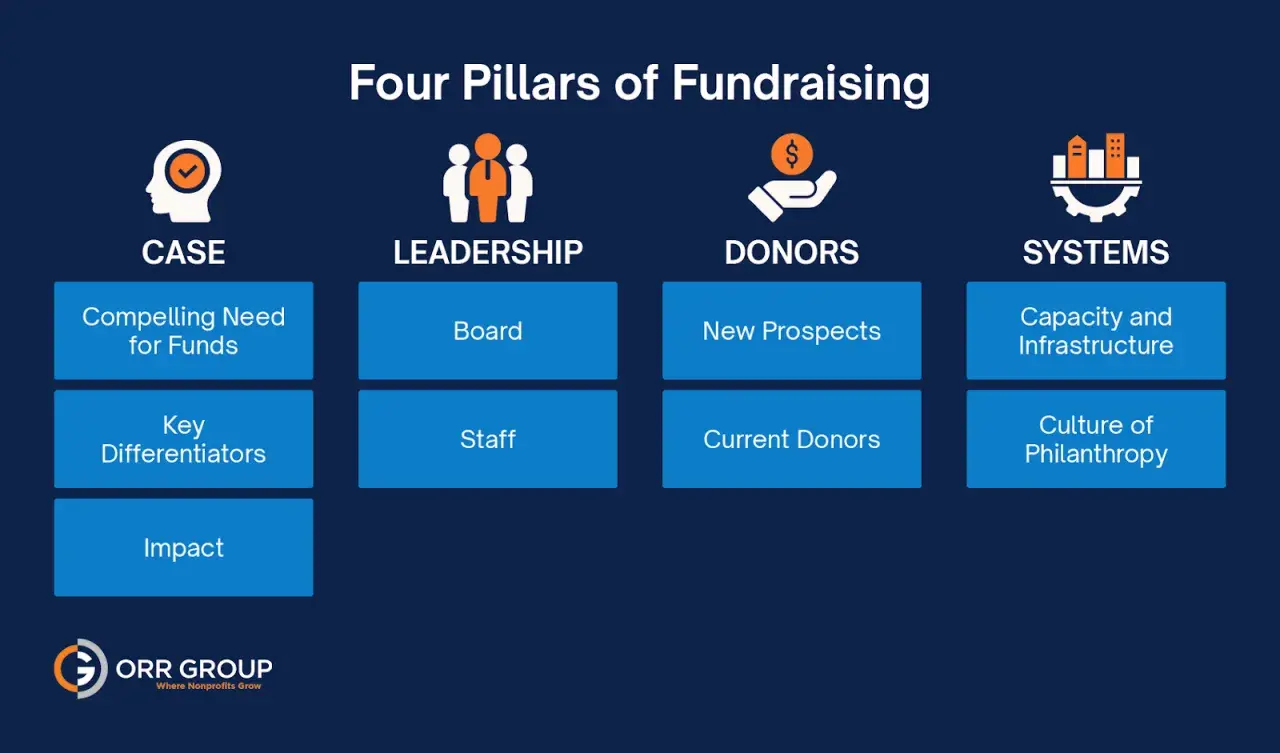
Key points to keep the plan useful
- Start with the funding gap and build backward from the real need, not from a favorite tactic.
- Use a small number of revenue streams that match your team’s capacity and donor base.
- Track net revenue, not just gross dollars, so costs do not hide weak campaigns.
- Assign an owner, a deadline, and a review cadence to every major action.
- In the U.S., recurring gifts, donor transparency, and relationship-based fundraising matter more than ever.
Start with the funding problem, not the fundraising tactic
I always begin with the gap, not the gimmick. The plan needs to answer a few blunt questions: what amount is required, by when, from which donor groups, and at what cost? If those answers are fuzzy, the rest of the document becomes a wish list instead of a working plan.
For a nonprofit, that means separating net revenue from gross revenue. Net revenue is what remains after platform fees, event costs, printing, travel, and staff time. That distinction matters more than people think, because a campaign that raises $50,000 and costs $18,000 to run does not behave like a campaign that raises $50,000 for $3,000.
Once the funding problem is defined, the template can do its job: assign a realistic target, choose the channels that can actually carry it, and set a time frame the team can defend. From there, the plan stops being abstract and becomes a tool for decision-making, which is exactly what the next section is built to capture.
What the document should contain
When I build a fundraising plan, I want one document to hold the core decisions in plain language. The point is not to create paperwork; it is to make the strategy visible enough that a board member, staff lead, or volunteer chair can use it without a long explanation.| Section | What to capture | Why it matters |
|---|---|---|
| Funding goal | Net amount needed, gross amount expected, and the date the money must be in hand | Prevents vague goals and makes the target measurable |
| Audience segments | Current donors, major prospects, board connections, grantmakers, corporate partners, and monthly givers | Shows who will be asked and how each group should be approached |
| Revenue streams | Individual giving, recurring gifts, grants, sponsorships, events, peer-to-peer, workplace giving, or DAF gifts | Spreads risk and keeps the plan from depending on one source |
| Case for support | The problem, the solution, the urgency, and proof of impact | Gives every appeal the same core message |
| Calendar | Launch dates, ask dates, board meetings, event dates, stewardship moments, and reporting checkpoints | Turns strategy into a sequence the team can actually follow |
| Budget | Direct costs, platform fees, staff time, and expected net return | Reveals whether the plan is financially sustainable |
| Ownership | Who drafts, who approves, who sends, who follows up, and who reports | Prevents the common problem of everyone assuming someone else is handling it |
| Metrics | Response rate, average gift, donor retention, conversion rate, net revenue, and monthly progress | Keeps review honest and gives you a basis for adjustment |
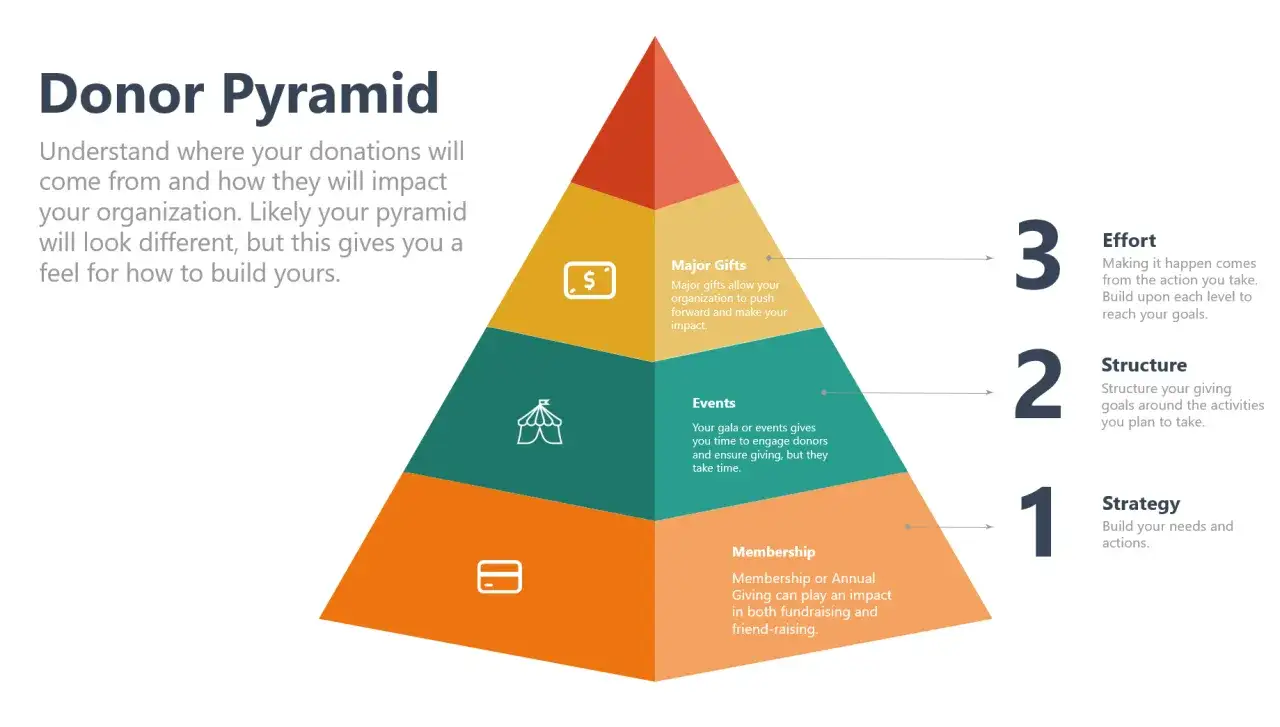
If you are planning a larger campaign, I would also add a gift pyramid, which is simply the ladder of lead gifts, mid-level gifts, and broad-base donations needed to reach the total. It is one of the fastest ways to see whether your target is realistic or just aspirational. With those pieces defined, the useful work is turning them into a draft people can use.
A fill-in structure you can use this week
I do not treat a fundraising strategy template as a static form. I treat it as a one-page control panel with enough detail to guide action and enough restraint to stay readable. If your team is small, the best version is usually the one that forces discipline rather than the one that tries to say everything.
| Template line | What to write |
|---|---|
| Purpose | Why the money is needed and what change it will create |
| Net goal | The amount needed after all fundraising costs are covered |
| Primary audiences | The donor segments most likely to respond this year |
| Core ask | The main donation request, pledge, sponsorship, or grant request |
| Revenue mix | The 2 to 4 channels that will carry most of the target |
| Calendar | The month-by-month sequence of asks, launches, follow-ups, and stewardship |
| Budget | Expected costs, tools, and staff time |
| Owners | Who is responsible for each task |
| KPIs | The small set of metrics you will review regularly |
| Risks and assumptions | What could derail the plan and what has to be true for it to work |
How to adapt the same plan to annual, campaign, and emergency fundraising
Not every fundraising effort needs the same level of detail. An annual plan, a capital campaign, and an urgent response appeal all use the same logic, but they do not need the same depth in each section. I like to separate them by time horizon and complexity so the team does not overbuild a small appeal or underbuild a major campaign.
| Plan type | Best for | Time horizon | What matters most | Main risk |
|---|---|---|---|---|
| Annual plan | Ongoing nonprofit fundraising across the year | 12 months | Balance, calendar discipline, and donor retention | Trying to do too many things at once |
| Campaign plan | One defined initiative, like a program launch or end-of-year drive | 6 to 16 weeks, or a few months | Message clarity, conversion, and fast follow-up | Weak scheduling and unclear ownership |
| Emergency appeal | Urgent needs that require quick donor action | Days to a few weeks | Speed, emotional clarity, and a simple giving path | Launching before the story, donation page, and follow-up are ready |
| Capital campaign | Large, multi-year fundraising goals such as facilities or endowment work | 18 months or more | Major-gift sequencing, feasibility, board engagement, and stewardship | Skipping the research and ask strategy |
For a capital campaign, I would add a feasibility study, a major-gift cultivation map, and a clearer ask ladder than I would in an annual plan. For an emergency appeal, I would strip the document down to the essentials: the need, the proof, the ask, the deadline, and the follow-up path. The template stays the same; the weight of each section changes. That flexibility matters even more now, because the fundraising environment in the U.S. is pushing organizations toward clearer, more trust-based plans.
What matters most in U.S. fundraising in 2026
Two signals stand out right now. Giving USA reported that U.S. charitable giving reached $592.5 billion in 2024, and individuals accounted for 66% of total giving. Candid also reports that nonprofits with a Seal of Transparency receive, on average, 62% more in donor contributions than organizations without one. My read is straightforward: donors still give, but they respond better to clarity, proof, and consistent relationships than to broad, generic appeals.That changes how I would design the plan in 2026:
- Build recurring giving into the base plan, not as a side project.
- Give stewardship a real schedule, because retention is cheaper than constant acquisition.
- Use at least one direct channel, one digital channel, and one relationship-led channel so the plan is not brittle.
- Keep public proof easy to find, including impact updates, leadership information, and clean donor acknowledgement.
- Use AI for segmentation, drafting, and testing, but not as a substitute for judgment or donor knowledge.
I also think boards underestimate how much the shape of giving matters. If most of your plan depends on one annual gala or one large grant cycle, the plan looks neat but carries too much risk. A more durable version uses recurring gifts, mid-level donors, board introductions, and a handful of targeted campaigns that build on each other. Once that is in place, the next threat is not the market; it is avoidable planning mistakes.
Mistakes that make the plan look complete but fail in practice
In the field, I see the same failures again and again. They are not usually dramatic, just quietly expensive.
- Setting one total revenue target and never breaking it down by channel, donor segment, or month.
- Choosing tactics before deciding how much staff capacity the plan actually has.
- Ignoring the cost to raise a dollar, which makes “successful” campaigns look better than they are.
- Leaving ownership vague, so important tasks drift until deadlines are already gone.
- Treating donor acquisition and donor retention as if they require the same workflow.
- Depending on a single event or a single funder to carry too much of the year.
- Reviewing the plan once and then letting it sit untouched for twelve months.
One quick test I use: if the plan depends on 300 new donors giving $100 each, plus a gala that nets $20,000, I want to know exactly where those donors will come from and what the gala costs to run. If the math only works on paper, the template is not ready. The stronger version is not the one with the most ambition; it is the one that survives contact with actual capacity and donor behavior. That leads naturally to the most overlooked part of the whole process: the review rhythm.
The monthly review that keeps the plan alive
The difference between a useful plan and a decorative one is usually the review habit. I prefer a short monthly check-in, because it is frequent enough to catch drift and brief enough that people will actually attend. The agenda does not need to be complicated.
- Are we on pace by revenue stream, not just in total?
- Which asks are still open, and who owns the next step?
- What is donor retention doing this month?
- Which channel is producing the strongest net return?
Every quarter, I would reset the plan a little more aggressively: reallocate time toward the channels that are working, cut anything that is producing weak net results, and update the calendar around new opportunities or delays. If I were handing this to a board or a small staff team, I would keep the plan brutally simple: one page of strategy, one working calendar, and one review cadence. That is enough to make the document useful without turning it into a second job.