
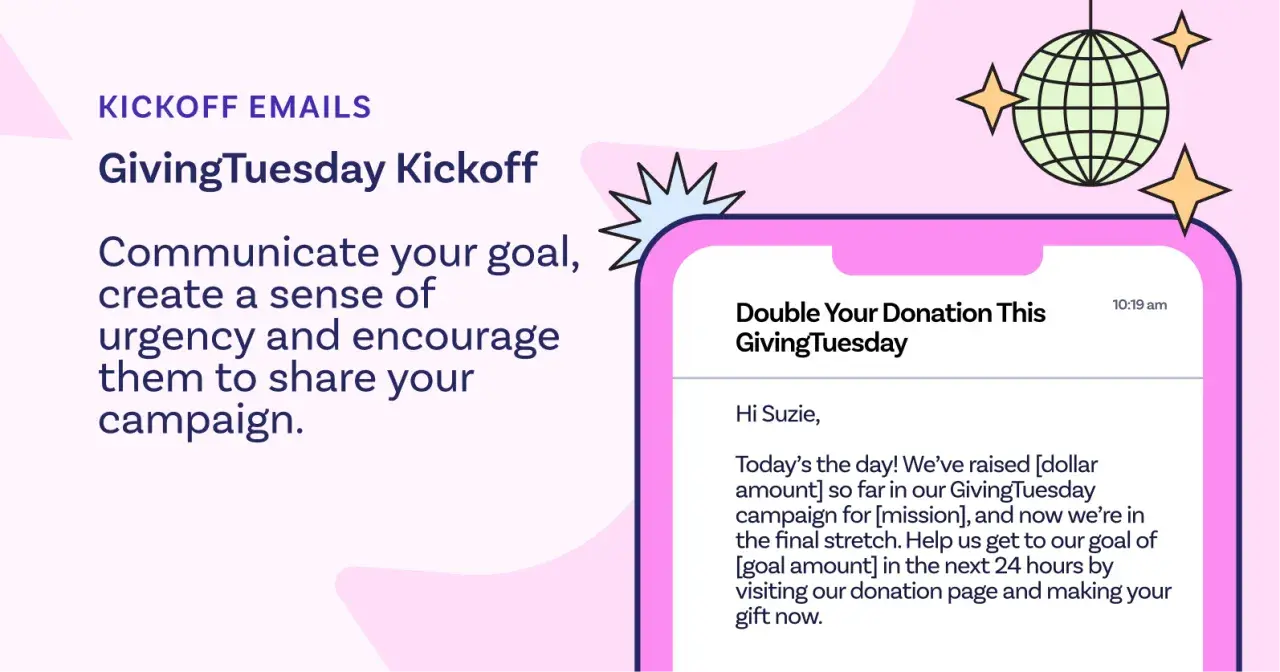
For most U.S. nonprofits, I start with a morning launch, then add a midday update and an early evening last call. That pattern is simple, but it works because it lines up with donor behavior instead of fighting it. The details change if your list is national, small, or heavily engaged, and I will show where the common advice is solid and where it needs adjustment.
The timing rule that gives a Giving Tuesday email the best shot at being opened
- If you can send only one message, use a morning window between 8:00 and 10:00 a.m. in the recipient’s local time.
- If you can send three, use morning, lunch, and early evening.
- For a national list, segment by time zone instead of blasting everyone at one Eastern time.
- Use the day before to warm up the list and the day after to thank donors quickly.
- Keep the first email short, specific, and easy to act on from a phone.
The fastest answer if you only get one email
If I had to choose a single send window, I would pick 8:00 to 10:00 a.m. local time. That is early enough to show up before the inbox gets crowded, but not so early that people file it away for later and never come back.
| Scenario | Best send time | Why it works | Watch out for |
|---|---|---|---|
| One email only | 8:00-10:00 a.m. local | Best chance of being seen before the day gets busy | Weaker if you send one fixed time nationwide |
| Two emails | 8:30 a.m. and 6:00 p.m. local | Launch plus last call | Skip the second send only if your list is fatigued |
| Three emails | 8:00-10:00 a.m., 12:00-2:00 p.m., 6:00-8:00 p.m. | Matches morning, lunch, and after-work behavior | Needs strong segmentation and clean writing |
| National list with no segmentation | 11:00 a.m.-12:00 p.m. ET | Compromise window that still lands in late morning for much of the U.S. | Not as strong as local-time sends |
That is the simple answer I would give a small team that needs a decision now. It gets even better once you understand why the morning send still tends to win the first slot.
Why the morning launch still earns the first slot
Morning is not magic; it is just the cleanest place to start. Neon One’s 2026 nonprofit data points to late morning and early afternoon as a strong general fundraising window, while Qgiv’s Giving Tuesday platform data shows the strongest gift activity from 10:00 a.m. to 1:00 p.m. ET and another lift from 4:00 p.m. to 8:00 p.m. ET. In practice, that means the first appeal should arrive before donors settle into those giving windows, not after them.
A morning launch also gives you room to build the rest of the day around evidence. Once your first email is out, you can send a progress update that refers to real momentum, real dollars, or a real matching gift. That feels more persuasive than sending a single oversized ask and hoping it does all the work.
- It catches people before meetings and errands take over.
- It gives your campaign a starting point for later updates.
- It leaves enough daylight for a second and third touch without feeling rushed.
- It works especially well when the email is short and mobile-friendly.
Once that first slot is clear, the next step is building the rest of the day around it instead of treating every send like a standalone blast.
A practical Giving Tuesday email timeline
The schedule I trust most is simple enough to execute and tight enough to avoid fatigue. I think of the day as three moments: launch, proof, and close.
| Time window | Purpose | What the email should do | Best use case |
|---|---|---|---|
| 8:00-10:00 a.m. local | Launch | State the ask, the goal, and why today matters | Best first send for most lists |
| 12:00-2:00 p.m. local | Proof | Share progress, donor momentum, or a match | Strong for people checking email at lunch |
| 6:00-8:00 p.m. local | Close | Use urgency, a deadline, and one clear CTA | Best for after-work donors and mobile readers |
| After 8:00 p.m. local | Only if needed | Send a final reminder only when the audience is highly engaged | Use sparingly; fatigue rises fast here |
If you can only manage two emails on the day, I would keep the morning launch and the evening close. The midday update is valuable, but it is the first message I would cut if the team is stretched thin or the list is already hearing from you often.
That schedule works because each email has a different job. The more similar the messages feel, the faster the list stops noticing them.
Time zones matter more than most teams expect
Timing gets messier the moment your donor base spans more than one time zone. A 9:00 a.m. Eastern send lands at 6:00 a.m. Pacific, which is too early for a lot of people and not early enough to feel intentional. If your platform supports it, I would send by recipient local time every time.
- Use local-time delivery for broad national lists.
- If you cannot segment, choose a late-morning Eastern window that still lands in the workday across the country.
- Treat West Coast donors as a separate audience if they make up a meaningful share of giving.
- For major donors, a personal note or call can outperform a mass send, especially later in the day.
I also separate audience behavior from audience geography. Staff, board members, recurring donors, and first-time subscribers do not all open at the same hour, so the best timing strategy is often different from one list segment to the next. That is why the next question is not just when to send, but what to send before and after the day itself.
What to send before and after the day itself
The day-of emails do most of the heavy lifting, but the surrounding messages do the quiet work that makes them convert. A teaser warms up the list, a reminder sets expectations, and a thank-you email keeps the relationship intact after the rush ends.
- One to two weeks before - send a teaser that names the date, the mission, and any match or campaign goal.
- The day before - send a short reminder that tells people what to expect and why their help matters.
- Giving Tuesday morning - launch the main appeal.
- Later that day - send an update with proof of progress and a stronger deadline.
- The next day - thank donors, share early results, and keep the momentum moving into year-end giving.
That sequence does two things at once. It keeps the campaign from feeling like a single desperate ask, and it gives donors a sense that their action is part of something moving in real time.
The mistakes that make good timing fail
Even a strong send window can underperform if the message and the moment do not match. The most common problem I see is not the hour itself; it is the mismatch between the hour and the email content.
- Launching too late in the day, when inbox competition and fatigue are already high.
- Using the same copy for every send, so the emails feel repetitive instead of staged.
- Writing a long first email that asks people to do too much at once.
- Ignoring mobile readers, even though many donors will open the message on a phone.
- Forgetting to test the list by geography, which can turn a good send time into a bad one for part of the audience.
I would also avoid sending a playful or story-heavy email at the final hour unless the list has already shown that it responds late in the day. The closing message should be tight, clear, and unmistakably urgent.
A 2026 timing playbook I would actually use
If I were planning a U.S. Giving Tuesday campaign this year, I would keep the structure disciplined and leave room for testing. My default would be a morning launch at 8:30 a.m. local time, a noon update with proof of momentum, and a final evening reminder around 6:30 p.m. local time. For a national list, I would schedule those sends by recipient time zone instead of forcing everyone into one Eastern clock.
- Use one main appeal that is easy to understand in under 10 seconds.
- Let the midday email show progress, not repeat the same ask.
- Keep the final reminder short enough to read on a phone in one glance.
- Thank donors the next day while the campaign is still fresh.
That is the timing framework I trust because it respects how people actually read email. It is direct, it leaves room for urgency, and it does not waste the one day when supporters are already primed to give.
