
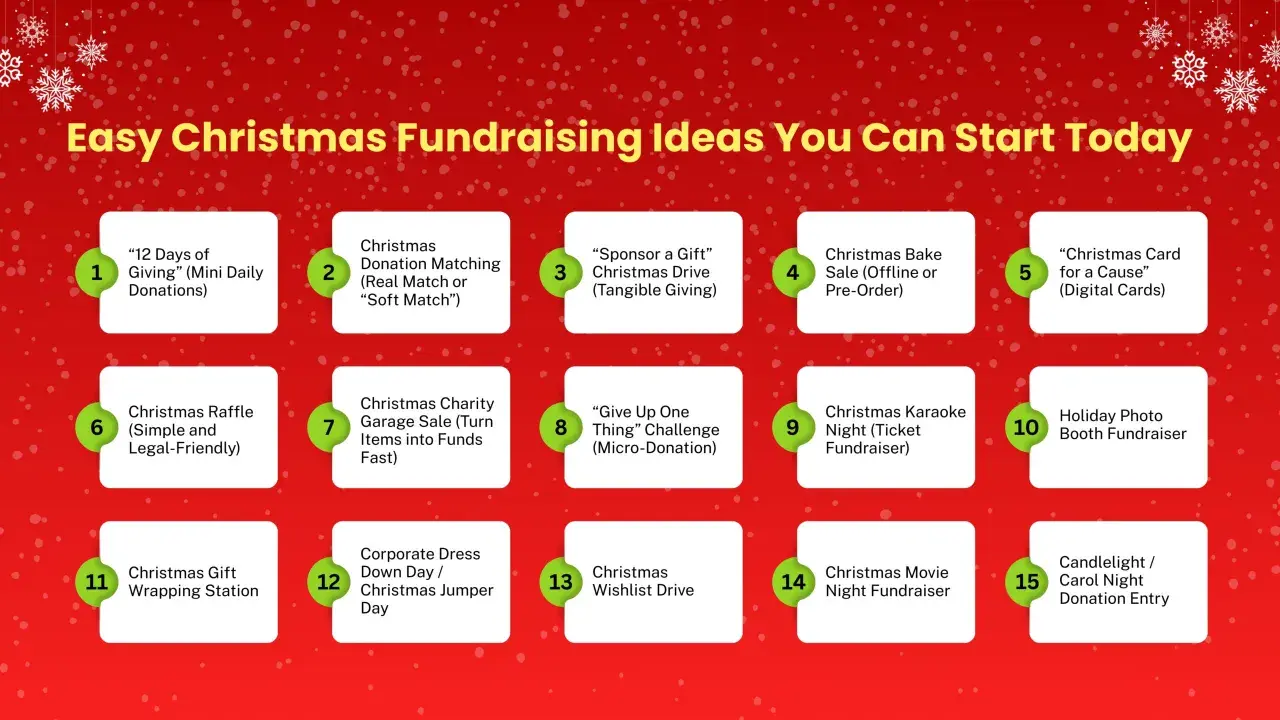
Holiday fundraising works best when it feels seasonal without becoming complicated. The strongest events and auctions give people a simple way to give, a clear reason to act now, and a visible community benefit. In this guide, I break down practical holiday charity ideas, show which formats fit different budgets, and explain how to choose items and promotions that actually move donations.
The simplest holiday fundraisers are the ones people can understand in seconds
- Seasonal giving is strongest when the ask is clear, the experience feels warm, and the impact is easy to picture.
- Small in-person events can work well, but online bidding often reaches more donors with less overhead.
- Experience-based auction items usually outperform generic baskets because they feel more exclusive and memorable.
- A realistic timeline is 6 to 8 weeks for a live event and about 3 to 4 weeks for a lean online auction.
- In the United States, year-end urgency is helped by Giving Tuesday, holiday generosity, and the December 31 tax deadline.
Why the holiday season changes how people give
The holiday period creates a rare mix of generosity, nostalgia, and deadline-driven action. People are already thinking about family traditions, gift giving, and year-end tax planning, so a charitable campaign does not have to work as hard to explain why giving matters. It still has to be specific, though. Vague appeals get ignored; a fundraiser with a clear purpose, a visible event, or a tangible item gives people something concrete to support.
I also see that holiday campaigns work best when they lower the effort required from the donor. That usually means one of three things: they can buy a ticket, place a bid, or donate in a way that feels like part of the season rather than an extra obligation. The format matters almost as much as the cause, which is why the next step is choosing ideas that feel natural for winter audiences.

Event ideas that feel seasonal without becoming expensive
If I were planning a holiday event from scratch, I would start with ideas that are easy to explain, easy to staff, and easy for families to attend. The goal is not to create a massive gala unless you already have the audience and budget for it. Smaller seasonal events often do better because they feel local and welcoming.
| Event format | Typical budget | Why it works | Watchouts |
|---|---|---|---|
| Gift-wrapping station | $50 to $300 | Useful, fast to understand, and easy to place in a mall, market, or church lobby | Needs steady foot traffic and a reliable volunteer shift plan |
| Hot cocoa and carols night | $100 to $500 | Family-friendly and simple to sponsor with local cafes or bakeries | Weather and venue access matter more than people expect |
| Wreath or ornament workshop | $150 to $750 | Guests leave with something they made, which makes the donation feel personal | Materials can become costly if the class size grows too quickly |
| Holiday movie night | $250 to $1,500 | Predictable, sponsor-friendly, and attractive to families and school groups | Licensing, seating, and sound quality must be sorted early |
| Community dinner or soup night | $300 to $2,500 | Creates a strong sense of belonging and works well for mission-driven organizations | Food service takes coordination, especially if dietary needs are important |
What makes these formats useful is not novelty. It is fit. A small nonprofit may get more return from a simple winter workshop than from a large banquet that consumes half the budget. A school or faith community may do better with a gift-wrapping table or cocoa stand because supporters already gather there. The right event is the one your team can actually deliver without burnout, which leads naturally to the auction side of the equation.
Auction items and experiences people will actually bid on
Holiday auctions work when the items feel scarce, useful, or emotionally rewarding. Generic donated baskets can still help, but they rarely create the same momentum as an experience or a package people cannot easily buy for themselves. I usually look for items that solve one of three donor desires: convenience, celebration, or exclusivity.
| Auction item type | Why bidders respond | Best sources |
|---|---|---|
| Weekend getaway or vacation package | Feels aspirational and easy to understand at a glance | Hotels, airlines, rental hosts, travel partners |
| Local dining and shopping bundle | Useful as a holiday gift and relevant to everyday life | Restaurants, boutiques, bookstores, florists |
| Hosted experience | Creates a memory, not just an object | Chefs, artists, coaches, board members, community leaders |
| Professional services package | Has practical value and can feel premium when bundled well | Photographers, organizers, trainers, accountants, beauty services |
| Seasonal comfort basket | Easy to theme for gifting and immediate use | Multiple small donors or one sponsor with a strong product mix |
For holiday bidding, presentation matters more than many organizers expect. A package with a great story, strong photos, and a clear retail value usually outperforms a more expensive item that is poorly described. I would also keep the auction mix tight. Three to five strong categories are often better than a long, cluttered list that makes donors scroll past the good stuff.
How to choose between an event, an auction, or both
The right format depends on your audience, your volunteer base, and how much risk you can absorb. I like to think about it in terms of reach and lift. Events create atmosphere and can deepen relationships. Auctions create flexible revenue and can scale beyond one room. A hybrid approach can do both, but only if you have the capacity to manage it cleanly.
| Decision factor | Best fit | Why |
|---|---|---|
| Small local supporter base | Event | People are more likely to show up in person than bid from afar |
| Geographically spread donors | Online auction | Distance matters less when bidding happens on a phone |
| Low volunteer capacity | Online auction | Less staffing is needed than for a live dinner or workshop |
| Strong corporate or business partners | Auction | Partners can donate services, experiences, and bundled value |
| Need for community visibility | Event | A live gathering makes the mission easier to see and talk about |
| Want both engagement and revenue | Hybrid | A kickoff event can introduce an online auction that stays open for several days |
My rule is simple: if your team has to choose, pick the format you can execute with confidence, not the one that sounds most impressive. A smaller campaign that runs smoothly usually earns more trust than an ambitious one with weak follow-through. Once the format is clear, the next job is to give yourself enough runway to promote it well.
A realistic timeline for a holiday campaign
Holiday fundraising gets easier when you stop treating planning as an afterthought. A live event usually needs 6 to 8 weeks of lead time. A lean online auction can sometimes be assembled in 3 to 4 weeks, but only if you already have a donor list, a payment process, and a few likely item donors ready to go.
- 6 to 8 weeks out - Choose the format, lock the date, check venue or platform requirements, and start donor outreach for sponsors or auction items.
- 4 weeks out - Publish the campaign, open registration or bidding, and preview 5 to 10 headline items with strong photos and short descriptions.
- 2 weeks out - Send reminders, confirm volunteers, and add one clear deadline or matching challenge to create urgency.
- Final 72 hours - Push last-call messaging, highlight top items, and make the checkout process as short as possible.
If you are using an online auction, keep the mobile experience simple. Donors should be able to register, bid, and pay without hunting through multiple screens. If you are hosting an event, reduce friction at the door. A slow check-in line is a surprisingly effective way to drain energy from an otherwise good evening. Once the logistics are in place, the final test is whether the campaign avoids the mistakes that quietly suppress revenue.
Common mistakes that quietly cut into revenue
The biggest holiday fundraising failures are usually not dramatic. They are small friction points that stack up. I see the same problems again and again: too many items, unclear messaging, underpowered promotion, and no plan for payment or pickup. None of these looks fatal on its own, but together they make a campaign feel less urgent and less trustworthy.
- Too many choices - A crowded auction spreads attention thin and makes the best items easier to miss.
- Weak descriptions - Donors need to know what makes an item special, who donated it, and what restrictions apply.
- Poor visuals - Holiday bidding is emotional; clear photos and good lighting matter more than people think.
- No mobile checkout - If payment feels awkward, the bidder delay becomes a lost donation.
- Unclear fundraising purpose - People give more confidently when they know exactly what their money supports.
- Ignoring local rules - As BetterWorld notes, raffle and auction requirements can vary by state, so I always check the legal side before launch.
There is also a softer mistake: trying to make the fundraiser feel like everything to everyone. Seasonal campaigns work best when they have one emotional center. Maybe it is winter warmth for families, meals for neighbors, or holiday support for children. If the message stays focused, the event or auction feels more human and less like a generic donation ask. That is the difference between a campaign people notice and one they scroll past.
What I would start with if I were building this from zero
If I had to choose one path fast, I would build a simple online auction around a small number of high-value experiences, then add one low-pressure seasonal event to create momentum. That combination gives you both reach and atmosphere without forcing the team into a full-scale gala. It also fits the way many supporters behave during the holidays: they like to browse, compare, and act quickly when the offer feels worthwhile.
Among holiday charity ideas, I would still favor the ones that are easy to repeat next year. A good winter campaign should be memorable, but it should also leave behind a template your team can reuse: one timeline, one donation workflow, one message, and a short list of items that actually performed well. That kind of discipline matters more than novelty, because the strongest seasonal fundraisers are not the flashiest ones. They are the ones that make giving feel simple, timely, and worth doing right now.
If you are starting this season, pick one format, set one deadline, and build around one clear story of impact. That is usually enough to turn a seasonal idea into a fundraiser people remember, support, and come back to next year.
