
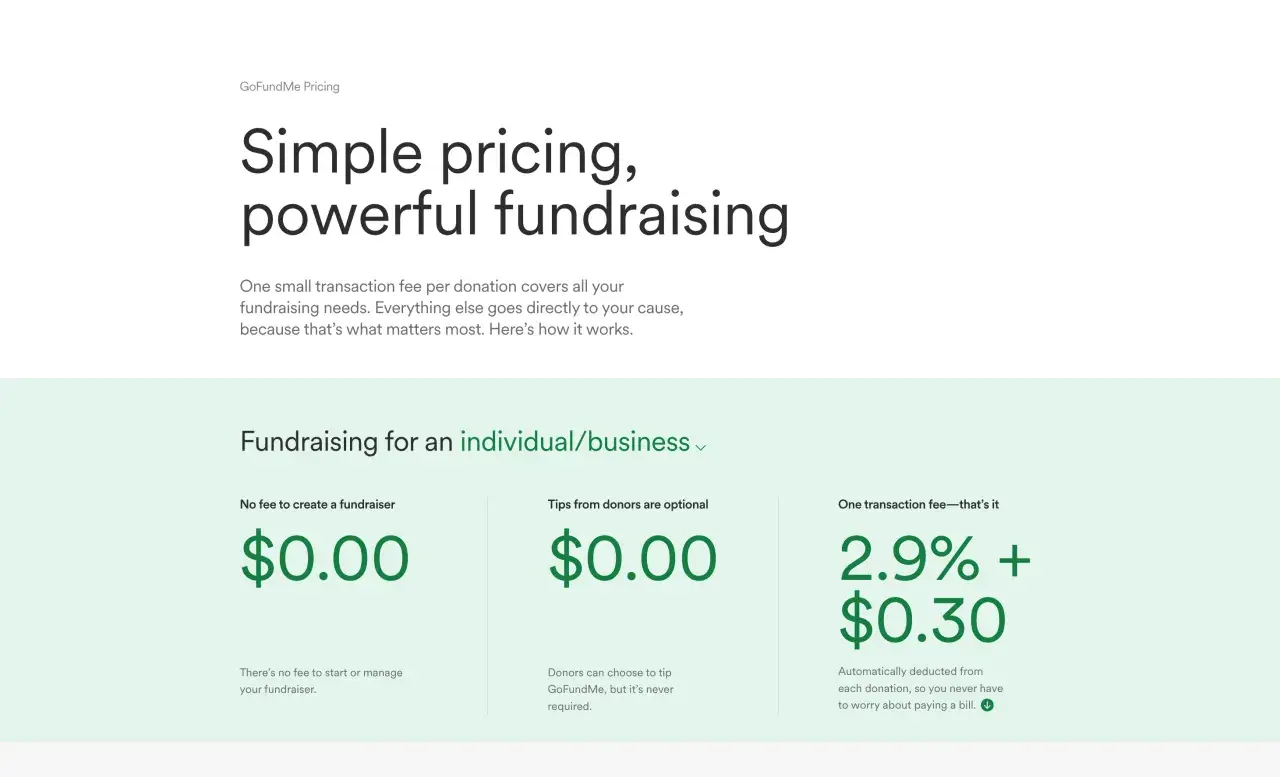
When people ask how much does GoFundMe take, they usually want the net amount they will actually keep. In the United States, the answer depends on the type of fundraiser, because standard personal campaigns and certified charity campaigns are not priced the same. I’ll break down the current rates, show what they look like on real donation sizes, and explain what nonprofits should budget beyond the headline number.
The fee is usually 2.9% plus 30 cents, but certified charities pay less
- Standard US personal and business fundraisers pay 2.9% + $0.30 per donation.
- Certified charities in the US are shown at 2.2% + $0.30 per donation.
- There is no fee to create or manage a fundraiser.
- Any donor contribution to GoFundMe is optional, not required.
- Recurring donations add an extra 5% fee on top of the monthly payment.
What GoFundMe charges in the United States
The published US pricing is straightforward. Standard personal and business fundraisers pay 2.9% + $0.30 per donation, deducted automatically before the money is delivered. Certified charities are shown at a lower US rate of 2.2% + $0.30, and there is no fee to start or manage a fundraiser.
I also think it is important to separate the fee from the optional donor contribution. Donors may be asked to support the platform, but that contribution is not required. For nonprofits, that distinction matters because the fundraising page can look “free” while the actual cost is still coming out of each donation behind the scenes.There is one more wrinkle for nonprofits: GoFundMe Pro pricing and fees differ, so a certified organization should confirm the exact product setup before assuming every campaign follows the same rate. Once you know the base structure, the next step is seeing what those percentages actually do to real donations.

How the fee changes with donation size
Small gifts feel the fixed 30-cent charge more than larger ones. That is why a $10 donation loses a much bigger share to fees than a $100 donation. The math is simple: multiply the gift by the percentage fee and then add $0.30.
| Donation | Standard US fundraiser | Certified charity |
|---|---|---|
| $10 | Fee: about $0.59, net: about $9.41 | Fee: about $0.52, net: about $9.48 |
| $25 | Fee: about $1.03, net: about $23.97 | Fee: about $0.85, net: about $24.15 |
| $50 | Fee: $1.75, net: $48.25 | Fee: $1.40, net: $48.60 |
| $100 | Fee: $3.20, net: $96.80 | Fee: $2.50, net: $97.50 |
| $500 | Fee: $14.80, net: $485.20 | Fee: $11.30, net: $488.70 |
I rounded these figures to the nearest cent, which is usually enough for planning. The point is not that every donation lands on an exact penny; the point is that the fixed fee changes the effective cost much more for small gifts than for larger ones. A campaign built on lots of $10 or $25 donations will feel that difference much faster than a campaign supported by fewer, larger contributions.
Once you see the fee in context, the next question is why those small donations feel so expensive in the first place.
Why small donations feel more expensive
The percentage looks modest, but the flat 30-cent charge changes the effective rate. On a $10 donation, the standard US fee is $0.59, which is close to 5.9% of the gift. On $25, it drops to roughly 4.1%. By the time you get to $100, the effective fee is much closer to the published percentage.
That matters in community fundraising, where many campaigns depend on a wide base of small donors. If a local mutual aid drive, school campaign, or neighborhood emergency appeal is expecting a lot of $10 to $20 gifts, the fixed fee becomes a real budget line. I would not treat that as a reason to avoid GoFundMe, but I would treat it as a reason to set expectations honestly with organizers and donors.
For nonprofits, this is where platform choice starts to connect with fundraising strategy. If the campaign is about speed and reach, GoFundMe can still be a practical choice. If the campaign depends on repeat giving or careful donor lifecycle management, the fee math is only one piece of the decision.
How I would set a fundraising goal after fees
The Help Center recommends setting the goal a little higher than the amount you actually need, and that advice is sound. I would estimate the average donation size first, then add the transaction fee on top of the total you want to keep. That prevents a campaign from hitting its public goal while still falling short of the real amount required.
Here is the simplest way to think about it:
- For a standard US fundraiser, estimate 2.9% of the total raised plus $0.30 per donation.
- For a certified charity, estimate 2.2% of the total raised plus $0.30 per donation.
- If your campaign will get many small gifts, add a little extra buffer because the flat fee matters more.
- If your campaign will rely on a few larger gifts, the effective fee will be closer to the percentage alone.
For example, if a campaign needs to net $5,000 and you expect 100 donations of $50, a standard US fundraiser would lose about $175 in fees. In that case, setting the target closer to $5,175 is more realistic than posting a round $5,000 goal and hoping the fee disappears. That kind of adjustment is small, but it can be the difference between a campaign that only looks funded and one that actually covers the need.
Once the goal is set correctly, the remaining question is whether any other features will raise the cost.
When recurring gifts and payment methods change the math
Recurring donations are useful for nonprofits because they smooth out cash flow, but they do cost more. Recurring donations add an additional 5% fee on top of the usual monthly processing cost. In other words, monthly gifts are not priced the same as one-time donations, and I would avoid treating them as interchangeable when building a budget.
Payment method can matter too. International transaction and conversion fees may apply based on the payment method, and the platform’s fee structure also covers debit, credit, and ACH processing. For a US community campaign, that usually does not change the headline answer very much, but for cross-border giving or mixed donor bases, it is enough to create real variation in net receipts.
The practical takeaway is simple: if a fundraiser is meant to support a specific service, program, or emergency need, the organization should know whether it is accepting one-time gifts, monthly gifts, or donations from outside the US. Those choices can alter the net amount more than people expect, which is why the fee conversation should happen before the campaign goes live, not after the first payout.
Where GoFundMe fits in a nonprofit software stack
For community impact work, I see GoFundMe as a strong front door, not always the full house. It is good at fast public campaigns, emotional storytelling, and friction-light donations. That makes it useful for urgent appeals, grassroots drives, and causes that need visibility more than complexity.
What it does not automatically solve is the broader nonprofit operations layer. If an organization needs deeper donor records, segmentation, recurring-gift stewardship, tax receipting workflows, or tighter reporting, a dedicated nonprofit platform usually earns its keep even if the subscription cost is higher. That is the real tradeoff in nonprofit software: a lower transaction fee does not always mean a lower total cost of fundraising.
For certified nonprofits, the lower published rate is helpful, but I would still compare it against the organization’s actual workflow. If staff spend hours patching together receipts, exports, and follow-up messages, the cheapest fee on paper may not be the cheapest system to run.
GoFundMe can be the right tool, but only when the campaign goal is speed, trust, and reach. When the goal is long-term donor cultivation, the platform choice needs to serve the whole fundraising operation, not just the first donation.
What I would budget for a US campaign on GoFundMe
If I were planning a campaign today, I would budget around the average donation size rather than the public headline total. A campaign built on $10 and $20 gifts needs a little more breathing room than one built on $100 gifts, because the fixed fee eats more of each small donation. A certified charity campaign has a better fee rate, but I would still leave a buffer for rounding, recurring gifts, and any payment-method variation.
For a quick rule of thumb, I would use this framework: standard personal or business fundraiser, 2.9% + $0.30; certified charity, 2.2% + $0.30; recurring monthly gift, add 5% more. That gives you a realistic number to work from without pretending every donation behaves the same way. If the campaign is mission-critical, I would also test the math on a few likely donation sizes before publishing the goal.
That is the safest way to answer the fee question in practice: not just what percentage GoFundMe takes, but what this specific campaign will actually keep after the fees are removed.