
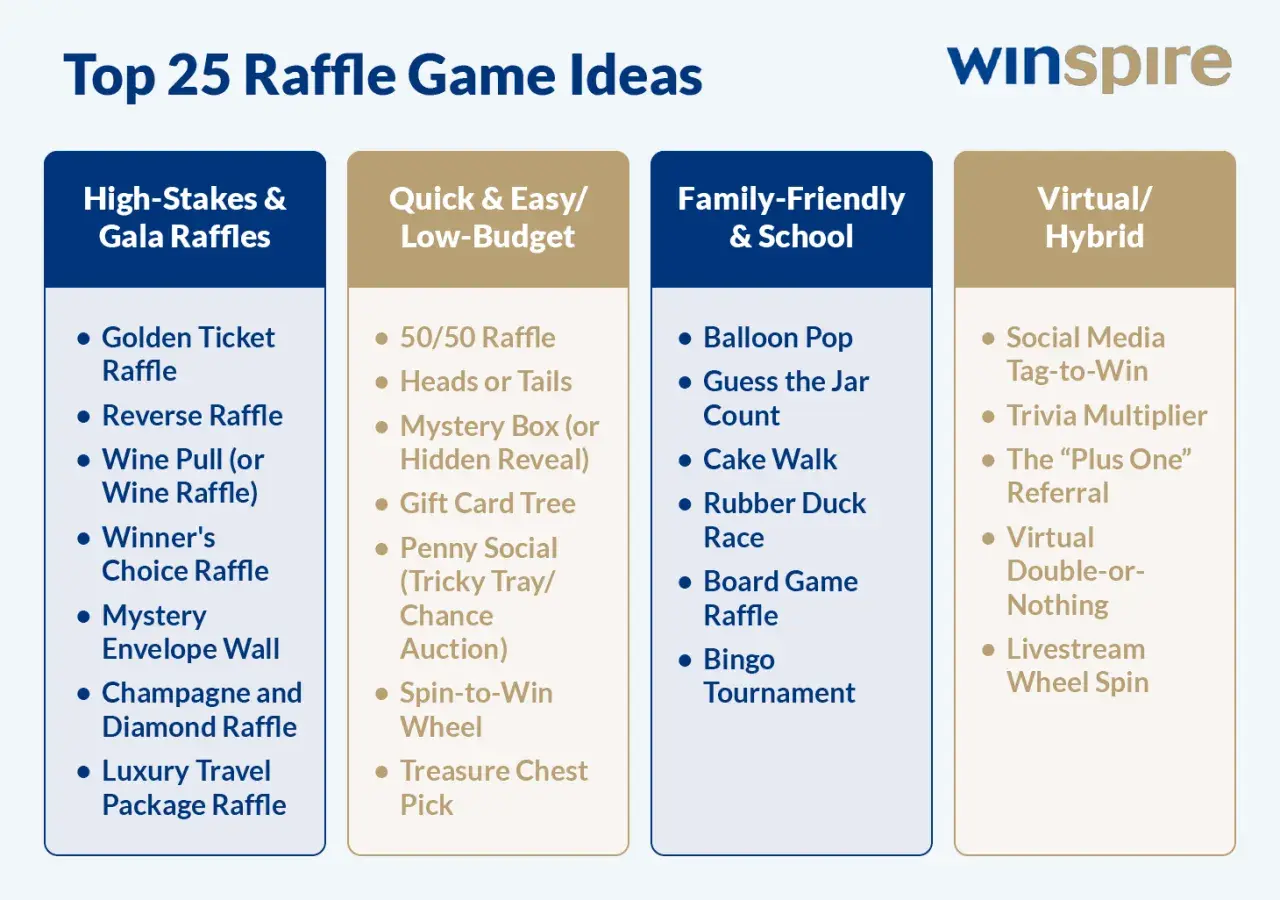
The essentials before you sell a single ticket
- Check your state rules first. Some states require registration, waiting periods, or special eligibility for nonprofits.
- Choose the simplest format that fits your audience. In-person, online, hybrid, and 50/50 raffles all work differently.
- Price tickets from the budget backward. Make sure the prize, fees, printing, and payment costs still leave room for fundraising.
- Put the rules in writing. Clear ticket terms reduce confusion when the drawing happens.
- Use a documented random draw. Fairness matters as much as revenue.
- Plan for tax reporting. Larger prizes can trigger IRS forms and withholding rules.
Start with the rules that apply to your organization
I always start here because it saves time, money, and awkward cleanup later. A raffle is not just a fun fundraiser; in many states it is a regulated charitable gaming activity, which means eligibility, registration, and reporting can matter as much as the prize itself. If your organization is not clearly allowed to run a raffle where you operate, nothing else really matters yet.
For a U.S. audience, the first question is usually whether the raffle is limited to certain nonprofit categories, whether you need a permit or registration, and whether there is a lead time before ticket sales begin. In California, for example, nonprofits generally need to register before conducting raffle activity, and the registration calendar runs annually. Washington requires the organization to have been organized and operating for at least 12 months before offering a raffle. In Texas, qualified organizations can hold only a limited number of raffles per calendar year.
| State example | Rule that changes the plan | Why it matters |
|---|---|---|
| California | Registration is required before raffle activity, and timing matters. | You may need weeks of lead time before you can sell a single ticket. |
| Washington | The organization must be active for at least 12 months. | Newer groups may need another fundraising format first. |
| Texas | Qualified organizations are limited to a set number of raffles per year. | Frequency limits affect how often you can use the model. |
My rule of thumb is simple: never print tickets before you know the rule set. If the law is unclear, I would treat that as a stop sign and confirm it with the state regulator or a local attorney. Once the legal frame is clear, you can decide what kind of raffle will actually fit your event.
Choose the raffle format that fits your event
The best raffle format depends on how people will participate, how many supporters you can reach, and whether the event is tied to a gala, auction, school night, or community celebration. I usually compare the options before I commit, because the wrong format can make a simple fundraiser feel clumsy fast.
| Format | Best for | Watch-outs |
|---|---|---|
| In-person raffle | Galas, festivals, auctions, school events | Reach is limited to the people in the room |
| Online raffle | Distributed audiences, alumni, donor lists, remote supporters | State and platform rules can be more complicated |
| Hybrid raffle | Events that want both local energy and broader sales | More moving parts, especially for tracking entries |
| 50/50 raffle | Events that want a very easy-to-explain cash prize | May be restricted or handled differently by state law |
When I am choosing prizes, I prefer items people can picture using immediately: a restaurant package, sports tickets, a family membership, a donated weekend stay, or a service bundle from a local business. That is often more effective than a generic expensive item, because the prize feels useful and the donor can understand its value at a glance. If your raffle is tied to social good, the prize should support the same tone as the mission, not fight it.
If your event already includes a silent auction, I would keep the raffle simple and fast. The raffle should act like an easy entry point, not compete with the auction for attention. Once the format and prize style are set, the next step is to make the math work.
Price tickets and build a budget that leaves room for the cause
The cleanest way to price a raffle is to work backward from the net goal. I start with the money the organization actually wants to keep, then subtract the prize cost, payment processing, printing, permit fees, shipping, and any platform or staff costs. If the ticket price does not leave a healthy margin, the raffle is doing a lot of work for very little return.
Net fundraising = ticket revenue - prize cost - fees - printing - fulfillment - promotion
| Sample scenario | Calculation | Result |
|---|---|---|
| Low-cost community raffle | 300 tickets x $10 = $3,000 gross; donated prize; $180 in fees and printing | $2,820 net |
| Moderate fundraiser | 500 tickets x $5 = $2,500 gross; $900 prize cost; $200 in fees and materials | $1,400 net |
| Event-night add-on | 150 bundles x $20 = $3,000 gross; donated prize; $250 in processing and materials | $2,750 net |
For broad participation, I usually lean toward a lower ticket price, often in the $5 to $10 range. If the raffle is attached to a premium event or a higher-value prize, a higher price can work, but only if the audience understands why it is worth paying. Bundle pricing can help too, such as three tickets for a small discount, as long as your rules and local requirements allow it.
The mistake I see most often is pricing the ticket around the prize alone. That is too narrow. The better question is whether the ticket price feels easy to buy, yet still supports the mission after every expense is paid. Once that number is set, the logistics need to be just as disciplined.
Build the ticketing and recordkeeping before sales start
Good raffle operations look boring in the best possible way. Tickets should be easy to read, easy to track, and easy to match back to the buyer. If a winner is disputed later, your paperwork should settle the issue in minutes, not create a small crisis.
At a minimum, I would make sure each ticket or ticket stub includes:
- The organization name and a contact point
- A unique ticket number
- The ticket price
- The drawing date, time, and location
- A short description of the prize or prizes
- The claim deadline and how the winner will be notified
- Any age, residency, or eligibility restrictions
For the sales log, I prefer a simple spreadsheet with buyer name, email or phone, ticket numbers, payment method, date sold, and whether the stub was delivered physically or digitally. If you sell online, export the data regularly and save a backup. If you sell in person, keep the stubs in a single secure container and reconcile them before the drawing. That sounds basic, but it prevents the most common raffle problem: entries that cannot be traced cleanly after the fact.
I also recommend writing a short rules sheet, even for a small fundraiser. It should state whether one person can win more than one prize, what happens if the winner cannot be reached, whether entries are transferable, and whether staff or volunteers are eligible. Clear rules remove guesswork, and that makes the whole event feel more trustworthy. Once the paperwork is in place, the real work becomes getting people to buy in.
Promote the raffle like a campaign, not a last-minute ask
The raffle sells best when people understand three things immediately: what the money supports, what they can win, and when the drawing happens. That is the core message, and I try not to bury it under too much copy or too many graphics. A raffle is still a transaction, so clarity matters more than cleverness.
I like a simple promotion structure:
- Launch: announce the cause, the prize, the ticket price, and the deadline.
- Mid-campaign: remind supporters what the funds will do and show the prize again.
- Final push: create urgency with a clear countdown and a firm end time.
A 2- to 3-week promotion window is often enough for a small community raffle, while a larger event may need 6 to 8 weeks. If your audience is already connected to the mission, board members, volunteers, alumni, or past donors can become the main sales channel. If not, partner promotion and local business support matter more. In either case, the message should stay simple: support the cause, buy a ticket, know the deadline.
For event nights, I like printed signage near check-in, one announcement before the main program, and one final reminder before the drawing. The aim is not to nag people. It is to keep the raffle visible without making the room feel crowded by sales. Once the tickets are moving, the last thing you need is confusion at the drawing itself.
Run the drawing so nobody questions the result
Fairness is the whole point of the drawing, so I want the process to be visible, random, and repeatable. If the audience can see how the winner was chosen, you eliminate a lot of doubt. If the raffle is online, the system should leave a trail that shows exactly which entry won and when.
My usual approach for an in-person raffle is simple: verify the ticket pool, have a neutral person handle the draw if possible, announce the number loudly, and cross-check it against the sales log before naming the winner. For a digital draw, I want a unique entry ID, an exportable record, and a documented randomization method. In either case, I define the claim window in advance, such as 7 or 14 days, so nobody has to improvise later.
It also helps to decide in advance what happens if the winner is absent or unreachable. I would not wait until that moment to invent a rule. If the rules say the winner must be present, say so clearly. If a redraw is allowed, spell out the redraw process. And if there are multiple prizes, make sure everyone understands whether one ticket can win more than once. Small decisions like that are where a raffle becomes either smooth or messy.
After the draw, I like to close the loop quickly with a public announcement, a direct message or phone call, and a short thank-you to everyone who participated. The energy of the event matters, but the follow-through matters more. That follow-through is also where tax reporting enters the picture.
Close the loop on taxes, reports, and donor trust
According to the IRS, raffle winnings are taxable gambling income for the winner, including the fair market value of non-cash prizes such as cars or trips. For reportable winnings, the general threshold is $600 or more and at least 300 times the amount wagered, which is why larger prizes need extra care before you promise them publicly. When reporting is triggered, the winner copy of Form W-2G is generally due by January 31, and the IRS filing is due by March 1 or March 31 if filed electronically.
There is also a withholding angle to think about. If the prize value crosses the relevant threshold, federal income tax withholding may apply, and the rules depend on the type of gaming and the size of the payout. That is one reason I always check the prize structure before I announce something flashy like a vehicle, travel package, or cash equivalent. A big prize can create a bigger tax job than a small nonprofit team expects.
For your own records, I would keep copies of the ticket design, sales log, winner documentation, expense receipts, and tax forms for at least three years. That mirrors common state recordkeeping expectations and makes the next audit, board review, or planning cycle much easier. It also gives you a clean internal history if the same event becomes an annual fundraiser.
The hidden benefit of a well-run raffle is trust. When donors see a fair draw, a clear purpose, and a professional closeout, they are much more likely to participate again. That is the part most people forget: the raffle is not just a one-night fundraiser, it is a test of how seriously your organization handles the details.
Build the raffle around trust, not just chance
The most effective raffles are rarely the most complicated ones. They are the ones with a clear purpose, a prize people actually want, rules that are easy to understand, and a draw no one has to second-guess. If you keep those four things aligned, the event feels organized rather than improvised.
My practical advice is to treat the raffle as part of the larger mission, especially when it supports community programs, schools, shelters, or other social good work. The prize gets attention, but the cause earns the purchase. When those two are balanced well, the raffle becomes more than a game of chance; it becomes a clean, repeatable way to fund something that matters.
