
Key takeaways for a fundraiser that actually raises money
- Start with the audience, not the item list; the best bids come from relevance, not volume.
- For a group of about 100 guests, 25 to 35 well-chosen items is usually enough to create competition without clutter.
- Opening bids around 30 to 50 percent of fair market value keep the auction active without pricing out bidders.
- Hybrid and mobile bidding can expand reach, but they only work when item photos, instructions, and checkout are clean.
- Winning bids are generally purchases, not donations, so receipts and fair-market-value language matter.
What makes a silent auction worth doing for a mission-driven event
I like silent auctions when an organization wants more than a one-night cash grab. They give people time to browse, compare, and imagine themselves using the item, which creates a very different kind of energy from a straight donation ask. That slower pace is useful because it keeps guests engaged while the room is still social and relaxed.
There is also a real community effect. A strong auction gives donors something tangible to respond to, but it also creates repeated touchpoints with the cause: item descriptions, signage, sponsor mentions, checkout conversations, and follow-up thank-yous. That matters for nonprofits because the event is not only about revenue; it is also about turning casual supporters into people who feel connected to the work.
I would not treat it as a universal solution, though. If the audience is too small, too disconnected from the mission, or too difficult to reach in person or online, the format can become labor-heavy without producing much lift. Once the purpose is clear, the next decision is format, because that choice shapes everything else.
Choosing the format that fits your audience
In 2026, I would think of mobile bidding as the baseline rather than the upgrade. Even when the event is in person, people expect speed, clear instructions, and a low-friction checkout process. The real question is not whether to use technology, but how much complexity your team can support without losing control of the event.
| Format | Best for | Strengths | Watch-outs |
|---|---|---|---|
| In person | Local audiences, galas, school events, and groups that value face-to-face energy | High engagement, easy item browsing, strong room energy, easier sponsor visibility | Needs space, signage, volunteers, and a clean physical setup |
| Online | Remote supporters, longer fundraising windows, and organizations that want broader reach | Less venue pressure, more flexible timing, easier to share items widely | Depends on strong photos, descriptions, and disciplined follow-up |
| Hybrid | Nonprofits that want both live-event energy and remote participation | Largest potential audience, more bidder access, flexible participation | Most moving parts, more staffing, more room for technical mistakes |
My rule is simple: choose hybrid only if you can support it cleanly. A messy hybrid event usually performs worse than a well-run in-person auction because friction kills bidding faster than a small audience does. Once the format is set, the real fundraising power comes from the items themselves.

The item mix that actually earns bids
I usually think of the auction as a ladder. At the bottom are easy, low-friction items that get people started. In the middle are practical items and themed bundles that keep the bidding moving. At the top are headline pieces that create excitement and pull attention across the room or the screen.
| Item type | Why it works | Best use case |
|---|---|---|
| Gift cards | Easy to source, easy to use, and familiar to almost everyone | Entry-level bids and broad-appeal inventory |
| Experiences | They feel memorable and often carry more emotional value than a physical item | Higher bids, premium packages, and donor attention |
| Memberships | Useful, local, and attractive to families and repeat visitors | Mid-range auction spots that need steady bidding |
| Themed baskets | They bundle small donations into something that looks bigger and more complete | Community-driven events and family-friendly fundraisers |
| Signed memorabilia | Scarcity and collector appeal can drive strong competition | Headline lots and high-visibility tables |
| Local goods | They reinforce community identity and help small businesses participate | Events with strong neighborhood or regional support |
For a guest list of about 100 people, I would usually aim for roughly 25 to 35 items. That is enough variety to create competition without making the auction feel crowded or exhausting. More items are not automatically better; too many weak items can dilute attention and make the strongest pieces harder to notice.
I also prefer to source with intention. Ask board members first, then approach local businesses with a specific request instead of a vague appeal, and then fill gaps with donations that match the audience’s real interests. A basket full of random leftovers looks like filler. A basket built around a clear theme, on the other hand, looks like something worth bidding on.
There are also items I would avoid. Anything that spoils quickly, arrives in poor condition, or clashes with the organization’s values is usually not worth the table space. The auction should reflect the cause, not just absorb anything that was handed over.
Once the right mix is on the table, the next job is pricing it so people feel invited to play, not intimidated into walking away.
How I price items so bidding starts without getting stuck
The most common mistake I see is pricing items as if the goal were to recover every dollar immediately. That instinct sounds safe, but it usually suppresses early bids. I prefer to think in terms of momentum: the opening bid should feel achievable, the increments should feel reasonable, and the item should still have room to climb.
| Item tier | Typical opening bid | Bid increment | Why it works |
|---|---|---|---|
| Smaller baskets and low-cost items | 30 to 40 percent of fair market value | $5 or about 10 percent of the opening bid | Keeps casual bidders involved without making the item feel overpriced |
| Mid-range gift cards and memberships | 35 to 45 percent of fair market value | $10 or about 10 percent of the opening bid | Creates movement while preserving margin |
| Premium experiences and signature items | 40 to 50 percent of fair market value | $25 or 5 to 10 percent of the opening bid | Supports higher-value bidding without stalling the room |
Fair market value matters here because it gives everyone a common reference point. If an item has a clean retail price, use it. If it does not, compare similar sales and stay conservative. I would rather see a strong opening pace than a perfect spreadsheet that nobody wants to touch.
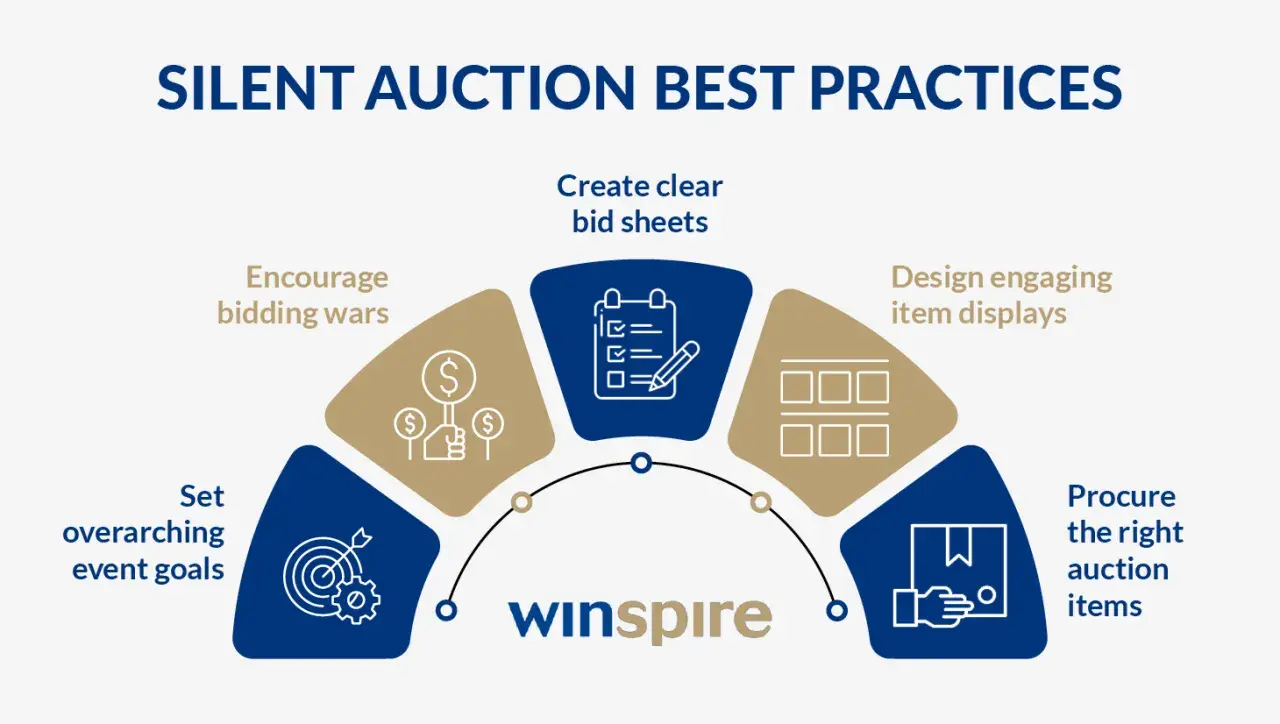
Presentation matters almost as much as price. Arrange tables with breathing room, keep items visible from a distance, and use clear signage that explains what the package includes, what the starting bid is, and how to participate. Color coding or simple numbering helps too, especially when the auction has many categories. A cluttered display makes people hesitate; a clean display makes them linger.
The bid sheet itself should feel easy to understand at a glance. If guests have to decode the process, they will delay, and delay kills momentum. Once bidding is simple, promotion becomes the next lever worth pushing.
Promotion that begins before the first bid
The best auctions do not start on event night. They start when people first see a few attractive items and realize the event is worth their attention. That is why I like to build promotion around item previews, not generic event language. People respond to specific opportunities more than to vague excitement.
Use a simple rollout. Open registration early if you can, publish an online catalog with photos and descriptions, and then keep teasing the strongest items as the event gets closer. The catalog does two jobs at once: it helps people decide whether to attend, and it gives them a reason to share the event with someone else.
| Timing | What to do | Why it matters |
|---|---|---|
| 6 to 8 weeks out | Finalize the item list, open registration, and publish the first catalog draft | Gives the auction time to build interest instead of rushing at the end |
| 2 to 4 weeks out | Send email teasers, ask board members to share, and highlight a few headline items | Turns passive supporters into active bidders |
| 72 hours out | Share reminders, short item spotlights, and final instructions | Converts interest into attendance and actual bids |
| Day of event | Use QR codes, text reminders, and on-site prompts | Reduces friction at the exact moment people are ready to act |
I also like to remind teams not to hide the auction behind the gala. If the auction is part of a larger event, it still deserves its own identity. Guests should know where to look, how to bid, and what makes the items worth their time. Once promotion is doing its job, the final guardrail is making sure the money you raise is not lost in poor checkout or sloppy tax handling.
The checkout and tax details that protect your margin
This is the part that is easiest to neglect and most expensive to get wrong. In the U.S., auction purchases are generally treated as purchases, not donations. If someone pays more than an item’s fair market value and that value was disclosed clearly, the excess may be deductible. If they simply win the item at or below fair market value, there is usually no charitable deduction tied to the purchase itself.
That means your documentation has to be clean. I would keep item descriptions accurate, note fair market value where appropriate, and give purchasers receipts that distinguish between the amount paid for the item and any separate donation. If a donor contributed appreciated property, the deduction rules can be different, so it is not something I would casually improvise from memory.
Operationally, checkout should be fast and orderly. The smoother the handoff, the less time guests spend waiting and the more likely they are to leave feeling good about the experience. I usually think one dedicated checkout volunteer is worth more than another decorative sign. Guests remember friction; they also remember ease.
This is also where a reliable record-keeping habit pays off. Keep bidder data, final sale amounts, unsold items, and any special notes in one place. That information will be useful long after the event ends, because the strongest auctions are the ones that learn from themselves.
What I would carry into the next auction
After the event, I would not start with the décor or the menu. I would start with the numbers. Which items drew attention but stalled? Which ones sold quickly? Which categories produced the highest final bids relative to value? Those patterns tell you more than a room full of compliments ever will.
I would also thank donors quickly, ideally within 48 hours, while the event is still fresh in their minds. Then I would ask a short follow-up question or two to the team: what created the most energy, what caused the most confusion, and what would we stop doing next time? That is how an auction stops being a one-off event and starts becoming a repeatable fundraising asset.
The strongest auctions are rarely the flashiest ones. They are the ones that fit the audience, keep bidding simple, and connect each item back to the cause in a way that feels specific and human. When that happens, the event does more than raise money; it gives supporters a concrete way to participate in the mission, and that is what makes the effort worth repeating.
