
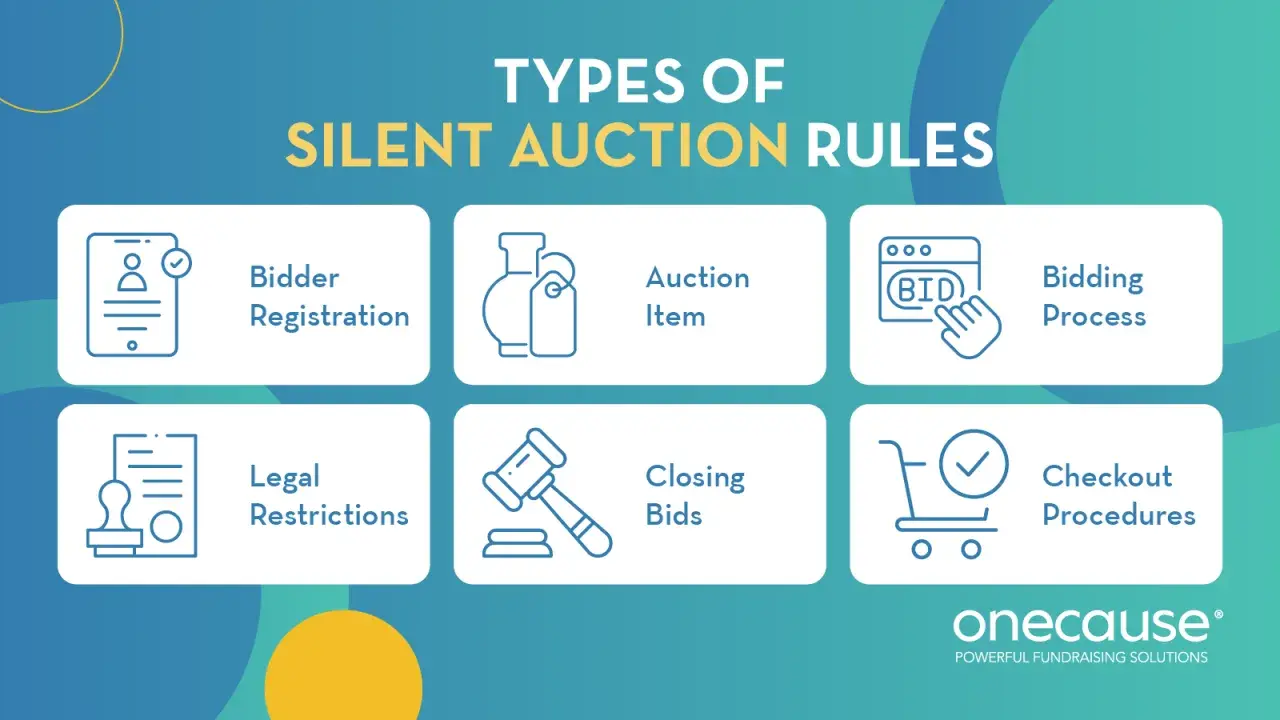
The essentials to lock down before bids open
- State who may bid, how bids are written or submitted, and exactly when bidding closes.
- Publish minimum increments, tie-break rules, payment deadlines, and pickup instructions in plain English.
- For U.S. charity events, treat tax disclosure and donor recordkeeping as part of the setup.
- Use one person or one system as the final authority so volunteers do not improvise under pressure.
- Keep the policy short enough that a guest can understand it in under a minute.
What the rules are really protecting
Most auction problems are not dramatic; they are preventable. I think of the policy as a trust document: it tells guests that the process is fair, tells staff what to do when something awkward happens, and gives the organization a record if a bidder later disputes the outcome.
- Fairness so one bidder does not get a hidden advantage over the rest of the room.
- Clarity so guests know whether a bid is final, how a winner is chosen, and what happens at close.
- Compliance so the charity can handle donor acknowledgments, disclosures, and receipts correctly.
- Momentum because a clean process keeps the event moving instead of forcing volunteers to interpret the rules on the fly.
When I see a silent auction go sideways, it is usually because one of those four things was left vague. Once you define them, the rest of the event gets much easier to manage.

The bidding rules guests need to see immediately
I like to put these rules on the bid sheet, the event page, and the check-in table. If a guest has to ask a volunteer for basic instructions, the policy is already too complicated.
| Rule | What I would specify | Why it matters |
|---|---|---|
| Who can bid | Adults only, registered attendees only, or open to all guests | Prevents confusion at the table and at checkout |
| Minimum increment | Set a floor for each price range, such as $1, $5, $10, or $25 | Keeps bidding moving without turning the sheet into a mess |
| Bid format | Paper bid sheet, mobile app, QR code, or sealed max bid | Everyone needs to use the same method |
| Close time | Exact end time, with or without a short extension window | Stops arguments about late entries |
| Tie handling | Earliest timestamp wins, or a second round opens for tied bids | Eliminates ad hoc decisions |
| Payment deadline | Immediate checkout, same-night payment, or next-day invoice | Prevents winners from disappearing after the close |
| Pickup terms | Take-home that night, scheduled pickup, or shipping at bidder expense | Avoids disputes about storage and delivery |
| Format | Best for | Main weakness |
|---|---|---|
| Paper bid sheets | Small, local events with fewer items | Illegible handwriting and missed last-minute bids |
| Mobile or QR bidding | Higher-volume events and remote participation | Setup complexity and device dependence |
| Sealed max bids | Items that attract competitive bidders | Less transparency during the event |
My rule of thumb is simple: use the least complicated system that still lets guests bid confidently. From there, the legal and tax layer becomes the next thing to get right.
The tax and disclosure layer for U.S. charity auctions
Once money changes hands, the event stops being only a fundraiser and becomes a recordkeeping exercise. That matters because the winner, the donor, and the organization all have different responsibilities. A quid pro quo contribution is a payment partly for a benefit received and partly as a donation, and that distinction drives the paperwork.
According to the IRS, a bidder at a charity auction can generally deduct only the amount paid above the item’s fair market value, and the buyer needs a reasonable basis for knowing that value. Fair market value is what a willing buyer would reasonably pay in the open market, not the amount raised in the room. In practice, that is why I like auction catalogs or item listings with a good-faith estimate instead of a vague one-line description.
| Party | What usually applies | Practical action |
|---|---|---|
| Winning bidder | Deduction is usually limited to the amount paid above fair market value | Do not promise a full write-off for the winning bid |
| Charity | Written disclosure is generally required for quid pro quo contributions over $75 | Prepare a standard disclosure statement before the event |
| Donor of an item | Noncash donation records become more demanding as value rises | Collect an intake form, estimated value, and ownership details |
| Higher-value donor gift | Form 8283 can come into play above $500, and items over $5,000 may require additional donee signatures | Have a process for documenting valuable items before bidding starts |
| General donor acknowledgment | Written acknowledgments are typically needed for charitable gifts of $250 or more | Use a template receipt, not a rushed handwritten note |
That is the part many organizers underestimate. If the donor paperwork is messy, the event may still run smoothly on the night, but the follow-up becomes painful later. I also verify state-specific sales tax, charity registration, and any local fundraising rules before printing final materials, because those details vary and are easy to miss when the team is focused on event night.
Once the tax layer is clear, the next job is keeping bidding fair in real time without slowing the room down.
How to keep bidding fair while the room is moving
The fairest auctions are not the ones with the most rules; they are the ones with the fewest surprises. I usually train volunteers to handle the same edge cases the same way every time, because inconsistency creates most of the friction.- Use one authority per item. One staff member or one system should control the final bid record.
- Set an extension policy before the event. If a bid lands in the final minute, decide in advance whether the item gets a 2-minute, 5-minute, or no extension.
- Define tie handling. Earliest timestamp wins, or the item reopens for a short final round. Pick one method and publish it.
- Ban fake bidding. Staff, sellers, and volunteers should not place shill bids to inflate prices. If you do not want the practice in your own event, write it down clearly.
- Make bids final once recorded. Allowing casual withdrawals invites arguments and undermines the sheet.
- Use sensible increments. For smaller items, $1 or $5 steps usually feel natural; for higher-value items, $10 or $25 steps keep the room from stalling.
In my experience, three things create most disputes: unreadable handwriting, a volunteer trying to be helpful in a way nobody approved, and a closing time that was never announced clearly. If you solve those three, the event feels dramatically more professional.
Closing the sale without friction
When the final bid lands, the job is not finished. The close is where the event either feels polished or suddenly becomes awkward, so I treat payment, release, and follow-up as part of the same process.
- State whether payment is due immediately, by the end of the night, or by a specific deadline the next day.
- Release items only after payment is confirmed, especially for high-value donations.
- Explain pickup windows and any storage limit so the venue is not left holding items for weeks.
- Say what happens if a winner does not pay, including whether the item may move to the next bidder.
- List any special handling rules for alcohol, travel packages, gift cards, or shipped items.
- Send receipts and thank-yous fast, because that is where a lot of trust is either built or lost.
I also describe donated items honestly. “As is” does not excuse a misleading listing, and a vague condition note can create more problems than it solves. If an item has a flaw, I write it down before bidding starts.
The one-page policy that keeps the room calm
If I had to compress the whole process into a single page, I would keep only the rules that change behavior: who may bid, how bids are counted, when the auction closes, how ties are resolved, how payment works, and what the tax disclaimer says. That is enough for most community fundraisers, and it is usually enough for guests to feel respected instead of managed.
For a charity or neighborhood event, clarity is not just administrative polish. It is part of the social value of the fundraiser itself, because people give more freely when the process feels fair, transparent, and easy to follow. If you get the policy right, the auction becomes less about policing mistakes and more about helping the cause win cleanly.
