
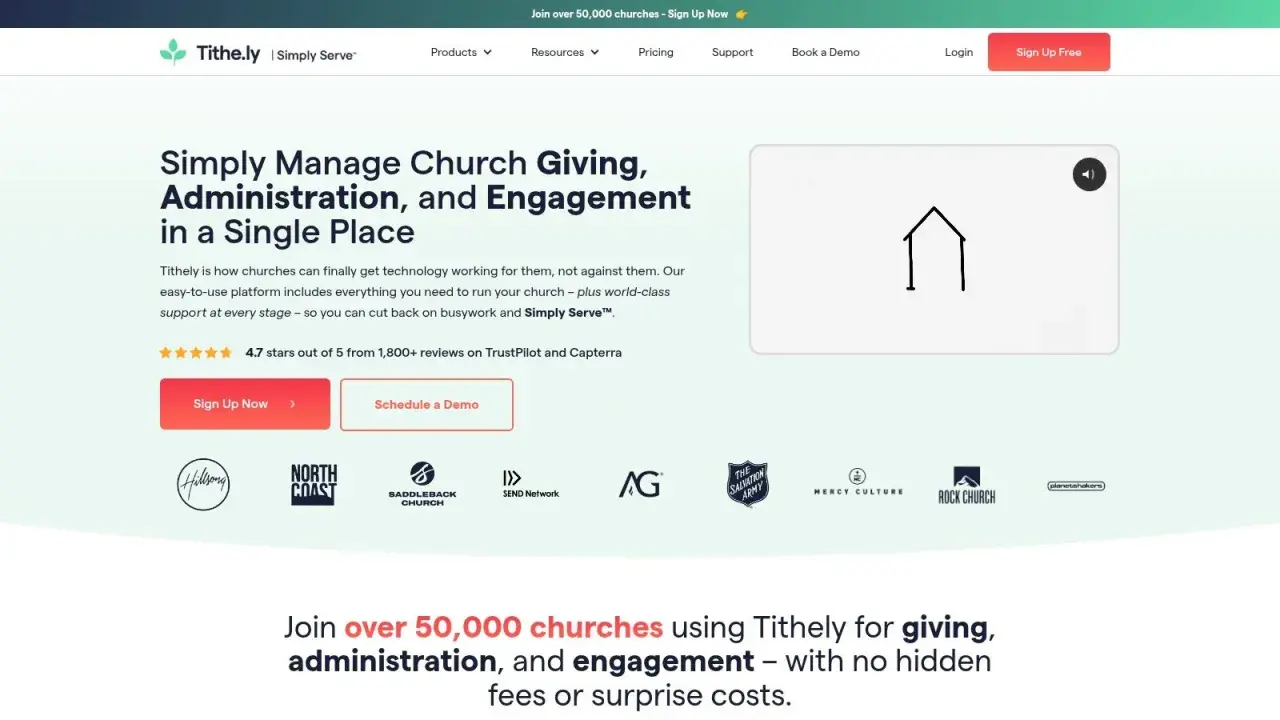
The real story behind tithely fees is simpler than it looks: one part is payment processing, and the other is optional software. For a U.S. nonprofit, that split matters because a free giving tool can still cost money per donation, while a bundled plan can replace separate systems for text giving, donor records, and a website. I focus here on the charges that actually show up on a budget, what donor fee coverage changes, and how to tell whether the pricing fits a small mission-driven team.
The bill breaks into processing costs and optional software subscriptions
- Giving has a $0 setup fee and $0 monthly fee, but each successful gift still carries a transaction charge.
- Standard U.S. card processing is 2.9% + $0.30; American Express is 3.5% + $0.30; ACH is 1% + $0.30.
- Monthly add-ons start at $19 and rise to $72, $89, or $119 depending on the tools you want.
- Fee coverage can keep the nonprofit whole, but it changes what the donor sees on the screen.
- Small gifts feel the flat $0.30 fee more strongly than larger gifts do.

What the current pricing actually includes
On the current pricing page, Tithe.ly Giving starts at $0 to set up and $0 per month, so the core product does not require a subscription just to accept donations. The actual cost comes from per-transaction processing, and the support docs also say there is no separate charge for settlements, deposits and transfers, refund handling, chargebacks, PCI security, recurring giving support, tax receipting, or customer service. That is important for a nonprofit because it keeps the bill tied to real usage instead of hiding admin work in extra line items.
| Item | Current charge in the U.S. | What it means |
|---|---|---|
| Giving setup | $0 | No onboarding fee for the giving product |
| Giving monthly fee | $0 | The donation platform itself does not require a subscription |
| Card payments | 2.9% + $0.30 | Applies to most major cards, including Visa and Mastercard |
| American Express | 3.5% + $0.30 | Higher percentage than standard cards |
| ACH or bank transfer | 1% + $0.30 | Lower percentage, but the flat fee still matters on small gifts |
I read that as a clean split: if your only need is online giving, the monthly bill can stay at zero; once you add communications or administrative tools, the platform becomes a subscription stack. That leads directly to the piece most teams underestimate, which is how donor fee coverage changes the actual gift total.
How donor-covered fees change the math
Tithe.ly’s help center explains the Cover the Fees option as a way for donors to increase their gift slightly so the organization receives the intended net amount. In plain English, the donor sees a higher total, but the church or nonprofit still gets the full gift amount after processing costs are taken out. I like the feature, but I would not assume it improves completion rates automatically; the wording on the form matters, and donors react differently when they see a few extra dollars added to a small gift.
| Intended gift | What the donor pays on a standard card gift | Extra amount the donor covers | Net to the nonprofit |
|---|---|---|---|
| $25 | $26.06 | $1.06 | $25.00 |
| $75 | $77.55 | $2.55 | $75.00 |
| $100 | $103.30 | $3.30 | $100.00 |
This is where fee coverage becomes more than a nice feature. On a modest gift, the added amount is visible enough to influence behavior, while on a larger gift it usually feels minor. That is why the next comparison is more useful than a flat percentage: the same fee rate feels very different on a $10 recurring gift than on a $250 one-time gift.
What common gifts really cost in practice
The flat $0.30 fee is the part many teams underestimate. For smaller donations, it can make the effective rate look much higher than the headline percentage suggests, even though ACH still tends to be cheaper than card processing. If most of your giving happens in small monthly amounts, I would pay close attention to how often donors use bank transfer versus cards.
| Gift amount | Card fee | ACH fee | Effective card rate | Effective ACH rate |
|---|---|---|---|---|
| $10 | $0.59 | $0.40 | 5.9% | 4.0% |
| $25 | $1.03 | $0.55 | 4.1% | 2.2% |
| $75 | $2.48 | $1.05 | 3.3% | 1.4% |
| $100 | $3.20 | $1.30 | 3.2% | 1.3% |
| $250 | $7.55 | $2.80 | 3.0% | 1.1% |
When I look at this table, the pattern is clear: the flat thirty-cent component is the real friction on smaller gifts, while the percentage dominates as gifts get larger. That matters because recurring giving programs are often built on lots of modest transactions, not a handful of large ones. Those small differences become more important once monthly software fees enter the picture.
Where the monthly software costs appear
Beyond giving, the platform can turn into a broader church or ministry software stack. The current pricing shows add-ons such as Text Giving at $19 per month, Messaging at $19 per month with 250 texts included and extra messages billed at 1.9 cents each, Sites at $19 per month, Church Management at $72 per month, Custom Church App at $89 per month, and All Access at $119 per month. If you only need giving, the monthly charge can stay at zero; if you want a connected workflow for communication, donor data, and online presence, the bill rises quickly.
| Product | Monthly cost | Best use case |
|---|---|---|
| Giving | $0 | Simple online donations with no subscription fee |
| Text Giving | $19 | Donors who prefer mobile text-based gifts |
| Messaging | $19 | Announcements, reminders, and donor outreach |
| Sites | $19 | A church or ministry website tied to the platform |
| Church Management | $72 | Member records, admin workflows, and internal tracking |
| Custom Church App | $89 | A branded mobile app for deeper engagement |
| All Access | $119 | The full bundle when you want one system instead of several tools |
The important question is not whether the bundle is expensive in isolation. It is whether the bundle is cheaper than stitching together several point solutions and spending staff time to keep them in sync. For a mission-driven team, that operational savings can matter as much as the sticker price.
When the pricing makes sense for a nonprofit team
I would call the pricing a strong fit when the organization wants recurring gifts, donor management, and communication in one place. It is also easier to justify when staff time is limited, because one platform can replace a payment processor, an SMS tool, a basic CRM, and a separate website vendor. In that setup, the monthly fee is not just an expense; it is part of a workflow that saves labor.
- Good fit if recurring gifts, donor records, and communication live in one place.
- Good fit if you would rather reduce manual reconciliation than chase the absolute lowest processor rate.
- Watch out if most gifts are tiny, because the flat fee takes a bigger bite.
- Watch out if donors rarely cover fees and you plan to absorb them.
- Watch out if you only need one payment rail and no broader software stack.
A practical way to budget without surprises
My rule is simple: budget card gifts at roughly 3% plus a small flat charge, ACH gifts at about 1% plus the flat charge, and then add only the monthly products you genuinely need. If you plan to enable fee coverage, test the form copy before you roll it out broadly, because donor comfort can matter as much as the math. For a nonprofit, the best pricing is the one that keeps fundraising predictable and lets more dollars reach programs instead of software sprawl.Seen that way, tithely fees are not really one fee at all. They are a combination of processing costs, optional subscriptions, and a few operational choices that can either protect your budget or quietly erode it if you do not look closely.
