
The best fit balances need, schedule, and verification
- Community service can be direct, skills-based, remote, team-based, mutual-aid driven, or court-ordered.
- Direct service helps when people need immediate, visible support; skills-based service helps when expertise matters more than physical presence.
- Virtual and micro-volunteering are strongest when time is tight, but they still need clear tasks and follow-through.
- School, employer, or court hours often require approved placements and written verification before the work starts.
- The most useful volunteers are reliable, trained, and matched to a real community need instead of just a nice-looking role.
What community service covers in the U.S.
Community service is unpaid work that benefits people, neighborhoods, or public institutions. That can mean direct help, but it can also mean keeping a nonprofit running, improving public spaces, teaching a skill, or helping a cause reach more people. In practice, I think it is better to separate service by what problem it solves than by the title of the role.
In the United States, the term is used in both civic and legal settings. A volunteer at a food pantry and a person completing supervised hours after a court order may both be doing community service, but the rules, documentation, and acceptable sites are not the same. AmeriCorps groups national service around education, public safety, the environment, and human needs such as health and housing, which is a useful reminder that service is broader than one-off errands.
Once you see that split, the categories become easier to compare.
The main service categories at a glance
When people ask about volunteer categories, I usually group them by how the work gets done. That makes it easier to see whether a role is about physical labor, expertise, communication, or compliance.
| Type | What it usually involves | Best for | Main limitation |
|---|---|---|---|
| Direct service | Packing meals, tutoring kids, cleaning parks, helping at shelters, or assisting after storms | People who want immediate, visible impact | Can be tiring, emotional, or seasonal |
| Skills-based or pro bono service | Using legal, design, accounting, IT, translation, or marketing skills | Professionals and students with defined expertise | Needs a well-scoped assignment |
| Remote or micro-volunteering | Short online tasks, transcription, captioning, phone banking, or tutoring | Volunteers with limited time or mobility | Requires quick response and clear handoff |
| Group-based service | School days, company volunteer events, club projects, or neighborhood drives | Teams that can mobilize quickly | Can become one-off unless repeated |
| Advocacy and fundraising support | Donation drives, donor outreach, event help, or awareness campaigns | Causes that need reach and resources as much as labor | Not every program counts it as service |
| Court-ordered service | Approved placements with attendance verification | People meeting legal requirements | Must follow approval rules exactly |
One category that sits slightly outside formal volunteering is mutual aid, where neighbors help each other directly with food, rides, childcare, repairs, or emergency support. It is often less structured than nonprofit work, but in many communities it fills gaps that formal programs cannot reach fast enough.
That broad map helps, but the practical differences show up when you look at how the work feels day to day.

Hands-on service that meets immediate needs
This is the version most people picture first: showing up, doing the work, and seeing the effect in real time. Many one-day events are built around 2-to-4-hour shifts, which makes them easier to fit around work or school. I think it is the clearest fit for volunteers who want visible impact and do not mind physical movement, repetitive tasks, or face-to-face interaction.
- Food insecurity support includes stocking shelves, packing boxes, serving meals, and helping with deliveries.
- Housing and shelter support includes intake assistance, laundry, meal prep, and basic facility upkeep.
- Youth and education support includes tutoring, mentoring, after-school help, and reading programs.
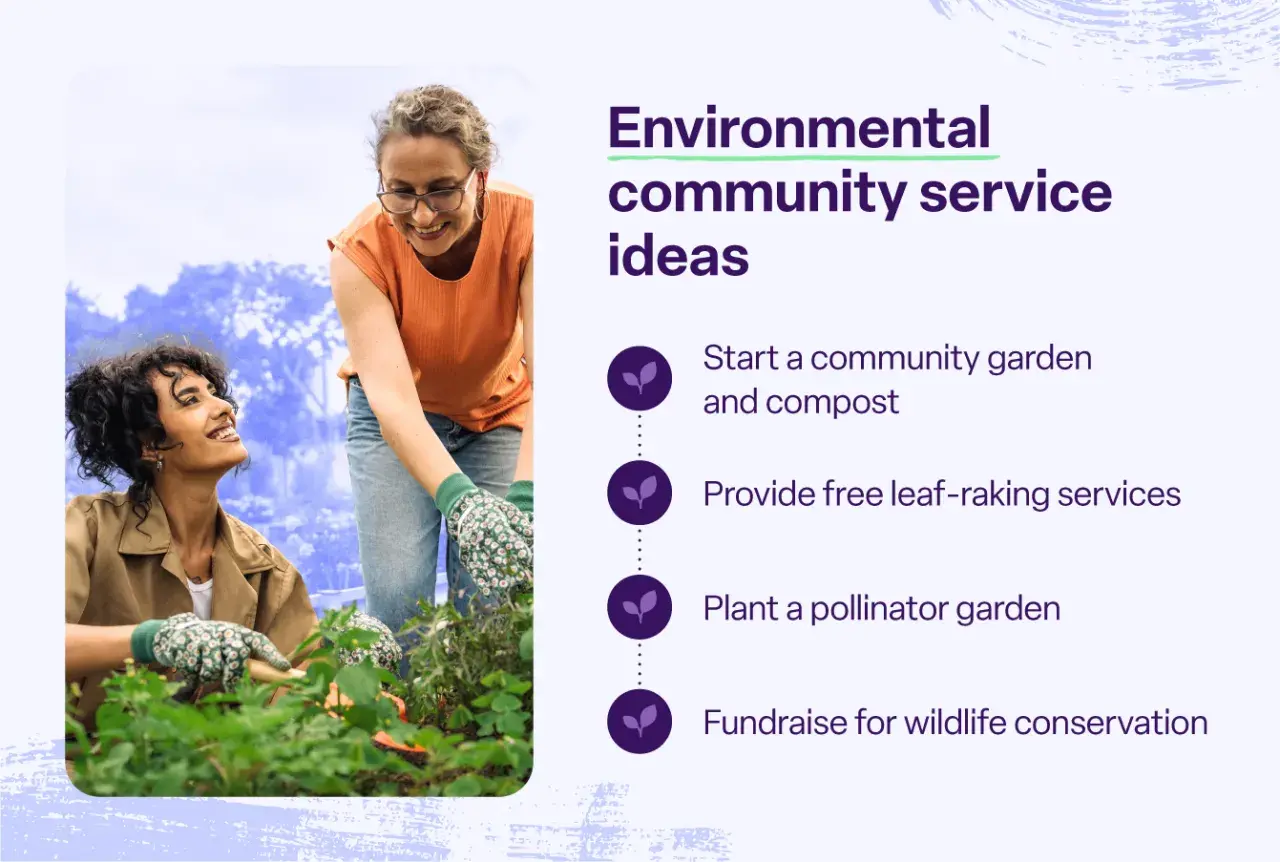
- Environmental service includes park cleanups, trail maintenance, tree planting, and recycling events.
- Disaster response support includes staging supplies, cleanup assistance, and checking on affected neighbors after storms or fires.
The upside is simple: the need is concrete, and the results are easy to understand. The tradeoff is that direct service can be tiring, emotional, or seasonal, so reliability matters more than enthusiasm. If you can only show up once, choose a one-time event; if you can return regularly, the community usually benefits more.
Not every useful role is visible to the public, which brings me to the work that keeps organizations functioning.
Behind-the-scenes service that nonprofits rely on
Some of the most valuable volunteering happens out of sight. A nonprofit may already have enough people packing boxes, but still need someone to answer phones, write grant copy, organize records, or fix a broken spreadsheet. I would call this the capacity-building side of community service: work that strengthens the organization itself, not just the next shift.This is where skills-based or pro bono service fits. Lawyers donate legal review, designers build flyers, bookkeepers reconcile accounts, translators make materials accessible, and IT volunteers keep systems usable. The point is not prestige; it is leverage. One hour of the right expertise can save a small organization ten hours of trial and error.
- Administrative support covers data entry, scheduling, intake calls, and filing.
- Fundraising and donor support covers event planning, sponsorship outreach, and thank-you campaigns.
- Communications support covers social posts, newsletters, photography, and basic design.
- Specialized pro bono work covers legal, accounting, HR, medical, or technical help when the nonprofit needs a licensed or trained professional.
Some organizations need this kind of help more than they need another pair of hands at a single event. The catch is that skills-based service works only when the scope is clear, because vague “help us with whatever” requests usually waste everyone’s time. Good matching is the difference between useful pro bono work and volunteer drift.
The next step is deciding whether to serve in person or from a distance.
Remote and micro-volunteering for tighter schedules
Virtual service has moved from a backup option to a standard part of the volunteer landscape. Points of Light lists thousands of online opportunities, including one-time tasks and ongoing commitments, and that range is exactly what makes remote work practical for busy people.
Micro-volunteering means short, clearly defined tasks that often take 15 to 30 minutes. That can be transcription, captioning, data cleanup, list building, or sending outreach emails. The appeal is obvious if you are balancing caregiving, a commute, or limited mobility.
- Good examples include transcription, captioning, data cleanup, list building, and phone banking.
- Best fit includes parents, caregivers, remote workers, people with mobility limits, and anyone who needs flexible scheduling.
- Watchouts include slow feedback, weak onboarding, and tasks that are so small they feel disconnected from any real outcome.
I like remote service when it is structured well, because it lowers barriers without lowering standards. But it only works when the nonprofit gives volunteers a clear task, a deadline, and a way to ask questions. If those three things are missing, remote volunteering tends to stall.
The format also changes depending on who volunteers together.
Team-based service for schools, employers, and faith groups
Group volunteering is less about individual identity and more about coordination. Schools use it for service-learning, companies use it for employee engagement, and faith or civic groups use it to mobilize more people at once. The advantage is scale; the risk is that the work becomes symbolic if the group never comes back.
| Group format | What it usually looks like | Where it works best | Main limitation |
|---|---|---|---|
| School-based service | Club projects, service-learning, graduation hours, or class-linked volunteer days | Youth mentoring, litter pickup, pantry sorting, and reading support | Can become a checkbox if it is not tied to reflection or learning |
| Corporate volunteering | Paid volunteer days, team projects, or skills-based service events | Pro bono work, cleanups, event staffing, and nonprofit operations | Often one-off unless the company builds a repeat program |
| Faith or club service | Meal prep, donation drives, home repairs, and outreach work | Local relationships and dependable recurring support | Needs to stay focused on public benefit and inclusion |
| Family or neighborhood service | Joint cleanups, drive collections, or helping nearby seniors | Easy entry point for new volunteers and children | Usually smaller scale and less specialized |
These formats are most effective when there is a clear job, a short briefing, and a follow-up plan. I am skeptical of any group event that looks impressive in photos but leaves the partner organization with cleanup work and no long-term support.
That skepticism is even more important when service is required rather than chosen.
Court-ordered service and why the rules are stricter
Court-ordered community service is not just volunteer work with paperwork attached. It usually has to meet a specific approval process, use an accepted site, and produce written verification of completed hours. That means the first question is not “Does this seem helpful?” but “Will the supervising authority count it?”In many programs, the work must be community-benefiting, unpaid, and supervised in a way that allows attendance to be confirmed. A role that mainly serves a private business or a political purpose usually will not qualify. If the placement is even slightly uncertain, I would get approval before starting, not after the hours are finished.
- Ask whether the site is approved before you start.
- Confirm how hours must be logged and signed.
- Check whether the work must be unpaid and community-facing.
- Verify any limits on political, private-benefit, or family-related roles.
- Keep your own records in case the paperwork gets delayed.
If you are trying to make hours count, do not assume that “helping somewhere” is enough. The site, the supervisor, the documentation, and the type of work all matter.
Once the rules are clear, choosing a fit becomes much easier.
How I’d choose the right role if I were starting from zero
When I help someone narrow the options, I start with the constraint, not the cause. That sounds less inspiring than it is practical, but it usually saves people from choosing a role they cannot sustain.
- Decide what you can repeat. One afternoon, one evening a month, or a weekly shift are very different commitments.
- Match the task to your strongest asset. If you have time, offer time; if you have a skill, offer the skill; if you have energy for people, choose face-to-face work.
- Check the hidden costs. Transportation, parking, childcare, background checks, and training can matter as much as the volunteer shift itself.
- Decide whether you need immediate or recurring impact. One-off events are great for fast needs, while recurring roles usually create deeper trust.
- Verify approval and documentation early. This is essential for school, employer, or court hours, and it saves a lot of frustration later.
- Start small, then stay if it fits. A modest role you can repeat is usually better than a heroic role you cannot sustain.
If I had to give one rule, it would be this: choose the role you can still do on a tired week. That is usually the role that creates the best long-term value, because the organization can plan around you instead of hoping you appear.
The goal is not to volunteer harder; it is to volunteer better, which is why the final test is whether the service is actually useful over time.
What makes service actually useful over time
The strongest volunteer work usually has four traits: it is needed, clear, repeatable, and respectful of the community’s own priorities. That last part is easy to miss. The most effective volunteers do not arrive with a script; they listen, learn, and adapt to the people already doing the work.
- Show up when you said you would.
- Accept training instead of improvising.
- Let the host organization define the task.
- Track hours and proof if the role requires it.
- Ask for feedback before your help drifts into clutter.
The best volunteer work is not the most dramatic one. It is the one that fits the problem, the schedule, and the rules well enough to keep helping after the first burst of energy fades. When those pieces line up, community service stops being a checkbox and becomes real support.
