
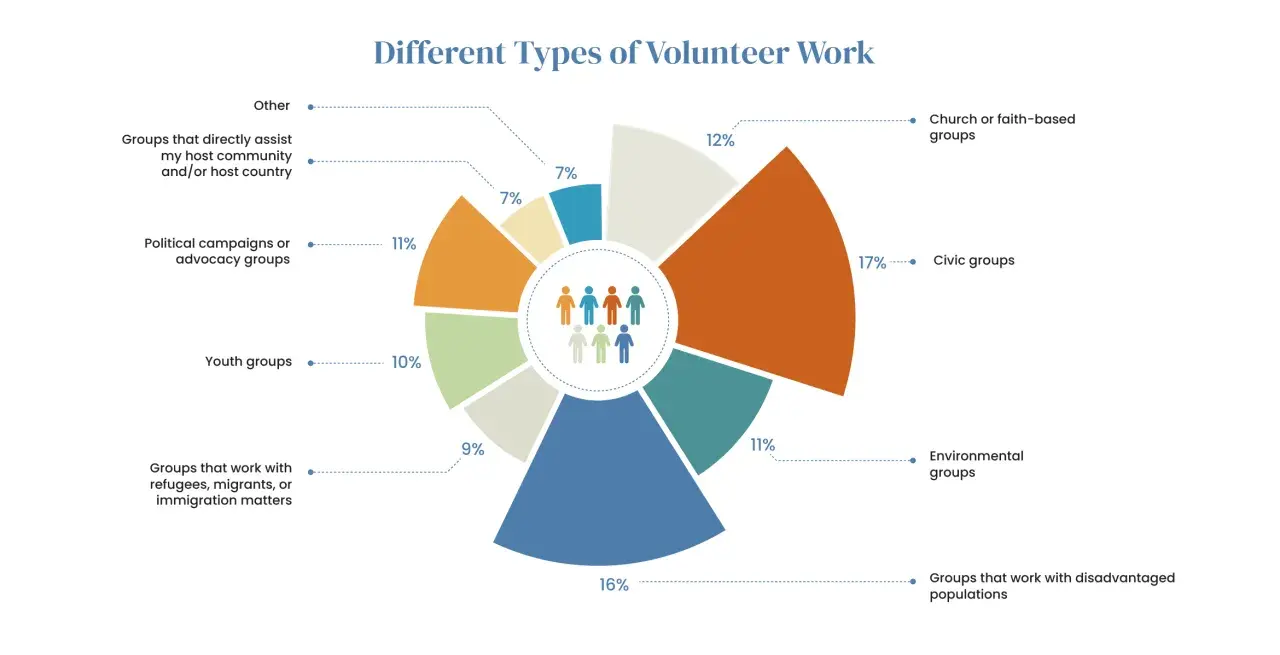
Volunteering is one of the simplest ways to contribute to a community without turning generosity into a transaction. In practice, voluntary work can mean anything from serving meals and tutoring students to helping a food bank sort donations or supporting disaster recovery behind the scenes. This article breaks down what counts as volunteer service in the United States, where the legal and practical boundaries sit, which roles create real impact, and how to choose work you can actually sustain.
The essential points in one glance
- Volunteer service is freely chosen, unpaid, and tied to a public, religious, or humanitarian purpose.
- In the U.S., the legal line matters: some unpaid activity is volunteering, but not every unpaid task qualifies.
- The most useful roles often cover hidden needs such as logistics, admin, tutoring, meal support, and event coordination.
- Small, consistent commitments usually create more value than occasional bursts of enthusiasm.
- The best volunteer fit is the one you can repeat without burnout, confusion, or resentment.
What counts as volunteer service in the United States
I usually separate volunteer service from other unpaid tasks with one simple test: the person is there freely, the purpose is public, religious, or humanitarian, and no one is trying to replace a paid job. The U.S. Department of Labor treats bona fide volunteers that way, meaning they serve without expectation of compensation and generally do not displace regular workers or perform work that would otherwise be done by staff.
That distinction matters more than the label on the flyer. Something can be unpaid and still not qualify as legitimate volunteering. A person can also be helping a good cause and still be placed in a role that is structurally wrong, especially if the organization relies on them like an employee.
| Example | Usually counts | Usually does not count |
|---|---|---|
| Serving meals at a nonprofit shelter | Yes | No |
| Helping with disaster relief or a community cleanup | Yes | No |
| Tutoring through a school or nonprofit program | Yes | No |
| Doing the same tasks as a paid worker at your employer, for free | No | Yes |
| Unpaid work for a for-profit business | No | Yes |
| Court-ordered community service | No, because it is required | Yes |
Once that boundary is clear, it becomes easier to see where volunteers actually add value and why some roles are far more effective than others.

Common roles where volunteers create visible impact
The strongest volunteer roles are often not the most dramatic ones. They keep people fed, organized, connected, and safe. I pay close attention to that invisible work because it is usually where organizations feel the biggest pressure.
| Area | Typical tasks | Why it matters | Best for |
|---|---|---|---|
| Food support | Sorting donations, packing boxes, serving meals, delivery | Reduces immediate pressure on families and shelters | People who like practical, fast-paced work |
| Education | Tutoring, reading support, mentoring, homework help | Gives students extra attention and confidence | Patient communicators |
| Disaster response | Intake, shelter setup, logistics, supply distribution | Keeps emergency operations moving when systems are strained | Calm, organized people |
| Environment | Trail cleanup, planting, recycling drives, invasive removal | Protects shared spaces and improves local quality of life | People comfortable with physical, outdoor work |
| Admin support | Phone calls, data entry, scheduling, translation, inventory | Multiplies staff capacity and keeps programs running | Detail-oriented volunteers |
The hidden roles deserve more attention than they usually get. A volunteer who enters data, manages sign-ins, or keeps a donation list clean may never get public praise, but that work often decides whether a program runs smoothly or falls apart at the edges. That is why impact is not always visible at first glance.
That mix of visible and invisible work also explains why volunteering continues to matter so much at the community level.
Why people volunteer and why communities still depend on it
AmeriCorps estimated that more than 28 percent of Americans, or 75.7 million people, volunteered for an organization between September 2022 and September 2023, and half of formal volunteers served 24 hours or less. I find that detail useful because it challenges a common myth: you do not need heroic hours to make a meaningful contribution.
Communities depend on volunteers for three reasons. First, they add capacity where budgets are thin. Second, they bring local knowledge that staff may not have. Third, they create social trust, which is hard to measure but easy to feel when a neighborhood responds well in a crisis.
For the volunteer, the value is usually broader than a feel-good headline. You learn how an organization works, who it serves, where the bottlenecks are, and what real need looks like in practice. I also think it is healthy to be honest about the limits: volunteering can strengthen a mission, but it should not be used to excuse chronic underfunding or to patch over problems that require policy or institutional fixes.
Once the purpose is clear, the next question is not whether you should help, but how to choose a role you can keep doing well.
How to choose a role you can keep doing
The best role is not the one that sounds the most impressive. It is the one you can repeat without burning out or confusing the people who depend on you. I usually tell people to make the decision with a short checklist rather than with pure enthusiasm.
- Decide how many hours you can give per week or per month for at least three months.
- Choose between direct contact and behind-the-scenes work.
- Ask what training, supervision, or background screening is required.
- Find out whether the role is one-off, seasonal, or ongoing.
- Confirm who owns the task and how success will be measured.
Those questions sound basic, but they prevent most of the common disappointments. A short event can be a great fit if your schedule is unpredictable. A weekly role is better if you want relationships and continuity. Skills-based service makes sense when you can contribute something specific, such as design, accounting, translation, or communications.
The rule I use is simple: if the commitment creates stress before the first shift, it is probably too big. Fit matters, but so do the boundaries around the work itself.
Rules and boundaries that keep the work legitimate
The cleanest rule in U.S. labor guidance is straightforward: employees cannot volunteer unpaid services to a for-profit private employer, and volunteer arrangements for public agencies or nonprofits must stay clearly separate from ordinary employment. The U.S. Department of Labor also notes that bona fide volunteers serve freely, usually on a part-time basis, for public service, religious, or humanitarian purposes, and without expectation of compensation.
That is where many organizations get sloppy. I would treat the following as red flags:
- You are doing the same work as a paid staff member.
- The organization depends on you like an employee but offers no training or supervision.
- The schedule is effectively full-time or open-ended.
- The role is described as “volunteer” but behaves like a payroll workaround.
- No one can explain who is responsible for the task or how quality is checked.
Good programs are specific. They define the task, the time commitment, the point of contact, and the exit path if someone needs to step away. Vague programs burn people out and make the whole effort feel chaotic, even when the mission itself is worthwhile. Once those boundaries are clear, the remaining job is to make the service sustainable.
What lasting community impact looks like in practice
In my view, the strongest volunteer programs are built on consistency, not drama. They ask for a manageable commitment, give people enough structure to succeed, and leave space for learning. That is what turns a nice gesture into dependable community support.If I were improving a volunteer program, I would start with four simple habits. Keep shifts short enough that people can repeat them. Give every person one clear responsibility instead of five vague ones. Measure outcomes, not just attendance. And make handoff easy so the work continues even when one volunteer leaves.
That approach also protects the volunteer. When expectations are clear, the experience is less draining and more meaningful, and people are far more likely to stay involved. The long-term payoff is not just donated time; it is stronger local capacity, better coordination, and a civic culture that feels more human because people are actually showing up for one another.
