
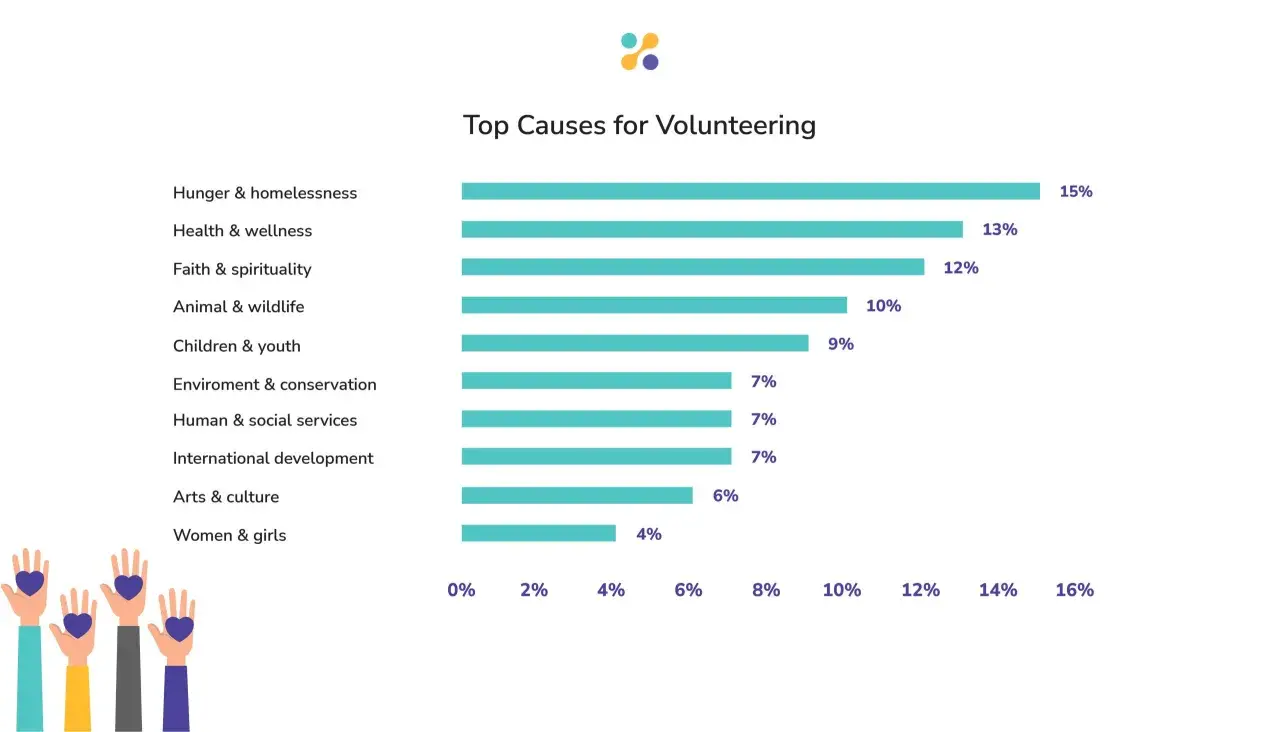
The main patterns behind volunteering in America right now
- Formal volunteering has recovered in the latest national data, but many people are giving fewer hours than before, which points to shorter, more flexible commitments.
- Volunteering now happens in person, online, and in hybrid formats, so the best role is often the one that fits real life rather than an ideal schedule.
- Informal helping still matters a great deal; helping neighbors, families, and local groups remains a major part of civic life.
- The strongest volunteer programs make expectations clear, give people one defined job, and treat volunteers like part of the team.
- The value of volunteer time is not just emotional or cultural; it has a measurable economic impact as well.
How volunteerism in the United States is changing
The latest national survey data from the U.S. Census Bureau and AmeriCorps show a clear rebound in formal service: 75.7 million people, or 28.3% of the population age 16 and older, volunteered through an organization between September 2022 and September 2023. That is important, but the finer detail matters even more. Average hours per volunteer have continued to fall, which tells me that the modern pattern is less about long weekly commitments and more about episodic service, seasonal help, and flexible participation.
There is also a second layer that often gets overlooked: informal helping. In the same period, 54.2% of Americans helped neighbors with errands, tools, rides, or other small tasks. That kind of support rarely gets treated as “official” volunteering, yet it is a major part of how communities function. Virtual service is now part of the picture too, with a meaningful share of volunteers contributing online.
| Type of service | What it looks like | Why it matters | Main tradeoff |
|---|---|---|---|
| Formal volunteering | Serving through an organization such as a food bank, school, shelter, or museum | Creates structure, accountability, and measurable impact | Usually requires more scheduling and onboarding |
| Informal helping | Running errands for a neighbor, sharing tools, offering rides, or checking in on someone | Fast, local, and often the first response when someone needs help | Harder to track and less visible to institutions |
| Virtual volunteering | Remote tasks such as design, tutoring, admin support, or communications | Removes travel barriers and opens the door to specialized skills | Can feel disconnected if the organization does not manage it well |
| Episodic volunteering | One-time, seasonal, or project-based shifts | Fits people with limited time or unstable schedules | Less continuity if the role is not designed carefully |
For me, the biggest shift is that volunteering is no longer a single model. A healthy community now depends on a mix of structured service, quick neighborly help, and flexible roles that people can actually sustain. That leads directly to the next question: why do people keep showing up at all?
What people usually get back from volunteering
People volunteer for different reasons, but the motivations usually cluster around a few practical ideas. They want to feel useful. They want to stay connected to other people. They want to give their time to something that feels larger than their own routine. And sometimes they want to test a career interest, build confidence, or share a skill that does not get used enough in their day job.
I usually think about the return on volunteering in two layers. The first is personal: structure, purpose, and social connection. The second is skill-based: communication, leadership, project management, event support, and problem solving all get stronger when people use them in real settings. A volunteer role can be a quiet way to build credibility, especially for students, career changers, and retirees looking for a meaningful next chapter.
- Purpose gives people a reason to show up consistently.
- Connection reduces isolation and creates a sense of belonging.
- Skills grow faster when they are used on real tasks with real stakes.
- Perspective deepens when volunteers spend time close to the needs of a community.
The caution is simple: volunteering should not become another source of burnout. If the role is vague, emotionally heavy, or too demanding for the time available, the benefit disappears quickly. Good service feels meaningful, but it also has to fit the season of life someone is in. That fit becomes easier to see once we look at where volunteers do the most work.

Where volunteers make the strongest local impact
Some volunteer roles are highly visible, while others do most of the real work quietly in the background. Food banks, schools, libraries, shelters, parks, disaster response groups, and local arts organizations all rely on volunteers, but the tasks are different. In my view, the most effective placements are the ones where a volunteer’s work clearly frees up staff time or expands access for the public.| Setting | Common volunteer tasks | Why the role matters |
|---|---|---|
| Food banks and meal programs | Sorting donations, packing boxes, distributing food, delivering meals | Directly reduces immediate food insecurity and keeps logistics moving |
| Schools and mentoring programs | Tutoring, reading support, after-school help, event assistance | Consistency matters more than flashy effort; one steady adult can change a child’s experience |
| Libraries and museums | Event support, digital literacy help, archiving, visitor support | Extends access to learning and culture without requiring large budgets |
| Parks and environmental groups | Cleanups, planting, trail maintenance, habitat restoration | Produces visible community benefit and shared ownership of public spaces |
| Disaster response and recovery | Shelter support, supply coordination, case assistance, cleanup help | High impact, but usually requires training, coordination, and clear safety rules |
| Social service organizations | Administrative support, transportation, companionship, reception | Lets professionals focus on complex cases while volunteers handle essential support work |
Skills-based volunteering is worth naming separately. It means using professional abilities such as accounting, design, coding, translation, or grant writing for a nonprofit project. Done well, it is one of the highest-value forms of service because it solves a problem the organization could not easily pay to fix.
Not every role is safe or suitable for every volunteer, though. In some settings, especially disaster work and health-related support, training and boundaries are not optional. The strongest opportunities are not always the most dramatic ones; they are the ones where a volunteer can reliably do useful work without creating extra burden. That is why the structure behind the role matters so much.
What separates a strong volunteer program from a weak one
There is a management side to volunteering that people often underestimate. A strong program does not just welcome help; it makes it easy for people to help well. The role is specific, the time commitment is clear, the training is short but real, and someone owns the volunteer experience from start to finish.| Good sign | Why it works | Weak sign | Why it fails |
|---|---|---|---|
| Specific task and shift length | People know exactly what success looks like | "We need help with everything" | Creates confusion and discourages follow-through |
| Quick onboarding | Reduces friction and gets people serving sooner | Long forms with no guidance | People drop out before they start |
| A named contact person | Questions get answered and issues get solved quickly | No one seems responsible for volunteers | Volunteers feel invisible |
| Feedback after a shift | Shows that the work mattered | Silence after sign-up | Retention falls because the role feels transactional |
| Flexible scheduling | Broadens access for parents, shift workers, and busy professionals | Only one rigid time slot | Limits participation to people with unusually open schedules |
The pattern is simple: volunteers stay when the work feels understandable, useful, and manageable. They leave when the role is vague, oversized, or disconnected from real outcomes. If an organization wants long-term commitment, it has to design for it instead of hoping goodwill will fill the gaps. That is also the standard I use when I evaluate whether a role will fit a specific person.
How to choose the right role for your schedule and skills
When I help someone think through a volunteer choice, I start with constraints, not ideals. How much time is truly available? Is transportation easy or annoying? Does the person want direct contact with people, or would they be happier behind the scenes? Answering those questions first usually prevents a bad match.
- Set a realistic time budget. Start with the smallest commitment you can keep for at least a month. One shift a week is better than an ambitious plan that collapses in two.
- Choose the format first. In-person, hybrid, or remote service each works well for different lives. A good role respects the volunteer’s geography, schedule, and energy level.
- Pick one cause you can stay close to. The most durable volunteer relationships usually come from proximity to an issue, not from abstract guilt.
- Decide whether you offer hands-on help or specialized skills. Some organizations need a steady pair of hands. Others need a spreadsheet, a lesson plan, or a website fix.
- Test the role before you commit deeply. One shift or one short project tells you more than a polished description ever will.
The mistake I see most often is choosing a role because it sounds noble rather than because it fits real life. That usually leads to overcommitment, missed shifts, and frustration on both sides. A role that fits is not smaller in value; it is more likely to last. And when service lasts, its impact grows beyond the organization itself.
Why volunteering matters beyond the nonprofit world
Volunteering is often described in moral or emotional terms, but there is a hard practical side to it. Independent Sector estimates the value of a volunteer hour at $36.14 in 2025, which helps explain why volunteer labor is treated as a real economic input rather than a symbolic extra. That number still does not capture everything. It cannot fully measure trust, belonging, or the way volunteers make a neighborhood feel more workable.
On the ground, the impact usually shows up in four ways: direct service, organizational capacity, social trust, and resilience. Direct service is the most visible part, such as meals delivered, tutoring sessions completed, or trails cleaned. Organizational capacity is the less glamorous but often more important piece: volunteers let staff focus on complex work instead of drowning in logistics. Social trust is built when people who might never meet otherwise work toward the same goal. And resilience grows when communities have more people who know how to respond when systems are strained.| Impact layer | What changes | Example |
|---|---|---|
| Direct service | Immediate needs get met faster | Food distribution, tutoring, cleanup work |
| Organizational capacity | Paid staff can focus on higher-complexity tasks | Admin help, event staffing, communications support |
| Social trust | People cooperate more easily across differences | Neighborhood projects, school events, civic cleanups |
| Economic value | Communities receive labor that would otherwise be costly to replace | Broad, repeated service across many local organizations |
There is one limit worth naming plainly: volunteers can strengthen a system, but they should not be used as a substitute for essential public or professional services in high-risk settings. The best programs use volunteer labor for reach, responsiveness, and community connection, not to patch structural gaps indefinitely. That is why a practical starting plan matters so much for people who want to help without wasting time.
A simple 30-day plan for starting well
If I were starting from zero, I would keep the first month narrow and concrete. The goal would not be to do everything. The goal would be to find one role that feels useful enough to repeat.
- Make a short list of two causes. Choose the ones you can see yourself caring about on an ordinary Tuesday, not only on an ideal weekend.
- Contact two organizations. Ask what a typical shift looks like, what training is required, and who supervises volunteers.
- Ask one direct question. “What is the one task that would help you most if I did it well?” That answer tells you a lot.
- Start with one shift or one project. Low-friction entry is the safest way to test whether the role is sustainable.
- Review after 30 days. Decide whether the work fits your schedule, your energy, and your sense of purpose.
If the answer is yes, keep going. If it is only partly yes, adjust the role before you quit it. The best volunteer commitment is not the biggest one; it is the one you can still imagine doing three months from now. That is how service becomes part of civic life instead of a one-time gesture.
