
What useful board minutes must contain
- Attendance and quorum so the record shows the board could legally act.
- Motions and votes so decisions are unmistakable, not implied.
- A brief discussion summary that explains the reasoning without turning the minutes into a transcript.
- Action items with owners so follow-through does not get lost after the meeting.
- Document references when reports, budgets, or presentations shaped the decision.
- Conflict, recusal, or executive-session notes when governance requires a tighter record.
What strong board minutes actually capture
I think of board minutes as a record of decisions first and a record of discussion second. For routine approvals, action-focused minutes are usually enough. For strategic, contentious, or high-impact topics, I want just enough context to show why the board chose one path over another.
| Element | What to record | Why it matters |
|---|---|---|
| Meeting details | Date, time, location or platform, and whether it was a regular or special meeting | Anchors the record and makes later review easier |
| Attendance and quorum | Who was present, absent, and whether quorum was established | Shows the board had authority to act |
| Motions and votes | The exact action approved, who moved and seconded, and the vote result | Removes ambiguity about the board’s decision |
| Discussion summary | The main issues raised, concerns reflected, and the board’s rationale | Helps a new director understand the “why” behind the vote |
| Action items | Who owns each next step and any deadline | Turns minutes into a follow-through tool |
| Supporting documents | Reports, budgets, presentations, or policies introduced during the meeting | Creates a traceable governance trail |
| Special notes | Conflict disclosures, recusals, privileged discussions, or formal executive-session actions | Protects the organization and preserves the proper record |
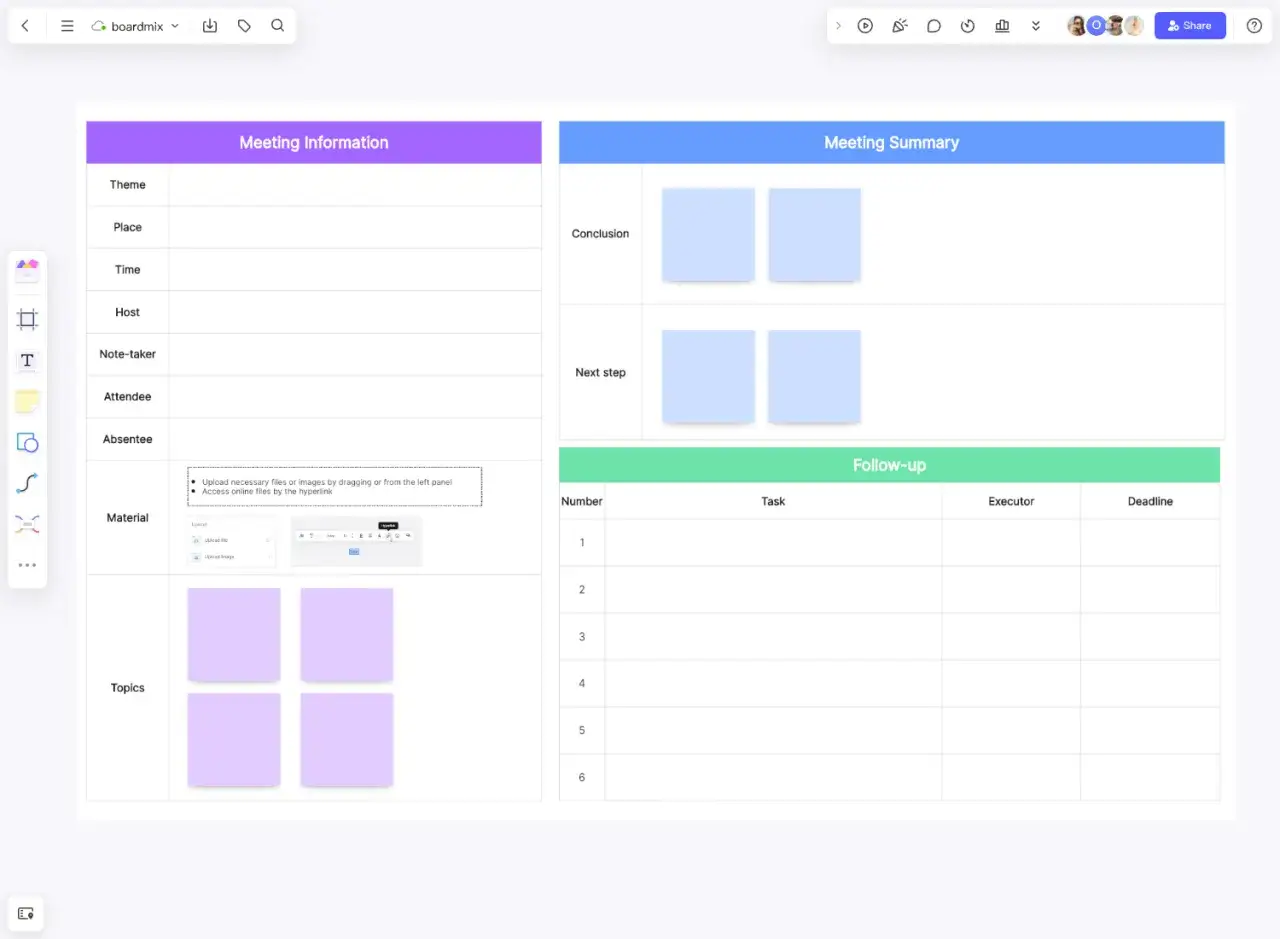
Board meeting minutes examples you can adapt
The easiest way to learn this format is to see how it changes with the type of decision being made. I would not write the same way for a routine consent agenda, a budget choice, and a conflict-of-interest discussion.| Meeting type | Best style | What to emphasize |
|---|---|---|
| Routine approvals | Action minutes | Motion, vote, and next steps |
| Strategic or contested issue | Brief discussion minutes | Options considered, concerns, and rationale |
| Conflict or executive session | Minimal but precise | Disclosure, recusal, and formal action only |
Routine approval meeting
Sample: The board reviewed the consent agenda, approved the prior minutes, and accepted the treasurer’s report. Motion passed unanimously. The operations director will circulate the updated volunteer schedule by June 6.
This works because it stays action-focused. You can tell what was approved, what changed, and who owns the next step.
Strategic funding or program decision
Sample: The board discussed three options for expanding the food-distribution pilot: extending current hours, adding a second site, or redirecting funds to mobile delivery. Directors raised concerns about staffing capacity and neighborhood access. After review, the board approved the mobile delivery option and allocated $24,000 from the reserve line, pending a donor update from the development chair.
This version includes enough of the discussion to show why the decision was made without becoming a transcript. For a board overseeing community impact work, that balance matters because the record should show both mission alignment and practical tradeoffs.
Read Also: Board Committees - Boost Effectiveness, Not Bureaucracy
Conflict disclosure or executive session
Sample: A director disclosed a conflict related to the vendor proposal and recused themselves from the vote. The board entered executive session to discuss personnel matters. No detailed discussion from the executive session was recorded, but the board approved the related compensation action by formal vote upon return to open session.
This is the kind of detail that protects governance without oversharing sensitive discussion. Once you can handle those three scenarios well, the next step is to standardize the structure you use every time.
A template that fits most US nonprofit boards
I like templates that make it hard to omit the essentials and easy to stay concise. For a US nonprofit or community board, this structure is usually enough for routine governance and flexible enough for major decisions.
- Meeting details - date, time, place or platform, and whether it was a regular or special meeting.
- Attendance and quorum - list directors present, absent, and any guests.
- Approval of prior minutes and agenda - note corrections and the approval result.
- Reports - capture only the material points from finance, programs, fundraising, or committees.
- Motions and votes - record the exact action, who moved and seconded, and the outcome.
- Action items - assign one responsible person and, when possible, a deadline.
- Adjournment - record the closing time.
For a mission-driven organization, I would also leave a short line for any stakeholder feedback that influenced the vote, especially when the board is deciding on services, outreach, or grant-funded activity. That small addition keeps the minutes tied to real community impact, which is often what future readers care about most.
What mission-driven boards should record beyond the basics
Not every board needs the same level of detail, but boards in the social good space usually benefit from recording a little more context around impact. That does not mean padding the minutes. It means capturing the factors that shaped the decision.
- Mission alignment - note when the board links a decision to program outcomes, beneficiary access, or equity goals.
- Funding constraints - record when grant terms, donor restrictions, or reserve usage shaped the vote.
- Community input - summarize relevant comments from volunteers, members, residents, or partners.
- Implementation responsibility - show which committee, staff lead, or officer owns the follow-up.
- Future reporting - capture requests for a follow-up report so the next meeting has continuity.
This is where minutes stop being a formality and start becoming an accountability tool. Once the record reflects mission choices clearly, the next question is how to avoid undermining that clarity with weak drafting habits.
Common mistakes that weaken governance
The most common problem I see is not bad grammar; it is bad judgment about what belongs in the record.
- Writing too much - if a routine draft takes more than about 15 minutes to read, it is probably too long.
- Recording everything said - that turns minutes into a transcript and buries the decision.
- Being vague - phrases like “the board discussed the issue” tell me almost nothing.
- Skipping quorum or vote detail - that creates avoidable governance risk.
- Ignoring conflicts or recusals - if a director steps out, the record should show it.
- Leaving follow-up ownerless - action items without names and dates usually disappear.
The fix is simple but not easy: write only what a future board member needs to know to reconstruct the decision and move the work forward. That becomes much easier if the secretary has a clean checklist before the meeting starts.
What I would keep on every board secretary’s desk
If I were training a new board secretary, I would keep the same four questions visible at all times: Who was there? What was decided? Why did the board decide it? Who owns the next step? Those four questions are enough to keep minutes concise without making them shallow.
- Did the minutes show attendance, quorum, motions, votes, and adjournment?
- Could a new director understand the rationale without re-reading the whole discussion?
- Did every action item have one responsible person and a deadline?
- Were sensitive matters handled with the right level of restraint?
When a draft passes that test, it is usually ready for approval. That is the standard I would use for any board that wants minutes to support real governance rather than just check a compliance box.