
Volunteer screening works best when it matches the role, the people being served, and the amount of access the person will have. In the U.S., volunteer background check requirements are not one nationwide rule; they shift with state law, program funding, and whether the volunteer will be around children, older adults, or other vulnerable groups. Done well, the process protects people without turning every application into a bureaucratic obstacle.
The safest volunteer screening is the one that matches the role
- There is no single federal rule that fits every volunteer position.
- Higher-risk placements usually justify deeper checks, especially when access is unsupervised.
- Child-care and similar settings often use layered screening, not one database search.
- If a third-party screening company is involved, disclosure and written permission are part of the process.
- Good policies look at relevance, recency, supervision, and appeal options, not just the existence of a record.
- Some volunteer programs still exempt low-risk roles from formal criminal history checks.
What the screening is trying to prevent
I usually start with the risk, not the record. The point of screening is not to punish people for having a past; it is to reduce the chance that a volunteer will have access to children, vulnerable adults, cash, medication, private homes, or sensitive data in a way that could lead to harm.
That is why one offense is not automatically equal to another. A decades-old nonviolent misdemeanor tells me something very different from a recent pattern of abuse, theft, identity fraud, or sexual misconduct. The practical questions are simple: What will this person touch, see, or control? How much supervision will exist? How much trust does the role require?
- Direct harm risk matters most in roles with close contact with children, seniors, or people with disabilities.
- Access risk matters in jobs involving keys, homes, records, donations, or payment systems.
- Trust risk matters when the volunteer will work alone, travel with participants, or act without a second set of eyes.
When organizations usually require checks
In practice, volunteer background check requirements are driven by risk, not by a single national rule. I usually treat unsupervised access to children, older adults, people with disabilities, homes, or financial information as the point where a deeper review becomes hard to avoid. Lower-risk roles, such as supervised event setup or outdoor cleanup, often need far less.
| Volunteer setting | Typical screening approach | Why it matters |
|---|---|---|
| Child care, tutoring, mentoring, after-school support | Multi-part check before service begins, often with criminal history, abuse registry, and sex offender review | There is little margin for error when the volunteer works closely with minors |
| Senior services, home visits, companion support | Criminal history check plus identity verification and references, sometimes fingerprints for higher-trust placements | Volunteers may enter private homes or work one-on-one with vulnerable adults |
| Cash handling, donations, keys, records, transport | Targeted criminal review and careful reference checks | The main concern is misuse of access, not just physical harm |
| One-time events, packing, cleanup, supervised group tasks | Lighter screening or no formal criminal check, depending on the site | Close supervision reduces the need for a full investigative process |
| Leadership, board, fundraising, financial oversight | Identity, references, conflict-of-interest review, and targeted screening where money or private data is involved | Decision-making power can matter as much as physical access |
For child-care settings, the expectation is especially strict: checks are normally completed before the person starts, and renewals are commonly required at least every five years. Federal child-care guidance also uses a 45-day or less turnaround benchmark, which is a useful reminder that safety and speed both matter when a program is trying to recruit and onboard people.
There are also exceptions. In AmeriCorps Seniors, some nonstipended volunteer roles are not required to pass criminal history checks, although sponsors may still screen based on local risk. That is a good example of how volunteer screening should follow the setting instead of assuming every role needs the same level of scrutiny.
Once the risk tier is clear, the next step is choosing the right mix of checks instead of ordering every report available.
Which checks are common and what each one tells you
I rarely rely on a single report. A name-based search is quick, but it can miss identity problems or generate false matches. A fingerprint-based check is slower and usually more expensive to administer, but it gives you a much tighter identity match. The strongest volunteer policies layer checks instead of betting everything on one database.
| Check type | What it tells you | Best use | Limit |
|---|---|---|---|
| Name-based criminal search | Searches public criminal records tied to a name and other identifiers | General screening for lower- and mid-risk roles | Can produce false positives or miss records if identity data is incomplete |
| Fingerprint-based criminal check | Matches the person’s prints to criminal history records | High-trust, unsupervised, or child-serving roles | Takes more coordination and usually has a slower turnaround |
| Sex offender registry check | Flags registration status in sex offender databases | Roles with children or other vulnerable populations | Not a substitute for a full criminal history review |
| Abuse or neglect registry check | Looks for substantiated abuse, neglect, or exploitation findings where available | Child care, elder services, and disability support | Registry scope and availability vary by state |
| Reference and interview review | Checks reliability, boundaries, communication, and role fit | Almost every volunteer placement | Useful, but not a substitute for official records |
The best programs combine these tools deliberately. For example, a youth mentor may need a fingerprint check, a sex offender registry review, and references, while a supervised event volunteer may only need identity verification and a code of conduct. That difference is not softness; it is proportional screening.
But the tools only work if the process itself is clean, which is where consent, documentation, and decision-making come in.
How the process should work from application to decision
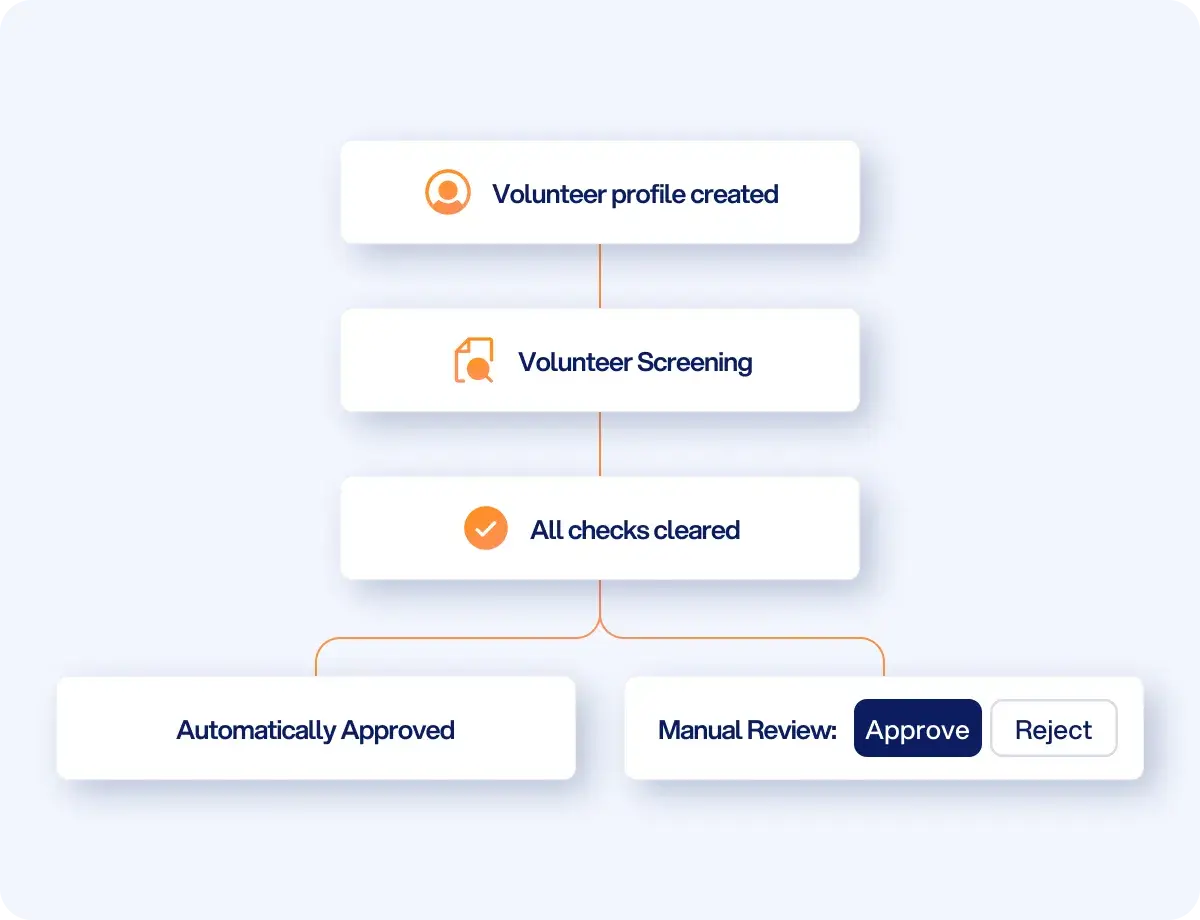
- Classify the role first. I would not screen a one-hour event helper the same way I screen someone who will enter a client’s home alone.
- Tell the volunteer what will be checked. If you use a consumer reporting company, the FTC’s FCRA rules require a standalone disclosure and written permission before the report is ordered.
- Verify identity before you submit data. Small errors here cause false matches, delays, and a lot of unnecessary frustration.
- Run only the checks that match the risk. More data is not automatically better if it does not change the decision.
- Review the result in context. I look at severity, recency, pattern, relevance to the role, and whether supervision can reduce the risk.
- Follow adverse-action steps if needed. If the report leads to a negative decision, the person should get a copy of the report and the summary of rights before the final call.
- Set a recheck schedule. Higher-risk volunteer placements should be reviewed more often than low-risk, supervised roles.
For time-sensitive programs, I also care about turnaround. A screening process that takes so long people disappear is not a strong process; it is a broken one. In child-care settings, the 45-day benchmark is a useful operational target because it keeps safety from becoming an excuse for endless delay.
A process can still be technically correct and socially bad if it is inconsistent or overbroad, which is why fairness matters as much as speed.
How to keep the policy fair, lawful, and volunteer-friendly
The biggest mistake I see is blanket screening rules that ignore context. A volunteer who hands out food under direct supervision should not be treated the same as someone who drives seniors alone to appointments. If the policy does not distinguish between those two roles, it is probably too blunt.
- Do not use a single rule for every role. Risk tiers make policy decisions easier to defend and easier to explain.
- Do not turn every record into an automatic rejection. Old, unrelated, or low-level offenses may be manageable in a supervised setting.
- Do not ask for more data than you need. Collecting extra personal information increases privacy risk without improving safety.
- Do not skip the human review. Databases can flag a record, but they cannot explain motivation, rehabilitation, or fit.
- Do not leave volunteers guessing. If people do not understand the process, they assume the worst and walk away.
My rule of thumb is simple: if the offense is old, unrelated, and the volunteer will be supervised, I look hard at whether a narrower control works better than a rejection. If the role involves children, medical access, private homes, or money, the threshold gets much stricter. The point is not to be lenient; the point is to be accurate.
State and local laws can tighten the rules too, especially around criminal history and the timing of questions, so a national template should never be copied blindly into every community program.
How to build a policy that protects people without scaring off good volunteers
A practical volunteer policy is usually shorter than people expect. It defines the risk level for each role, names the required checks for that role, explains consent and review steps, and sets a recheck rhythm. That is enough for most community organizations, and it is far better than a vague promise that “we run background checks” without saying how or why.
- Write separate standards for low-risk, medium-risk, and high-trust roles.
- Use deeper screening only where access or supervision justifies it.
- Train staff to read results consistently instead of improvising each time.
- Document exceptions so the policy is not applied differently from one volunteer to the next.
- Store reports securely and keep them only as long as the program actually needs them.
