
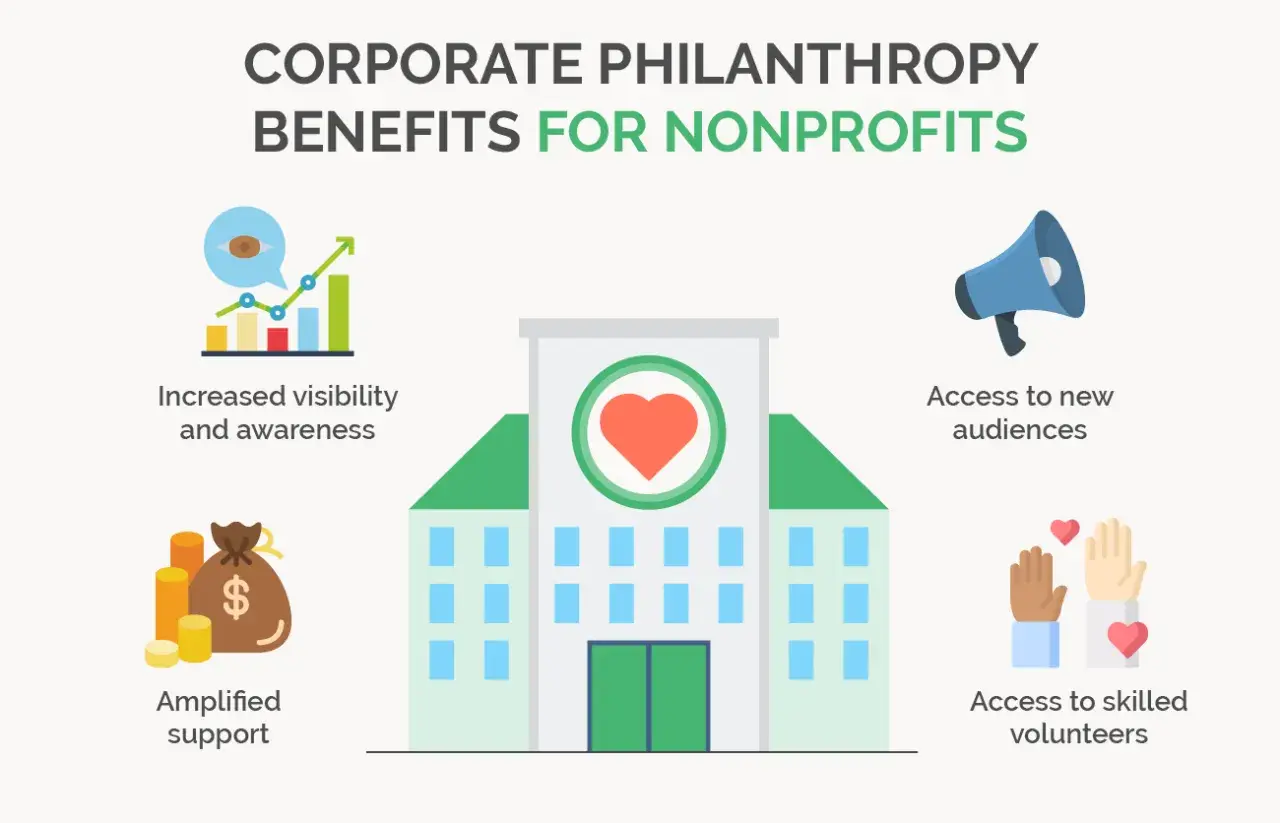
Corporate fundraising for nonprofits works best when the company can see a clear reason to say yes. I usually look at it as a mix of mission fit, business value, and a specific ask, because businesses rarely fund good intentions alone. In the U.S., that matters more than ever, since Giving USA reported that total charitable giving reached $592.50 billion in 2024, and corporate support still plays an important role inside that broader pool.
The strongest corporate support comes from a clear fit, a useful offer, and a simple path to yes
- Separate sponsorships, matching gifts, in-kind support, volunteer programs, and cause marketing before you pitch.
- Start with companies that already have a visible overlap with your mission, geography, audience, or workforce.
- Offer benefits a business can actually use, such as recognition, employee engagement, or measurable community impact.
- Keep the first proposal short and specific, because corporate teams respond better to clarity than volume.
- Track renewals and workplace-giving follow-through, not just first-time gifts, if you want steady revenue.
What corporate support usually means in the real world
I start here because many nonprofits treat all business-related money as one category, and that usually weakens the strategy. Corporate support can mean a sponsorship, a matching-gift flow, in-kind donations, volunteer grants, or a co-branded campaign, and each one has a different decision maker and a different value exchange.
The National Council of Nonprofits describes corporate sponsorship as a business payment that supports a nonprofit’s mission and is generally acknowledged by the nonprofit. That distinction matters, because acknowledgment is not the same as advertising, and it shapes how you build the offer.
| Support type | Best use | What the company gets | Main watch-out |
|---|---|---|---|
| Sponsorship | Events, programs, or campaigns with public visibility | Recognition, goodwill, and community association | Keep benefits to acknowledgment unless you want the payment treated like advertising |
| Matching gifts | When supporters work for companies with match programs | Employee engagement without a large admin burden | Most revenue is missed because donors never submit the match |
| Volunteer grants | When your work benefits from hands-on help | Visible employee participation and community time | You need solid tracking for hours and eligibility |
| In-kind support | When you need goods, services, or space | A tangible contribution without a cash outlay | Quality and timing can be inconsistent |
| Cause marketing | When there is a strong consumer-facing brand fit | Audience reach and sales-linked storytelling | Terms, claims, and reporting must be very clear |
Once you separate the funding models, the next step is choosing the companies most likely to care about your offer.
Why some companies respond and others do not
The best corporate prospects are not always the biggest ones. They are the ones with a visible reason to care. I look for overlap in four places: geography, workforce, customer base, and stated social-impact priorities. If a company has employees in your city, sells to the same community, or already talks publicly about the issue you address, your ask has a much better chance of landing.
It also helps to understand how companies think internally. Many now care about how a partnership reflects on employees, customers, and brand trust, not just how generous it sounds on paper. That is why a local bank with a large employee base in your county can be a better first win than a national brand with no local connection.
- Local presence usually makes the story easier to explain.
- Employee density matters because workplace-giving and volunteer programs are easier to activate when many staff members can participate.
- Prior giving is a strong signal, especially if the company has supported similar causes before.
- Decision access matters, because a warm intro often beats a polished cold email.
- Budget cycle matters, because some companies plan sponsorships quarterly while others lock them in annually.
I usually score prospects before I ever pitch them. That keeps me from spending time on companies that look impressive from the outside but have no practical reason to engage. When the prospect is a fit, the offer has to be concrete enough to survive an internal review.

How to package a partnership that feels worth funding
A business usually wants one of four outcomes: visibility, employee engagement, community credibility, or content it can reuse internally. I write the offer around those outcomes instead of around a nonprofit wish list. That means the proposal should say what the company receives, how often, and in what format, without burying the reader in mission language.
I would not package every ask as a sponsorship. A cleaner approach is to build a few partnership tiers that map to different company goals and budgets. One company may want a small event sponsor package, while another wants an annual partnership with employee volunteer days and impact reporting.
| Partnership level | Example value for the company | What I would include |
|---|---|---|
| Community sponsor | Local visibility and goodwill | Logo placement, social mention, event recognition |
| Program sponsor | Deeper brand association with a specific initiative | Short speaking opportunity, photo rights, impact summary |
| Employee engagement partner | Staff participation and morale | Volunteer day, team challenge, internal communications copy |
| Anchor partner | Broader, ongoing community footprint | Quarterly reporting, co-planned campaign, leadership touchpoints |
Keep the benefits realistic. If you promise audience size, media reach, or donor conversion rates you cannot prove, the relationship starts on shaky ground. A good package is not flashy, it is usable. With the offer defined, the outreach process can stay short and manageable.
A practical outreach process that lowers friction
I prefer a short, staged process. The first message is not the full pitch, it is a fit check. The second step is a one-page summary with two or three options. The third step is a conversation that answers the company’s internal questions before the proposal gets stuck.
- Research the company’s business model, leadership, and public priorities.
- Find one internal champion, ideally someone with a relationship to your board, staff, or community.
- Connect your mission to one business goal, not five.
- Lead with a specific dollar range instead of saying “any support would help.”
- Send a one-page proposal first, then a fuller deck only if the company asks for it.
- Offer a clear decision date so the ask does not drift.
If I cannot explain why the company should care in two sentences, I know the pitch is not refined enough yet. The easiest way to lose momentum is to make the business do too much interpretation. That matters even more when you build in workplace giving, which is easy to miss.
Why matching gifts and volunteer programs deserve their own lane
If I had to pick the most underused revenue stream in corporate fundraising, it would be workplace giving. Recent industry data suggests that 65% of Fortune 500 companies offer matching gifts, that roughly 11% of total corporate cash contributions flow through matching gift programs, and that $4 billion to $7 billion in matches go unclaimed each year. The lesson is simple: this money rarely appears because a company is generous by default. It appears when the nonprofit educates donors and makes the next step obvious.
The operational details matter more than many teams expect. Most companies set minimum match thresholds at $50 or less, so smaller gifts still matter. The average maximum match limit is much higher than most donors assume, and many employees never submit the forms because they are not reminded in time.
- Ask donors to check match eligibility immediately after giving.
- Place a matching-gift search prompt on the thank-you page and in the receipt email.
- Use a reminder within 24 hours, while the donation is still fresh in the donor’s mind.
- Track volunteer grants separately from cash matches, because they behave differently.
- Train frontline fundraisers to mention workplace giving without sounding mechanical.
For a nonprofit that wants faster wins, this is often the lowest-friction corporate revenue to unlock. Once that is in place, the next challenge is avoiding the mistakes that make otherwise good asks stall.
Common mistakes that make corporate asks stall
Most weak corporate proposals fail for predictable reasons. They ask for money before proving fit, they offer benefits the nonprofit cannot actually deliver, or they send the same generic deck to ten different companies and hope one sticks. None of that feels tailored, and companies can tell.
- Leading with need instead of shared value.
- Making every ask look like a sponsorship, even when another model fits better.
- Overpromising visibility, reach, or media attention.
- Skipping the research that shows why the company is a logical partner.
- Ignoring tax and compliance boundaries when the offer starts looking like advertising.
- Failing to report back after the gift, which makes renewal much harder.
The biggest quiet failure is usually stewardship. A company does not just want a thank-you, it wants proof that its support mattered. That is what makes renewal possible, and it is what turns a first gift into a relationship.
Building a partnership pipeline that compounds over time
The strongest corporate fundraising for nonprofits programs are not built on one good month of outreach. They are built on a rhythm: prospect, qualify, pitch, steward, renew. When I build that rhythm, I use a simple quarterly cadence, a short CRM note for every contact, and reporting that shows the partner what changed because they gave. CRM, in this context, is just the contact-tracking system your team already uses or should be using.
I also think in layers. A small number of anchor partners can stabilize the budget, while a wider pool of local sponsors, match-program donors, and in-kind supporters keeps the pipeline healthy. That mix is usually more resilient than chasing only one large gift or only one sponsorship gala.
- Keep a live list of 25 to 50 qualified prospects.
- Review workplace-giving opportunities every month.
- Send impact updates at 30, 90, and 180 days after a gift.
- Ask for renewal before the current relationship goes quiet.
That is the model I trust: clear fit, a realistic offer, disciplined follow-up, and proof that the partnership created something tangible. When those pieces are in place, corporate support stops feeling opportunistic and starts looking like a repeatable part of community investment.
