
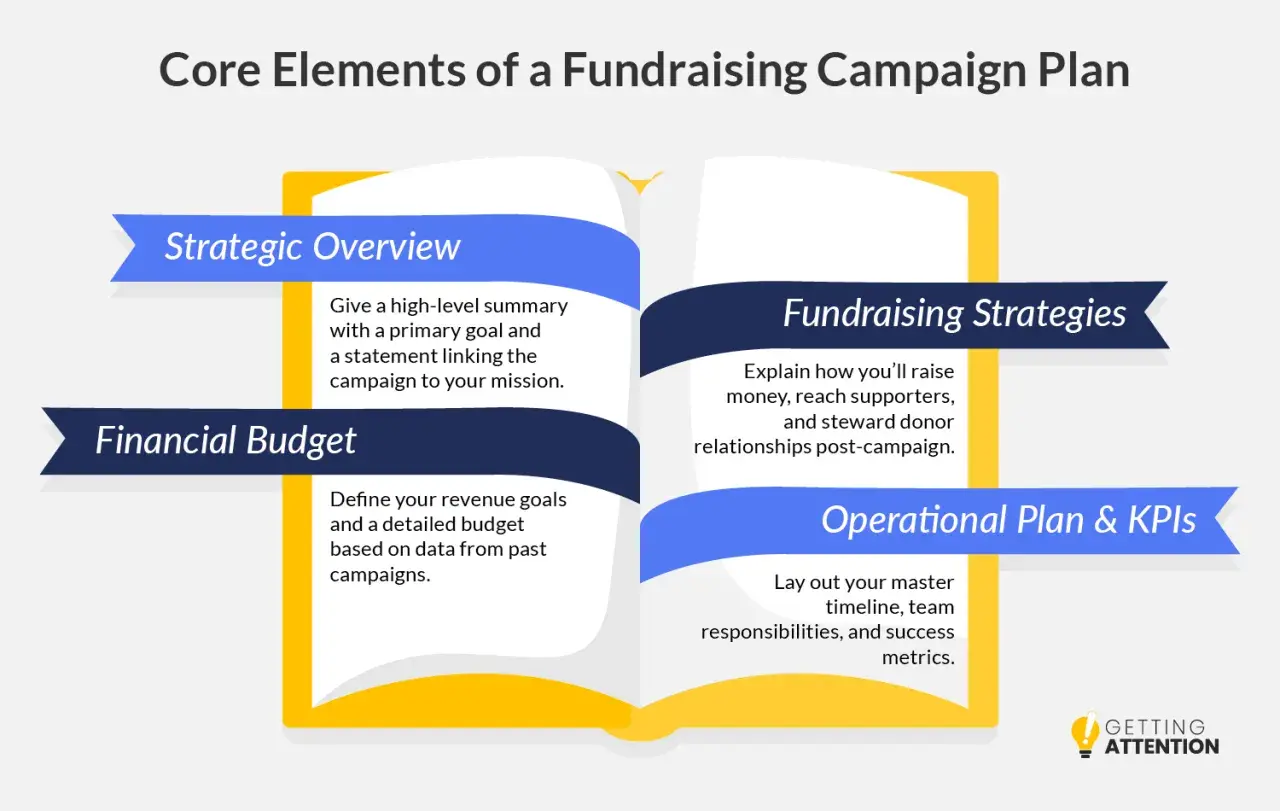
A strong fundraising campaign plan is less about hype and more about making the right decisions early: who you are asking, why now, what the money will do, and how you will keep momentum once the first wave of attention fades. For community-focused organizations, that structure matters because donors respond best when the ask feels specific, credible, and easy to act on. In this guide, I break down how to choose the right campaign format, set a realistic target, build the timeline, and keep the message sharp from launch to follow-up.
Key points to keep in mind
- A campaign works when it has a clear goal, a defined audience, and a realistic path from outreach to donation.
- The best format depends on your capacity, time horizon, and the size of the ask.
- U.S. nonprofits should prepare receipts and disclosure language before the first donation arrives.
- The donation page and email sequence need to make the ask obvious in seconds, not after a long explanation.
- Live tracking matters because weak response usually points to a fixable problem in message, segment, or page flow.
What a campaign has to do before it can raise anything
I think of a campaign plan as a decision document, not a calendar. It should tell the team what problem the campaign solves, how much money is needed, who is most likely to give, which channels will carry the ask, who owns each task, and what counts as success. If those answers are fuzzy, the campaign usually becomes a collection of hopeful posts and rushed emails instead of a coordinated effort.
As Candid notes in its fundraising guidance, long-term donor trust matters more than a one-off burst of attention. That matches what I see in practice: donors do not just respond to urgency, they respond to clarity and consistency. The plan should therefore answer six basic questions before anyone writes copy or buys ads:
- What exactly are we funding?
- Who benefits, and why now?
- How much money do we need, gross and net?
- Which donors are the primary audience?
- What channels will carry the campaign?
- Who is responsible for each step, and by when?
Once those decisions are clear, the next step is choosing the campaign shape that fits your capacity instead of forcing every initiative into the same mold.

Choose the campaign shape before you build the calendar
I usually pick the format before I pick the tools. A neighborhood food pantry, a youth arts program, and a multi-year community center build all need different machinery, and the wrong model can waste money before it raises any.
| Campaign type | Best for | Typical timeline | Main strength | Main risk |
|---|---|---|---|---|
| Digital-first drive | Urgent needs, smaller budgets, broad donor bases | 2 to 8 weeks | Low overhead and fast feedback | Message fatigue if the audience is too broad |
| Peer-to-peer campaign | Schools, volunteer networks, community-led causes | 4 to 10 weeks | Extends reach through supporters’ own networks | Needs coaching, assets, and steady follow-up |
| Event-driven campaign | Local visibility, sponsorships, and relationship building | 6 to 12 weeks | Creates energy and a public moment | Costs can erode the net if planning is weak |
| Year-end giving drive | Annual operating support | 4 to 6 weeks | Donors are already primed to give | Inbox competition is intense |
| Capital campaign | Facilities, major program expansion, long-term investments | 6 to 24 months | Supports larger gifts and deeper donor work | Requires prospect research and patience |
If your team is small, I usually recommend starting with digital-first or peer-to-peer before anything event-heavy. The fixed costs stay lower, the feedback loop is shorter, and the lessons are easier to carry into the next effort. Once you know the campaign shape, the target and budget become much easier to defend.
Set a target you can defend, not just a number that sounds ambitious
The cleanest way to set a target is to work backward from the money actually needed, not the amount that sounds exciting on a slide. I separate the goal into three parts: the program need, the extra cost of raising the money, and the cushion required to keep the campaign honest. If your program needs $25,000 and you expect platform fees, payment processing, design work, or event expenses, the gross target has to be higher than $25,000.
Here is the basic math I use:
- Net goal = the amount the program or project actually needs.
- Gross goal = net goal + fees + production costs + any fulfillment costs.
- Donor count estimate = gross goal divided by average gift size.
- Channel pressure = how much reach you need to get that many gifts.
For example, a $25,000 goal with an average gift of $50 means roughly 500 gifts before fees. If the average gift climbs to $100, the donor count drops to about 250, which changes the strategy immediately. A lower average gift usually needs broader reach and stronger segmentation; a higher average gift usually needs more direct outreach and personal follow-up.
Budgeting matters just as much. A lean digital campaign might be run with a few hundred dollars for creative, email tools, and page setup. An event-led campaign can move into the low thousands once venue, food, printing, and staffing enter the picture. Once the numbers are honest, the operational timeline becomes much easier to staff.
Build the timeline, team, and compliance basics before launch
I like to split the work into five phases so no one is guessing about timing.
- Preparation - finalize the goal, story, page, budget, and donor list.
- Pre-launch - line up board members, ambassadors, matching gifts, and first-wave emails.
- Launch - send the first appeal, publish the core story, and make the donation path easy.
- Mid-campaign - share progress, segment follow-ups, and keep the campaign visible.
- Close and stewardship - thank donors quickly, send receipts, and report outcomes.
For U.S. nonprofits, I treat the admin layer as a launch blocker, not an afterthought. The IRS says a donor claiming a deduction of $250 or more needs a contemporaneous written acknowledgment, and quid pro quo contributions over $75 require written disclosure of the value of goods or services provided. If you are offering tickets, meals, merchandise, or other benefits, that language should be ready before the first payment is processed.
I also make sure the team knows who owns each task. One person should own donor lists, another should own content, another should watch the form and payment flow, and another should manage stewardship. When the roles are clear, the campaign feels lighter and the campaign plan becomes easier to execute under pressure.
Write the message and donation experience so people can decide fast
This is where many campaigns lose money for no dramatic reason. The ask may be good, but the page is slow, the story is buried, or the email is too generic to feel relevant. GoFundMe Pro’s donation-page guidance makes a point I agree with: a visitor should understand the goal in less than five seconds. That means the headline, impact line, suggested amounts, and call to action all need to work together immediately.
I want the donation experience to answer four questions fast:
- What is being funded?
- Who benefits from this gift?
- Why does it matter right now?
- What does each donation amount actually do?
On the email side, I rarely send the same appeal to everyone. First-time donors need more context. Recurring donors need continuity and recognition. Volunteers often respond better when the message connects their effort to a concrete outcome. If you have major-gift prospects, they usually need a personal note instead of a mass message. Mailchimp’s nonprofit benchmark data puts average open rates around 40% and click rates around 3.27%, which tells me the channel is healthy only when the message is relevant enough to earn attention.
In practical terms, I look for three things on the donation page: a short and believable story, visible trust signals, and a low-friction form. If the form is too long, the page is confusing on mobile, or the suggested amounts feel random, the campaign starts leaking donors before the first gift lands. A sharp message is not decoration here; it is part of the conversion path. From there, the campaign becomes a live system that needs active monitoring, not passive hope.
Watch the live signals and adjust while the campaign is still moving
Once the campaign is live, I check the numbers often enough to catch drift early. A weak response does not always mean the mission is weak. More often, it means one part of the machine is off: the audience is too broad, the page is too busy, the ask is too vague, or the follow-up is too slow.| Signal | What I infer | What I change first |
|---|---|---|
| High traffic, low donations | The page or ask is not clear enough | Tighten the headline, reduce form friction, and sharpen suggested amounts |
| Good opens, weak clicks | The email subject worked, but the body did not move action | Rework the CTA, add impact detail, and move the donation link higher |
| Clicks, but no gifts | The landing page or payment flow is breaking trust | Test mobile view, simplify fields, and add clearer trust signals |
| Strong start, then a stall | Urgency faded or the audience has gone quiet | Release a progress update, activate a match, and refresh the story |
| One segment responds well, others do not | The message is specific enough to work, but only for one audience | Clone the winning angle and tailor it to the weaker segment |
I would rather make two thoughtful adjustments in the middle of a campaign than publish three more generic posts. The point is not to chase vanity metrics; it is to protect the conversion path while the audience is still paying attention. That habit is what turns a one-off push into a repeatable process.
What the next campaign should inherit from this one
After the close, I compare the final numbers against the assumptions I used at the start: average gift, donor mix, channel performance, conversion rate, cost per gift, and retention. I also look at the softer evidence, like which story pulled the strongest response and which audience segment needed the least effort to convert. That is where the real value sits, because the next campaign should not start from zero.- Keep the channels that delivered the best donor quality, not just the biggest spike.
- Cut any ask or page element that created friction without adding trust.
- Refine donor segments so future appeals feel more specific.
- Write down what worked while the team still remembers the details.
