
Keeping more of each donation matters when every processing point takes money away from the mission. Among fundraising sites with the lowest fees, the real winner is rarely the one with the flashiest landing page; it is the one whose fee structure matches your campaign, your donors, and your payment mix. In this guide, I break down the real cost drivers, compare the strongest low-fee platforms for U.S. nonprofits, and show where ACH, donor-covered fees, and subscription plans change the math.
The cheapest option is the one that lowers both platform and processing costs
- Zeffy is the clearest true zero-fee model for nonprofits if you want to avoid both platform and processing charges.
- Give Lively keeps the platform free and passes through modest processor fees, which makes it strong for lean nonprofit operations.
- Givebutter can stay effectively free when donor tips are enabled, but it is not the lowest-cost choice if tips are turned off.
- ACH bank transfers usually beat card payments on larger gifts, especially once donations pass the $100 mark.
- Donor-covered fees can reduce your out-of-pocket costs, but they work best when donors already trust the organization.
What low fees really mean on a fundraising platform
I do not compare fundraising software by headline fee alone. I separate what the platform charges, what the processor charges, and what the donor sees at checkout, because those are three different levers with very different effects on net revenue.Platform fee is the software’s own cut. Processing fee pays the card processor or bank rail. Donor tips or fee-coverage prompts shift cost away from the nonprofit, but only if donors accept the ask. Monthly plans matter too, because a low percentage fee can be outweighed by a subscription on a small campaign.
| Fee type | What it covers | Why it matters |
|---|---|---|
| Platform fee | Access to the fundraising software and campaign tools | Can be 0% or a percentage cut, and it adds up fast on larger totals |
| Processing fee | Card network and payment processor costs | Usually unavoidable unless the platform absorbs it or donor tips cover it |
| Monthly subscription | Advanced fundraising features and support | Can make sense at higher volume, but it is expensive for a small campaign |
| Donor tip or fee coverage | An optional contribution from supporters | Can turn a “free” platform into a zero-cost option for the nonprofit |
| Disbursement fee or delay | Payout handling and transfer timing | Usually small, but it affects cash flow and how fast funds reach the mission |
On a $100 card donation, a 2.2% + $0.30 processor fee comes to $2.50, while 2.9% + $0.30 comes to $3.20. ACH can fall to 0.8% with a $5 cap on some platforms, which is why bank transfers usually win for larger gifts. Once you separate those costs, the shortlist gets a lot cleaner.

The platforms I would shortlist first for a U.S. nonprofit
I would not rank these by brand recognition. I would rank them by how much money stays with the mission after fees, how much friction donors face at checkout, and how much fundraising software you actually get for the price.
| Platform | Headline cost structure | Best fit | Main tradeoff |
|---|---|---|---|
| Zeffy | 0% platform fee and no fees passed through to the nonprofit | Organizations that want the cleanest zero-fee model | The model is supported by donor contributions, so the platform economics depend on supporter behavior |
| Give Lively | No platform fee; 0.8% ACH capped at $5, 2.2% + $0.30 for cards, and other third-party rates on supported methods | Lean nonprofit teams that want a free platform with modest transaction costs | Less of an all-in-one suite than some paid fundraising systems |
| Givebutter | 0% platform fee when donor tips are enabled; if tips are off, a 3% platform fee plus processing applies | Peer-to-peer, events, auctions, and community fundraising | The free model depends on optional tips, so the economics change if you disable them |
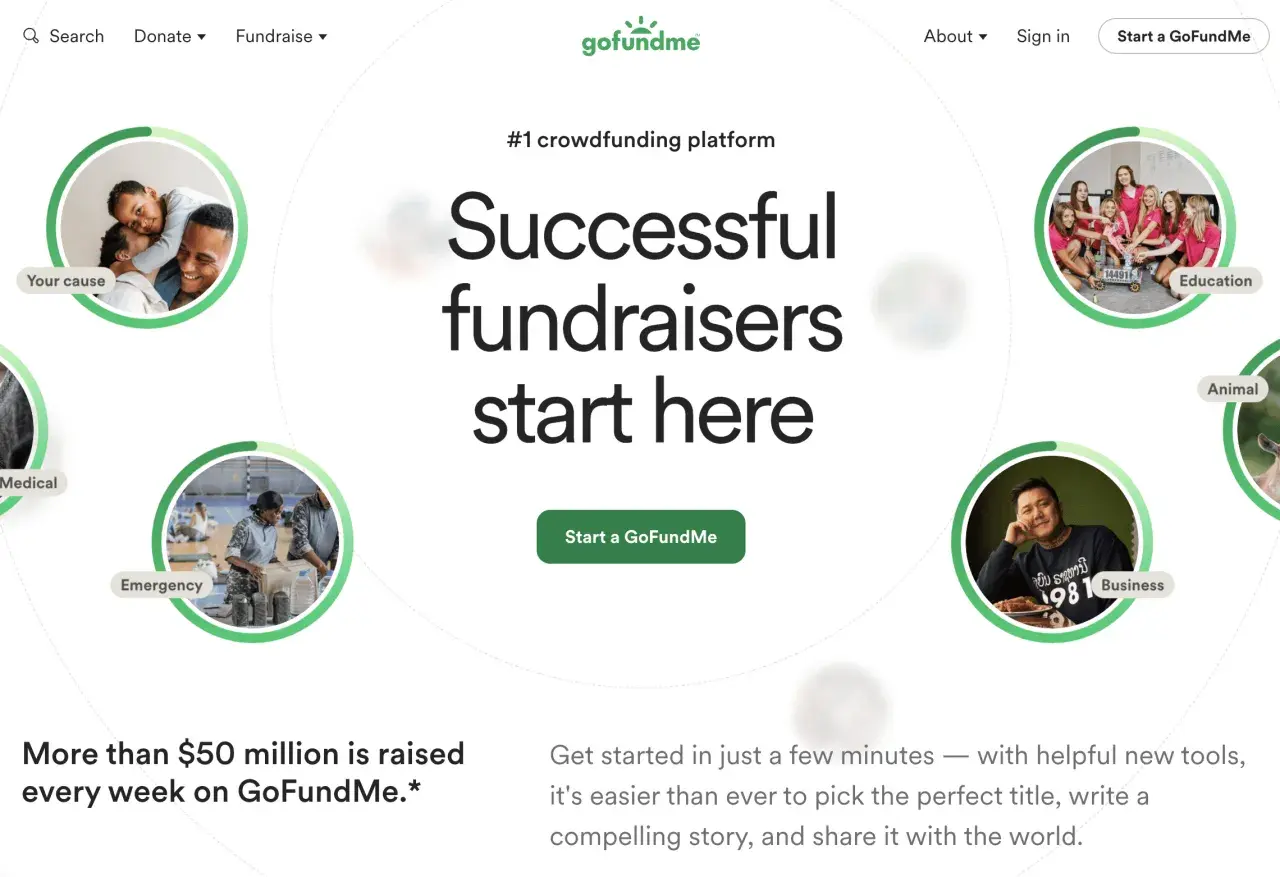
| GoFundMe Pro | No subscription or setup fee; processing starts around 2.2% + $0.30 with GoFundMe Pay, with some variation by payment method and contract | Branded nonprofit fundraising with managed support | Not a zero-fee model, and the exact rate depends on the account setup |
| Donorbox | About 1.6% to 3.95% platform fee depending on plan, plus processing; lower-fee plans can add a subscription | Recurring gifts, memberships, and organizations that need deeper fundraising software | The lower percentage only wins if your volume is high enough to justify the monthly plan |
Which option wins by fundraiser type
The fee winner changes with the kind of campaign you run. A platform that is cheap for a single donation page is not automatically cheap for events, auctions, or recurring giving.
Donation pages and recurring gifts
For simple donation forms and recurring support, I prefer Zeffy when zero fees matter most. Give Lively is my next stop if you want a free nonprofit platform with low processor costs and no subscription. Donorbox becomes interesting when recurring giving, donor management, and membership tools matter enough to justify a paid plan.
Events and auctions
Givebutter usually makes more sense here because the platform is built for pages, ticketing, and auctions in one place. If you disable donor tips, the cost rises quickly, so I only choose it for event-heavy teams that will actually use the extra tools. If you are running a gala, benefit dinner, or online auction, the software’s workflow can save more staff time than a small fee difference costs.
Peer-to-peer and community drives
School, church, and neighborhood campaigns need shareability more than they need enterprise complexity. Givebutter is strong when volunteers are building pages and sharing links fast. GoFundMe Pro can also work well when a polished public-facing campaign matters more than absolute fee minimalism, especially if your supporters already know the brand.
Read Also: Vertical Raise Fundraising - Maximize Donations Now
Large gifts and ACH-heavy giving
For bigger donations, ACH should be part of the decision. A bank transfer capped at $5 is hard to beat on a $1,000 gift, and it is often the cheapest route by a wide margin. If your audience is comfortable giving from a bank account, this single change can save more than switching platforms.
| Donation size | Card fee at 2.2% + $0.30 | Card fee at 2.9% + $0.30 | ACH fee at 0.8% capped at $5 | What I learn from it |
|---|---|---|---|---|
| $25 | $0.85 | $1.03 | $0.20 | Fixed fees matter, but the gap is still modest on very small gifts |
| $100 | $2.50 | $3.20 | $0.80 | ACH starts to pull ahead clearly |
| $1,000 | $22.30 | $29.30 | $5.00 | ACH becomes dramatically cheaper, so payment method matters more than the platform logo |
That is why I treat payment method as a fee lever, not just a checkout detail. The same platform can look average on small card gifts and excellent on larger ACH donations. Once you see that pattern, the next savings usually come from checkout design, not from chasing another product.
How I lower fees without making the donor experience worse
There is a difference between reducing fees and making the donation flow feel like a toll booth. I want lower costs, but I do not want the campaign to lose donors at the last step.
- Ask for ACH on larger gifts. I frame it as a mission choice, not a money-saving trick, because bank transfers keep more dollars in the program budget.
- Use donor-covered fees only where trust is already strong. It works best with recurring supporters and established communities, not cold traffic or first-time donors.
- Match the platform to the campaign type. Paying for event tools can be rational; paying for them on a simple donation page usually is not.
- Keep the checkout simple. A slightly higher fee with a better completion rate can beat the cheapest platform that donors abandon halfway through.
- Model three donation sizes before launch. I use $25, $100, and $1,000 because fixed fees distort small gifts while ACH savings show up fast on larger ones.
- Watch for extras that are easy to miss. Add-ons, premium support, custom integrations, and payout rules can change the real cost more than the platform headline does.
If a platform relies on optional tips, I also check how clearly that prompt appears at checkout. A transparent, soft ask is one thing; a confusing surcharge feeling is another. Once those basics are in place, the last decision is about fit, not just fee math.
The shortlist I would start with in 2026
If I were choosing today, I would narrow the field to five realistic paths. Each one is strong for a different reason, and the cheapest one on paper is not always the best one for the campaign you actually run.
- Zeffy if your priority is the cleanest zero-fee model and you are comfortable with a donor-supported platform.
- Give Lively if you want a free nonprofit platform with modest processing fees and no subscription.
- Givebutter if you need peer-to-peer fundraising, events, auctions, and a strong all-in-one stack.
- GoFundMe Pro if your team wants a branded nonprofit fundraising suite and can accept processor fees as the price of flexibility.
- Donorbox if recurring giving, memberships, or ACH-heavy donations matter enough to justify a paid plan.
My practical rule is simple: compare two finalists with the same $25, $100, and $1,000 donation flow on mobile and desktop, then look at total net proceeds, donor completion rate, and reporting together. That is usually where the real answer appears: not in the headline fee, but in the platform that helps the most money reach the mission with the least friction.
