
The fastest wins come from a mobile-first platform, clear item values, and a short close window
- Use one system for registration, bidding, notifications, and payment so bidders are never asked to switch tools midstream.
- Price items with a clear fair market value, then start bids at 30% to 50% of that value and use 10% to 15% bid increments.
- Keep the auction window tight enough to create urgency, and publish the closing time in every reminder.
- Collect payment details before the event or at first bid so checkout is quick and predictable.
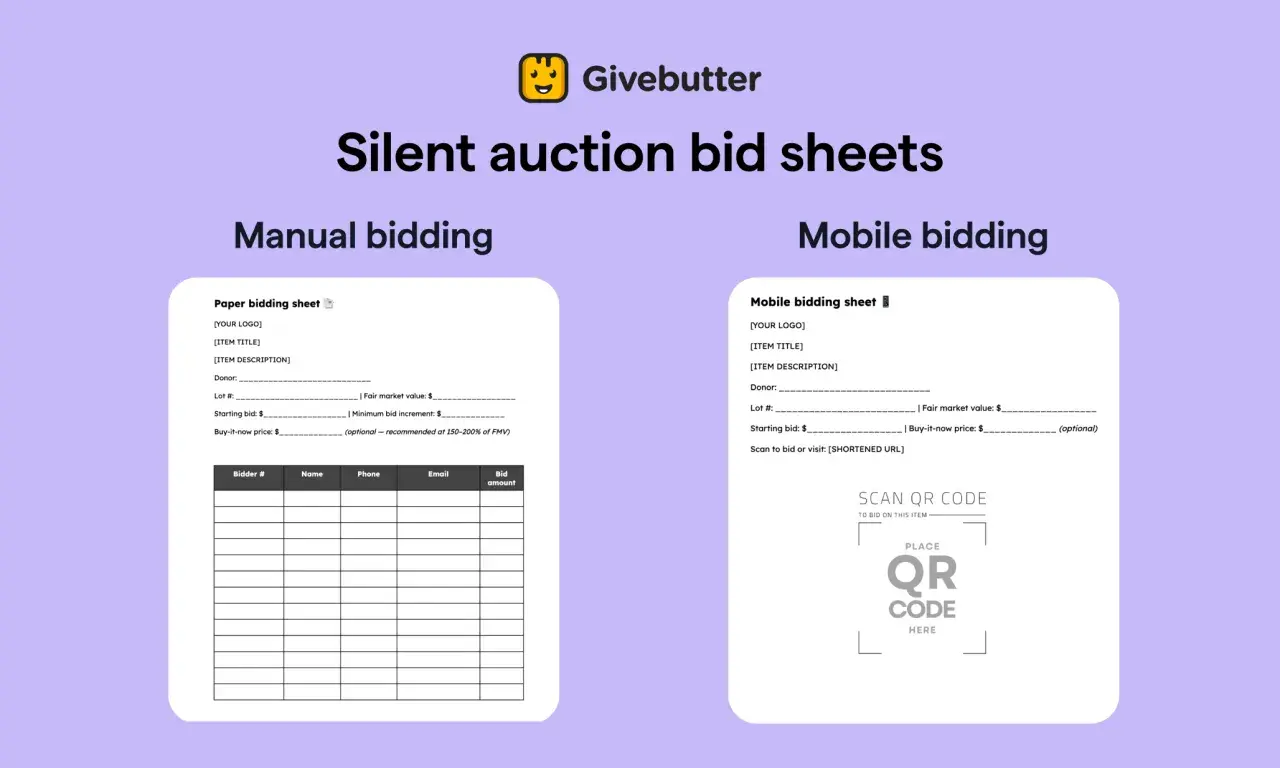
- Do not mix paper bid sheets with the same items in a digital auction unless you want confusion and extra reconciliation work.
- Send receipts and thank-yous quickly, while the excitement is still fresh.
Choose the format that fits your audience
The first decision I make is not about graphics or item count. It is about who will actually bid. A school community, a neighborhood nonprofit, and a statewide donor base all behave differently, so the format has to match the audience instead of forcing the audience to adapt to the format.
| Format | Best for | Strength | Tradeoff |
|---|---|---|---|
| Online only | Supporters spread across cities, alumni, remote donors, and smaller teams | Lowest friction for bidders and easiest to share beyond the event room | Needs stronger promotion because there is no live crowd to carry momentum |
| Hybrid | Galas, benefit dinners, and events with both in-room guests and remote supporters | Combines event energy with wider reach | More moving parts: registration, messaging, and closing all need tighter coordination |
| In-person with mobile bidding | Local audiences that still want a social event and a phone-first checkout | Less paper, faster bidding, easier item tracking | Requires decent connectivity and volunteers who can help guests use the platform |
For community and social good events, I usually favor the simplest version that still serves the mission. If the goal is to reach more supporters, an online or hybrid model usually wins because people can participate without buying a ticket or traveling. Once that format is clear, the next step is choosing tools and rules that do not create friction behind the scenes.
Pick the platform and rules before you list the first lot
The platform matters because it shapes the bidder experience, the volunteer workload, and the quality of your data after the event. I look for a system that handles registration, item pages, automated outbid notices, payment capture, receipts, and reporting in one place. If the software is PCI-compliant, that means it follows standard card-security requirements, which is exactly what you want when donor payment details are involved.
| Platform type | Best for | What it does well | What can go wrong |
|---|---|---|---|
| Dedicated auction software | Teams that want full control over items, bids, close-out, and reporting | Strong bidder flow, item management, and checkout | Can be overkill if you only have a handful of items |
| All-in-one fundraising platform | Organizations that already use a broader donor or event system | Less switching between tools, easier list management | Some auction features may be lighter than a dedicated auction tool |
| Manual workaround | Tiny events with very few items and a very small audience | Low software cost | High risk of errors, slow checkout, and poor bidder visibility |
I try to keep the rules equally simple. That usually means one bidding system, one official close time, and one checkout process. If you let people bid in one system and pay in another, you create avoidable confusion. I also avoid mixing paper bid sheets with digital bidding on the same items; it may feel flexible, but it usually creates more problems than it solves.
- Set the fair market value up front. In the U.S., bidders generally need to know the item’s fair market value because the deductible portion, if any, is typically only the amount above that value.
- Use one payment path. Capture cards at registration or at first bid so checkout does not become a bottleneck.
- Decide whether auto-extend is on. Some platforms extend the close time when a late bid lands, which reduces last-second sniping.
- Publish the timezone. If your audience is spread across regions, make the closing time impossible to misread.
Once the platform is settled, item quality becomes the real lever. The best software cannot rescue a weak catalog, but a good catalog can outperform a bigger one with sloppy pricing.
Build a catalog that makes people want to bid
I want each item to answer four questions instantly: What is it, what is included, when does it expire, and why should I care? That sounds basic, but many auctions lose bids because the item description is vague or the value is hard to judge. If a bidder has to hunt for details, the item is already less attractive.
For community-focused auctions, the strongest items are often the ones that feel useful, local, or experience-based. A dinner package, family outing, salon service bundle, private class, signed sports item, or neighborhood experience can work better than a random expensive object because more supporters can imagine themselves using it.
| Item type | Why it tends to perform well | My note |
|---|---|---|
| Local restaurant and entertainment packages | Easy to understand and easy to value | These often attract multiple bidders because they feel accessible, not elitist |
| Experience packages | Feels special and cannot be bought off a shelf | Great for donor engagement if the experience matches your mission or audience |
| Practical family bundles | Useful items get attention from supporters who want everyday value | Works well for school and neighborhood fundraisers |
| Mission-linked items | Connects the purchase directly to the cause | Strong for nonprofit auctions because the story is part of the value |
Pricing deserves the same discipline. I usually start by assigning a realistic fair market value, which is the price a willing buyer would reasonably pay in the open market. From there, a good planning range is to set starting bids at 30% to 50% of FMV and standard bid increments at 10% to 15% of FMV. For some less unique items, a buy-it-now option at 150% to 200% of FMV can work, but I would not use that on the most exciting lots.
If an item is hard to describe in one sentence, I treat that as a warning sign. A silent auction item should be easy to understand at a glance, because the faster a bidder understands the value, the more likely they are to keep bidding.

Design the bidder experience so the auction stays active
The strongest online auctions feel almost effortless from the bidder’s side. That means mobile-friendly pages, concise copy, strong photos, and a clear path from browsing to bidding to payment. I like to test the full journey on a phone that is not mine, because staff members tend to forgive rough edges that real supporters will not.- Use a phone-first layout. Most people will browse on a mobile device, so every item page should load cleanly on a small screen.
- Show the next bid clearly. If the bidder cannot tell exactly what to enter next, you lose momentum.
- Send outbid alerts and reminders. These work best when they are timely, brief, and tied to the items people actually favorited.
- Let supporters save favorites. A watchlist is simple, but it keeps people coming back.
- Ask for text opt-in at registration. SMS reminders are effective, but only if people agreed to receive them.
- Avoid a cluttered item page. One sharp image and one clean description usually beat three mediocre photos and a wall of text.
I also like to make the close time impossible to miss. Every item page, reminder email, and social post should say when bidding ends. If your audience spans time zones, spell out the timezone instead of assuming everyone is local. That tiny detail prevents a surprising amount of confusion.
The practical test I use is simple: can a donor place a bid in fewer than three taps and understand the current status without asking staff? If not, the experience still needs work. Once the bidder flow feels clean, promotion becomes easier because the campaign has something worth sharing.
Promote the auction like a campaign, not a last-minute announcement
Online auctions rarely underperform because of one bad item. They underperform because too few people hear about them early enough, or the message feels generic. I prefer a short, deliberate campaign that builds from awareness to urgency instead of one big blast at the end.
For a smaller community auction, I usually start building the item list and promotion plan 8 to 12 weeks ahead. Larger events may need more runway, especially if sponsorships, donor outreach, and content creation all depend on volunteers.
- Early phase. Announce the mission, date, and why the auction matters. Ask board members, staff, and item donors to share the first message.
- Middle phase. Show off the best items, explain how bidding works, and highlight one concrete impact story from the organization’s work.
- Final phase. Use urgency. Remind people when bidding closes, which items are competitive, and what their support will fund.
I get better results when I frame the auction around community impact instead of prizes alone. People may show up for the item, but they stay engaged when they understand what their bid helps accomplish. In a mission-driven auction, a good story is not decorative; it is part of the value proposition.
One tactic I rely on often is asking the item donor to help promote the catalog. A local business or community partner can introduce the auction to an audience you would not reach on your own, and that borrowed credibility can lift engagement fast. Once the promotion is underway, the closing process becomes the part that decides whether the event feels polished or chaotic.
Close cleanly, charge fast, and follow up while attention is still warm
The end of the auction is where a lot of teams lose time and goodwill. I treat checkout as part of the event, not an administrative afterthought. If bidders have already registered and saved payment information, the close feels smooth. If not, the final hour turns into a support desk.
- Lock the close time. Put it everywhere so bidders know exactly when the race ends.
- Use auto-extend if your platform supports it. It helps prevent last-second sniping and gives more bidders a fair shot.
- Separate quick checkout from problem cases. People with declined cards, split payments, or invoice questions need their own lane.
- Train volunteers before the auction opens. They should know where items are, how the software works, and who handles exceptions.
- Reconcile the night of the event. Export winners, payments, and item pickup status before the details get fuzzy.
For U.S. nonprofits, receipts need a bit of care. The IRS says bidders may generally claim a deduction only for the amount paid above the item’s fair market value, assuming the value was disclosed in good faith. That means I want the item page, the receipt, and any donor acknowledgment to be consistent. If a payment is partly a purchase and partly a contribution, the numbers should make that obvious rather than forcing the donor to figure it out later.
Fast follow-up matters too. A thank-you email within 24 hours, clear pickup instructions, and a clean receipt all reinforce trust. Supporters remember how the event ended, and a smooth ending makes them more likely to return next time.
Keep the data that makes the next event easier
The best online auctions leave behind more than revenue. They leave behind a useful record of what actually worked. I always save the item photos, descriptions, final bids, bidder engagement, email performance, and any volunteer notes about checkout friction. That turns one event into a reusable system instead of a one-time scramble.
- Track which items drew the most bids. That tells you what your audience values, not what you assumed they would value.
- Note when bidders were most active. Timing data helps you plan reminders and closing windows more intelligently.
- Record which messages performed best. Email subject lines, SMS reminders, and social posts rarely perform equally.
- Write down the bottlenecks. If registration, payment, or item pickup slowed down, fix that first next time.
- Keep donor and sponsor preferences. Good relationship notes make future procurement much easier.
If I had to reduce the whole process to one sentence, I would say this: online auctions work when the bidder’s path is obvious, the mission is visible, and the back end is organized enough that generosity feels easy. The more you can remove friction, the more your supporters can focus on the cause instead of the mechanics. That is what makes the next auction stronger than the last one.
