
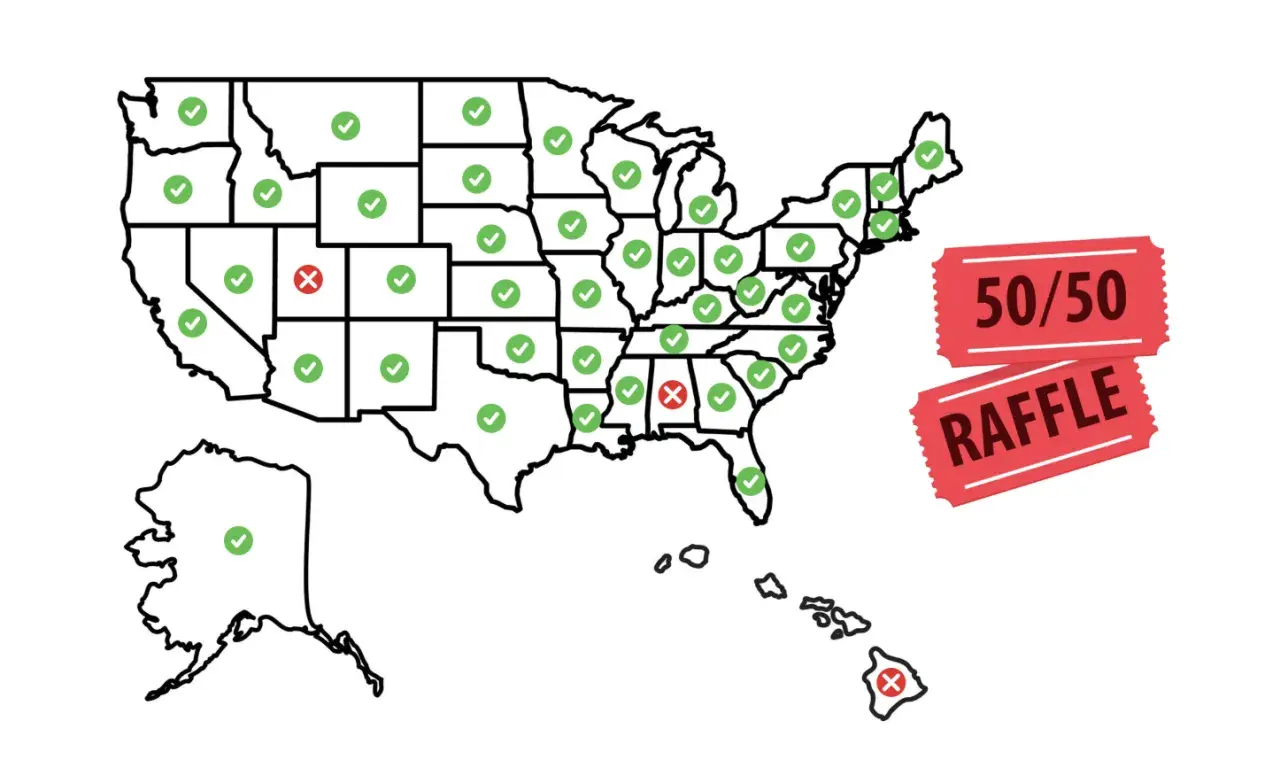
Are raffles legal in Florida? Yes, but only in a narrow charitable lane. Florida treats a raffle as a drawing by chance, and the event stays lawful only when the organizer is a qualifying nonprofit and the rules avoid any hidden payment requirement or rigged selection. I break down the legal line, the practical setup, and the mistakes that turn a fundraiser into an illegal lottery.
The key point for Florida raffle organizers
- Most raffles are prohibited by default; the lawful version is a limited exception for qualifying organizations.
- Eligible groups are narrowly defined and generally need a current IRS determination letter under the right 501(c) category.
- No purchase, donation, proof of purchase, or entry fee can be required to enter or win.
- Written disclosures matter, including the rules, the organization’s identity, the source of prize funds, and the drawing details.
- Violations can bring criminal and consumer-protection exposure, so casual fundraising language is not enough.
When a raffle is actually legal
Florida’s starting point is simple: chance-based prize drawings are usually treated as prohibited gambling activity. The charitable exception exists, but it is not broad. It is built for organizations that fit specific tax-exempt categories and can show they are operating as a real nonprofit, not just borrowing nonprofit language for a fundraiser.| Issue | Practical rule in Florida |
|---|---|
| Who can run it | A qualifying tax-exempt organization, not just any group with a good cause |
| Allowed tax status | Typically a current 501(c)(3), (4), (7), (8), (10), or (19) organization with proper IRS recognition |
| Entry cost | No required purchase, contribution, donation, or proof of purchase |
| Event paperwork | Rules and disclosures must be clear before tickets or entries are circulated |
| Purpose | Fundraising for a legitimate organization, not a disguised sales promotion |
I would not treat the nonprofit label as enough on its own. A community group, booster club, or civic association can still fall outside the safe harbor if its structure does not match the statute. Once you know who can legally host the event, the next question is what the law still forbids even when the host qualifies.
What Florida bans even in a charity raffle
The biggest mistakes are usually not exotic. They are ordinary fundraising habits that seem harmless until they turn the event into an illegal lottery. Florida is especially strict about money being tied to entry, because that is where a raffle starts to look less like charitable giving and more like gambling.
- Requiring an entry fee, donation, substantial consideration, payment, proof of purchase, or contribution to enter or win.
- Predetermining the winner, rigging the selection, or using a fake “random” draw.
- Conditioning the event on a minimum number of tickets sold or a minimum amount of money raised.
- Rejecting entries arbitrarily or treating paying supporters differently from non-supporters.
- Failing to notify the winner promptly or failing to award every advertised prize.
- Publishing rules or ads that are false, deceptive, or misleading.
- Cancelling the drawing after promotion has already started.
- Making prize delivery depend on later voluntary donations.
One nuance matters here: the law allows an organization to suggest a minimum donation, but that suggestion cannot become a condition. I read that as a practical warning sign. If the organizer’s real message is “pay to play,” the event is drifting out of safe territory.
That is also why the penalties are not just technical. A violation can be treated as a deceptive and unfair trade practice, and the statute also exposes the organizer to misdemeanor liability. In other words, this is a compliance issue, not just a wording issue. That leads directly to the part most organizers should do before printing a single ticket.
How to set up a compliant drawing
The safest way to run a Florida fundraiser is to build the event around compliance first and publicity second. I usually think in terms of a checklist, because that forces the organizer to answer the hard questions before the flyer goes live.
- Confirm the organization’s status. Make sure the host fits the narrow tax-exempt categories the statute allows and has the current IRS determination letter to prove it.
- Check charitable solicitation obligations. If the group has to register or renew under Florida’s charitable solicitation rules, that should be handled before money is collected.
- Write the rules before selling anything. The event rules should cover eligibility, drawing date, time, location, prize description, and how the winner will be selected.
- Make the no-cost entry path real. The statute requires the materials to say that no purchase or contribution is necessary, so the free-entry method should be easy to understand and easy to use.
- Disclose the prize funding source. If the prize is cash or purchased with donated money, that should be visible in the event materials.
- Use a transparent draw. The drawing should be random, documented, and free of any preselection or manipulation.
- Keep a paper trail. Save the rules, entry records, winner notification, and proof that the advertised prize was actually awarded.
If the event is promoted online, I would apply the same standard there as I would on a printed ticket. A vague social post is not a substitute for clear rules, and it does not protect the organizer if the structure is wrong. Once the checklist is in place, the next question is whether the host itself is actually eligible.
Why nonprofits still need to be careful
Not every nonprofit is automatically allowed to run a raffle. That is the part people miss most often. Florida’s exception turns on specific federal tax categories, not just on good intentions or community service. A chamber of commerce, for example, may be a nonprofit in a general sense, but that alone does not put it inside the raffle exception.
Chapter 496 adds another layer if the organization is soliciting contributions in Florida. Some smaller groups may be exempt from registration, but the exemption is not something to assume casually. The organization has to be able to substantiate it, and if registration is required, it needs to be current before the fundraising campaign begins.
My practical rule is blunt: if a group cannot quickly show me its tax status, its registration posture, and its written rules, I do not want it advertising a raffle yet. That same caution becomes even more important when the event starts to look like a promotion tied to sales.
When the event is really a sales promotion
Sometimes organizers call something a raffle when Florida law may actually view it as a game promotion tied to product or service sales. That distinction matters because the rules are different. A retailer, brand, or sponsor that uses chance and prizes to market goods is not relying on the charity-raffle exception; it is entering a separate regulatory lane.
| Charity raffle | Sales promotion |
|---|---|
| Usually hosted by a qualifying nonprofit | Usually tied to the sale of consumer products or services |
| No required purchase or contribution | Still tightly regulated, with its own disclosure rules |
| Governed by the charitable drawing statute | Governed by the separate game-promotion statute |
| Designed to raise money for a cause | Designed to support marketing or sales |
For larger sales promotions, the compliance burden becomes more formal. If the total announced prize value is above $5,000, the operator has filing and financial-security requirements, including advance filing of rules and either a trust account or a surety bond. That is one reason I tell businesses not to borrow the word “raffle” loosely. In Florida, the label does not control the law; the structure does.
The safest way to frame a Florida raffle before tickets go out
If I had to reduce the whole issue to one sentence, it would be this: a legal Florida raffle is a transparent charitable drawing run by a qualifying organization with no required payment to enter. Everything else is detail, and those details are where events usually fail.
Before you print tickets or launch an online campaign, check three things first: the host’s legal status, the no-cost entry structure, and the written disclosures. If any of those pieces are weak, the event is not ready. For community groups that want to raise money for a meaningful cause, that extra caution is usually the difference between a clean fundraiser and an avoidable legal problem.
