
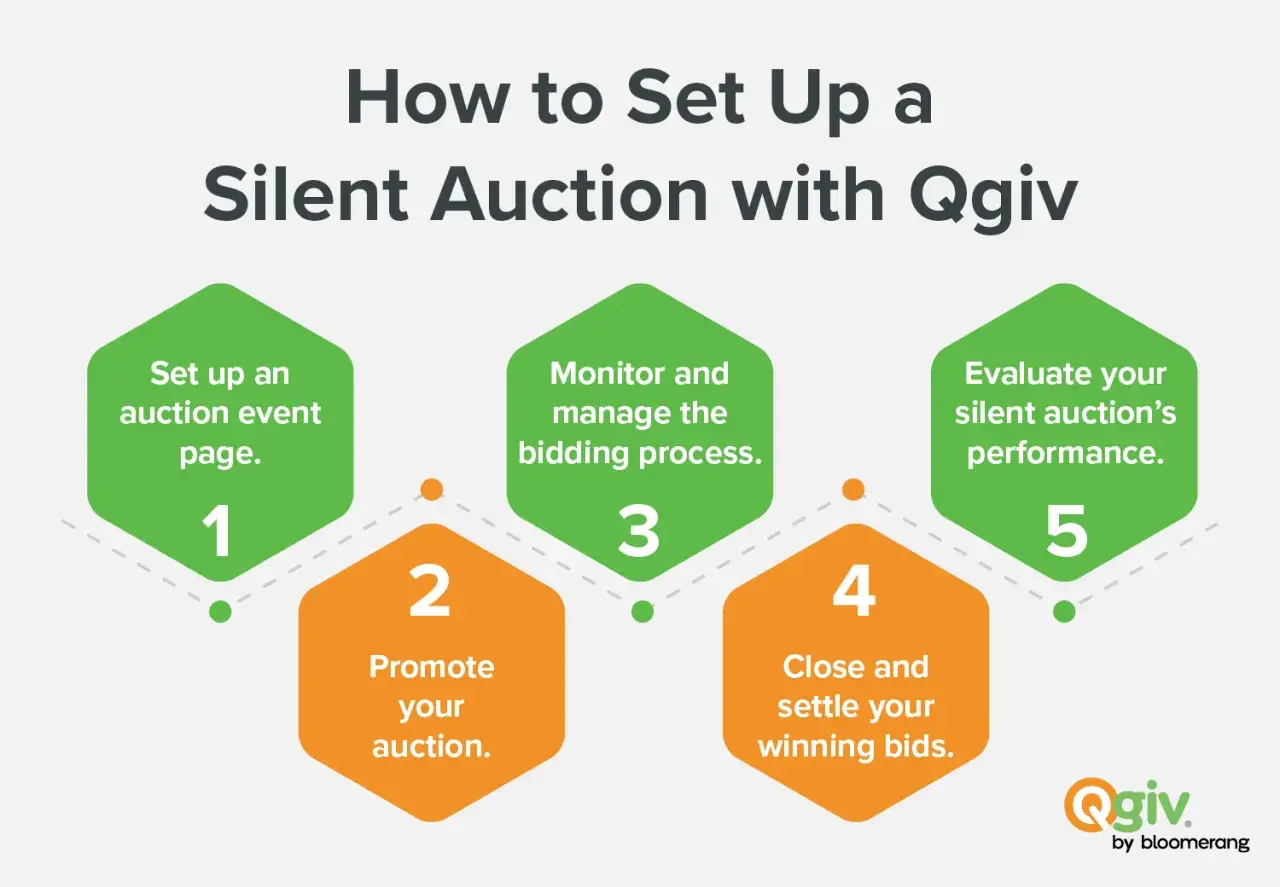
The pieces that make the night work
- Start with a revenue goal and a guest profile before you collect a single item.
- Mix low-, mid-, and high-value items so more people can bid comfortably.
- Price opening bids around 30-50% of fair market value and keep increments simple.
- Choose paper, mobile, or hybrid bidding based on your audience and your staff capacity.
- Plan checkout early, because the final 20 minutes can either feel smooth or completely congested.
- Measure what sold, what stalled, and what your supporters actually responded to.
Start with the goal, not with the item list
I usually begin by defining the purpose of the auction in plain terms. Is the goal to raise $5,000 for a school trip, $25,000 for a community program, or a larger net amount that funds an annual campaign? That target changes everything, because it determines how many items you need, how much volunteer help you need, and how ambitious your bidding should be.
A silent auction is not just a pile of donated goods with bid sheets attached. It is a fundraising system. The best events balance revenue, donor experience, and mission visibility, which is why I think the planning phase matters more than the room setup. If your average winning bid will likely land around $75, then a $7,500 gross goal implies roughly 100 winning bids, and that means you need enough inventory to keep a room of bidders moving without making the event feel overstuffed.
For community-centered organizations, I also recommend thinking beyond dollars. A strong auction can introduce new supporters to your mission, strengthen sponsor relationships, and make the cause feel visible in the room. Once the target is clear, the next step is to choose items that can realistically support it.
Choose items bidders will actually compete for
The item list is where many auctions go wrong. People often donate what is easy to source instead of what is exciting to win. A box of miscellaneous gift cards, a random gift basket, and three nearly identical home decor items may be generous donations, but they do not create urgency. I look for items that spark imagination: experiences, convenience, exclusivity, and local relevance.
| Item type | Why it works | Common mistake |
|---|---|---|
| Local experiences | Restaurant dinners, classes, tours, and family outings feel easy to use and easy to picture. | Offering only generic merchandise with no clear audience. |
| Premium packages | Weekend stays, VIP seating, or bundled sponsor perks can drive competitive bidding. | Making the package too complicated to redeem. |
| Useful mid-ticket items | These keep more guests in the game and prevent the auction from feeling elite. | Skipping this tier and leaving a gap between cheap items and headline items. |
| Mission-linked items | Examples like a behind-the-scenes school tour or reserved parking can feel personal and community-centered. | Forgetting to explain why the item matters to your audience. |
I like to build a ladder of price points on purpose: a few accessible items, a solid middle range, and one or two headline lots that can draw attention across the room. That mix keeps both casual bidders and bigger donors involved, which is exactly what a fundraiser needs.
Once the catalog feels balanced, the next job is pricing it so people can start bidding without hesitation.
Price the items so bidding starts easily and ends profitably

Pricing is where strategy matters more than instinct. If the starting bid is too high, guests hesitate. If it is too low, you leave money on the table. The most practical approach is to treat fair market value, or FMV, as the anchor and then work outward from there.
| Pricing decision | Practical rule | Why it helps |
|---|---|---|
| Starting bid | 30-40% of FMV for most items, with premium items sometimes closer to 50% | Gives guests a low enough entry point without cheapening the item |
| Bid increment | About 10% of FMV or a clean dollar amount that feels natural | Prevents tiny jumps that slow the room down |
| Buy-it-now | Use it selectively, often around 150-200% of FMV | Works best when you want a rare item to move fast without killing competition |
My advice is to keep the math simple. Guests should be able to glance at a sheet and know whether they can jump in. If they need to calculate too much, they often stop bidding. That is why rounded numbers usually outperform clever ones.
There is also a practical tax angle in the United States. The IRS generally treats the amount paid above fair market value as the charitable portion in qualifying cases, so I make sure FMV is displayed clearly and separated from the winning amount on receipts. That protects the organization and keeps donors from making assumptions they should not make. Once the pricing is settled, the next challenge is the way people actually bid.
Design the bidding experience so participation feels effortless
At this point, I decide whether the auction will be paper-based, mobile, or hybrid. Paper still works for small, local events with a short item list and a comfortable volunteer bench. Mobile bidding is better when the crowd is larger, the room is busy, or you want people to keep bidding from their phones without clustering around tables. A hybrid model is often the safest choice because it gives you flexibility and a fallback if Wi-Fi or device use becomes messy.
| Format | Best for | Strength | Limit |
|---|---|---|---|
| Paper bid sheets | Smaller in-person events | Low-tech and familiar | Slower checkout and more manual work |
| Mobile bidding | Busy rooms, hybrid events, larger supporter bases | Faster bidding, real-time updates, less crowding | Depends on device comfort and connectivity |
| Hybrid setup | Most community and nonprofit auctions | Balances accessibility with speed | Requires more setup discipline |
Whatever format you use, the room or event page should be easy to navigate. I like to give guests a preview window of 30-60 minutes before active bidding really starts, because it gives them time to browse, compare items, and decide where they want to compete. Clear item numbers, readable descriptions, and visible closing times matter more than flashy design.
One more rule I never skip: always keep a backup plan. Printed bid sheets, a charged tablet, or a manual winner list can save the event if the technology stumbles. Good systems are built for bad moments, not just perfect ones. Once that structure is in place, promotion becomes much easier.
Promote the auction before anyone enters the room
A silent auction should not begin when the doors open. It should start when people first hear about it. I prefer a simple, layered promotion plan: one early announcement, one reminder as the catalog takes shape, and one final push close to event day. That rhythm is enough for many local fundraisers, and it avoids overwhelming supporters with too many messages.
The most effective promotion usually does three things at once: it explains the cause, shows a few attractive items, and makes participation feel easy. If the event is tied to community impact, say so clearly. People do not just bid on objects; they bid on outcomes they care about. That is especially true for schools, youth groups, and local nonprofits where supporters want to see a direct connection between their bid and the mission.
If you have sponsors or partner businesses, ask them to help spread the message. Their audience may not know your organization yet, and a shared promotion effort can expand the bidding pool faster than paid advertising alone. More eyes on the catalog almost always means more competition in the room.
Promotion also gives you a chance to pre-sell the experience. Guests who already know the best items, the closing time, and the check-in process arrive ready to participate instead of needing a long explanation at the door. That makes event night easier, which leads directly to the part many teams underestimate: the close.
Run the event like a sequence, not a scramble
The most profitable silent auctions usually feel calm from the outside because the team has already rehearsed the moving parts. I like to think in sequence: check-in, preview, bidding, closing, checkout, pickup. If any one of those stages is fuzzy, the event starts leaking time and attention.
- Open with orientation. Give guests a quick explanation of the rules, the closing time, and how to bid or use mobile tools.
- Use closing warnings. A 30-minute warning, then 15 minutes, then 5 minutes keeps urgency high without surprising people.
- Close items in sections. Do not end every item at the same second if you can avoid it; staged closing keeps bidding focused and reduces congestion.
- Separate checkout from pickup. One area should handle payments while another hands out items.
- Create an express lane. Guests who have payment information on file should not wait behind people who still need to settle details manually.
For volunteer staffing, I prefer people assigned to single tasks instead of general “help with everything” roles. One person can monitor bids, one can handle questions, one can troubleshoot checkout, and one can manage item pickup. That division sounds small, but it keeps the event from becoming dependent on one overloaded coordinator.
Backup payment options matter too. Even if most guests use cards or mobile checkout, a few will want cash or checks, and a flexible setup prevents them from becoming a bottleneck. When the process is tight, the night ends with energy instead of fatigue.
The details I would not skip next time
After the event, I spend time on the parts that most teams rush past. Which items drew the strongest bidding? Which ones never moved? Did the room layout help people circulate, or did it create dead zones? Those answers are more valuable than a general feeling that the night “went well.”
- Track gross revenue and net revenue separately so you know what the auction really contributed.
- Note which item categories performed best, not just which individual lots sold highest.
- Ask volunteers where lines formed and where guests got confused.
- Save bidder data and contact information for future outreach, especially for first-time supporters.
- Follow up with winners quickly, because fast confirmation builds trust and makes people more likely to return.
For me, the real measure of a good silent auction is not only how much money it raises on one night. It is whether it leaves you with a cleaner system for the next event, a stronger relationship with supporters, and a clearer picture of what your community values. If you keep the planning simple, the pricing disciplined, and the checkout smooth, the auction stops feeling like a logistical burden and starts behaving like what it should be: a focused, community-backed fundraiser that works.
