
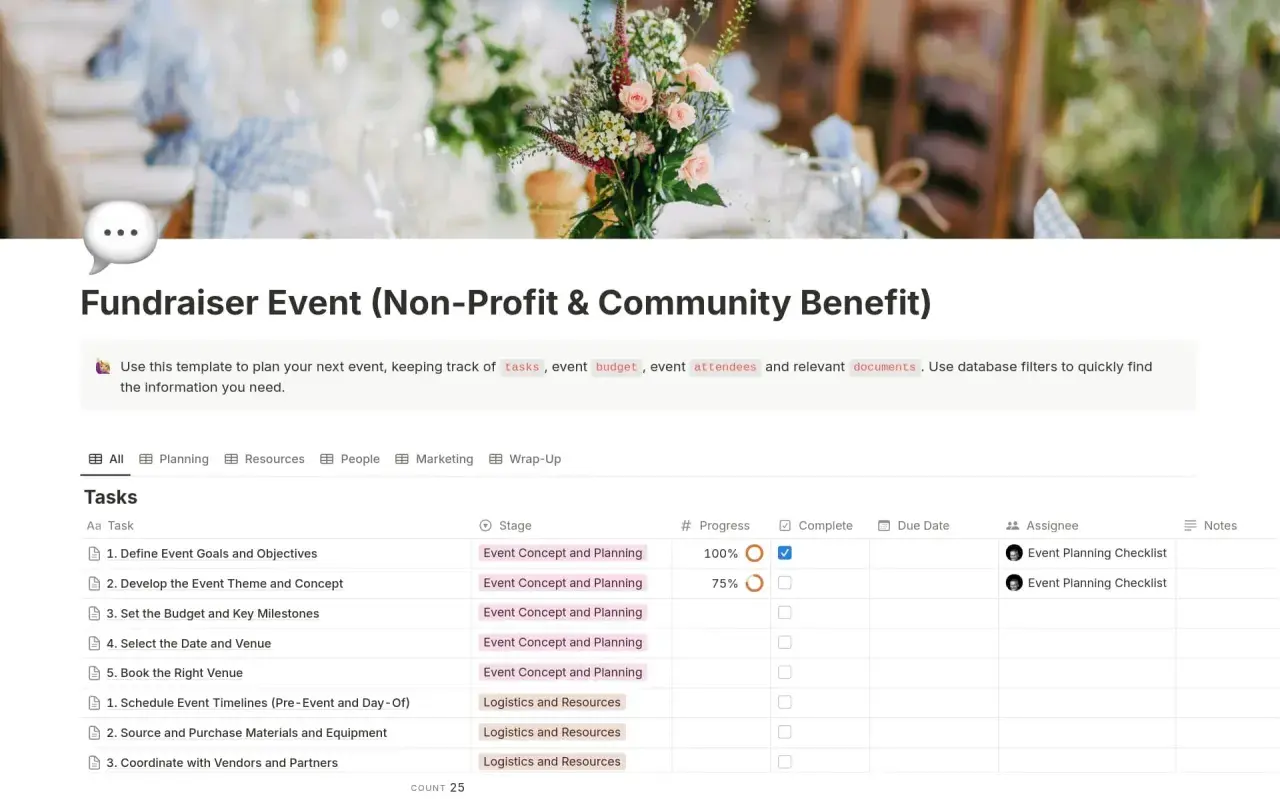
A well-run gala is less about spectacle than structure. A strong nonprofit gala template keeps your team focused on the mission, the money, and the guest experience without forcing everyone to improvise on event week. In this guide, I break down the sections I would include, the budget lines I would track, and the auction and logistics choices that usually make the difference between a smooth night and a stressful one.
The essentials at a glance
- Start with the gala’s purpose and net fundraising target before you lock the menu, décor, or theme.
- Build the template around seven working blocks: goals, budget, sponsors, auction, timeline, run of show, and post-event follow-up.
- Treat tickets, sponsorships, auction revenue, and paddle raise as separate lines so the real return stays visible.
- Plan the auction as part of the guest journey, not as an add-on; mobile bidding and clean checkout usually matter more than flashy extras.
- Use a backward timeline with hard deadlines for sponsor asks, item procurement, promotion, seating, and technical checks.
- Reserve space in the document for after-event stewardship, because the best gala templates help you raise more next year too.
What this template is really for
When I build a gala planning document, I want it to answer one simple question: what has to happen, by when, and who owns it. If the template does not make those three things obvious, it becomes a decorative checklist instead of a working tool. For a U.S. nonprofit gala, that usually means the document should tie the event back to the mission, the fundraising goal, and the guest experience in one place.
I also want the template to force one discipline that teams often skip: planning for net revenue instead of gross revenue. A night that raises a lot on paper can still underperform if venue costs, payment fees, printing, and auction fulfillment eat too much of the total. That is why the document should make the financial picture visible early, before anyone gets attached to a theme or a price point.
Once that purpose is clear, the rest of the planning becomes easier to organize and easier to defend. That leads naturally to the part most teams need first: the actual sections the document should contain.
The sections I always include in the document
A useful gala plan is not a long narrative. It is a working file with a few parts that stay stable from year to year and a few parts that change with the event. When I lay it out, I keep the structure simple enough that a volunteer chair can read it, but detailed enough that staff can execute from it.
| Template block | What to capture | Why it matters |
|---|---|---|
| Event goal | Net revenue target, attendance target, donor priority, and the mission outcome the gala supports | Prevents scope creep and keeps decisions tied to fundraising impact |
| Budget | Revenue assumptions, expense lines, fee assumptions, and contingency reserve | Makes it clear whether the event can actually deliver the return you need |
| Sponsorship plan | Tier names, benefits, ask amounts, deadlines, and who is responsible for each outreach lane | Keeps sponsor outreach consistent and avoids last-minute scrambling |
| Auction plan | Format, item mix, procurement deadline, starting bids, and checkout process | Stops the auction from becoming a messy side project |
| Marketing timeline | Save-the-date, invitation, reminder cadence, social content, and registration push | Improves attendance and reduces the pressure on the final week |
| Run of show | Minute-by-minute flow, speaker order, meal timing, appeal moment, and backup plans | Gives every lead a clear job during the event itself |
| Post-event follow-up | Thank-you cadence, receipt timing, donor notes, and after-action review | Protects retention and helps the next gala perform better |
If I were simplifying this further, I would say every gala template needs three views of the same event: the money view, the operations view, and the relationship view. With those in place, the calendar becomes much easier to manage.
The timeline that keeps a gala moving
For a signature gala, I plan backward from the date with a runway of 9 to 12 months. If the event is smaller, the committee is experienced, and the venue is already familiar, 4 to 6 months can be enough. The point is not to stretch the timeline for its own sake; the point is to keep sponsorship, auction procurement, creative work, and logistics from colliding in the final two weeks.
| When | What I want finished | Outcome |
|---|---|---|
| 9 to 12 months out | Date, venue, fundraising goal, committee, and budget framework | Locks the event’s scale before spending starts |
| 6 to 8 months out | Sponsorship package, ticket strategy, platform selection, and key messaging | Creates the revenue foundation before promotion gets loud |
| 4 to 5 months out | Auction procurement, creative assets, save-the-date, and donor outreach list | Gives donors time to respond without pressure |
| 8 weeks out | Registration live, volunteer recruitment, early promotion, and speaker confirmations | Keeps momentum visible |
| 4 weeks out | Seating logic, program copy, item loading, and payment workflow testing | Reduces day-of uncertainty |
| 2 weeks out | Final headcount, tech check, volunteer briefing, and run-of-show review | Moves the team from planning into execution |
| 48 hours after | Thank-yous, receipts, sponsor follow-up, and debrief notes | Protects donor relationships while the event is still fresh |
The biggest mistake I see is compressing procurement and promotion into the same short window. Once that happens, the event starts depending on luck. A better template keeps the work staggered so the team can breathe, which is especially important when the next step is setting the budget realistically.
How I build the budget without guessing
I like to build the budget in two columns: revenue and expense. That sounds basic, but it is the only way to keep a gala honest. If you price tickets first and ask questions later, it is easy to mistake a busy room for a profitable one.
These are the planning ranges I usually use for a mid-size U.S. gala, not hard rules. Venue and catering tend to eat the largest share, while AV, printing, auction support, and contingency fill out the rest. If your venue is donated or heavily discounted, the percentages shift quickly.
| Line item | Planning range | What changes it |
|---|---|---|
| Venue and catering | 35% to 50% | Room rental, plated versus buffet service, bar package, and guest count |
| AV, lighting, and staging | 8% to 15% | Speaker needs, screens, microphones, uplighting, and live performance setup |
| Entertainment and emcee support | 5% to 12% | Band size, auctioneer fee, and whether the program needs multiple speakers |
| Marketing and print | 3% to 8% | Invitation design, signage, programs, photography, and paid promotion |
| Auction procurement and fulfillment | 5% to 10% | Shipping, packaging, item display, and winner delivery costs |
| Staffing and contingency | 10% to 15% | Volunteer support, payment setup, last-minute rentals, and unexpected fixes |
I also model payment fees separately, because they can quietly become a meaningful line item. For example, on 200 tickets at $150 each, a 3% fee already removes $900 from ticket revenue before a single auction bid is counted. That is why I prefer to set the revenue goal with net return in mind, then work backward to the ticket price and sponsorship mix.
Most gala ticket prices I see land somewhere in the $100 to $250 range, often with table pricing or hosted-table packages layered on top. That range is not a rule, but it is a practical signal that your audience expects some level of formality and sponsorship support. Once the budget is stable, the next question becomes how the auction and donation pieces should fit into the night.
Where auctions and donations fit into the night
A gala works best when the fundraising moments feel like part of the experience, not interruptions to it. I usually design the evening around three revenue lanes: silent auction, live auction or featured appeal, and direct giving. Each lane has a different job, and the template should say so clearly.Silent auctions
Silent auctions work well when you want broad participation without forcing the room into a single high-pressure moment. I like to keep the item mix balanced and useful: experiences, local goods and services, and a smaller number of premium items. A practical starting point is roughly one auction item for every 2 to 3 attendees, with a mix that leans toward items people actually want to bid on rather than items that merely look impressive on paper.For planning purposes, I also think in terms of behavior, not just inventory. Mobile bidding usually performs better than paper bid sheets because guests can bid before dinner, during the program, and right up until closing without crowding around tables. In many galas, that keeps the room calmer and the bidding more active at the same time.
Live auctions and paddle raises
If the event has a strong mission story or a small set of high-value items, a live auction can still be worth the time. The downside is that it needs pacing, an experienced auctioneer, and a room that is still engaged after dinner. I am cautious about live auctions that are included only because they feel traditional; if the room is not built for them, they often slow the night down instead of lifting it.
For direct appeals, the paddle raise is usually the most emotionally powerful part of the program. It works best when the ask is tied to a specific mission moment, a clear funding need, and a range of giving levels that feel attainable. If the script is vague, the raise stalls. If the story is specific, the room usually follows.
Read Also: Workplace Fall Festival Ideas: Easy & Engaging Events
Checkout and payment flow
The checkout process deserves the same attention as the program script. I want a clean handoff from bidding to payment, especially if guests are buying auction items, making a paddle pledge, and settling ticket balances all at once. Fast payment matters because people remember the last five minutes of the night more clearly than the middle thirty.
My rule is simple: if the auction plan is hard to explain in one minute, it is too complicated. Once the revenue mechanics are clear, the run sheet becomes easier to staff and the event can move with less friction.

Run of show and staffing details that prevent chaos
This is the part of the template that saves the most stress on event day. A run of show is the minute-by-minute script for the gala: who does what, when it happens, and what the backup plan is if something slips. I would never rely on memory for this.
| Time | What happens | Lead |
|---|---|---|
| 2:00 PM | Venue load-in and AV setup begins | Volunteer coordinator |
| 4:30 PM | Auction items staged and payment devices tested | Auction chair |
| 5:00 PM | Volunteer briefing and final role review | Event chair |
| 6:00 PM | Doors open, check-in, and cocktail hour | Registration team |
| 7:00 PM | Guests seated and welcome remarks begin | Emcee |
| 7:15 PM | Dinner service starts | Caterer |
| 8:00 PM | Mission moment and paddle raise | Executive director |
| 8:30 PM | Silent auction closes and live auction begins | Auction chair |
| 10:30 PM | Checkout and item pickup | Auction team |
| 11:30 PM | Load-out and close | Volunteer coordinator |
I also add a small contingency block to the template, because real events always drift. If the caterer runs late, I want a backup speaker ready and a way to stretch cocktail hour. If the AV fails, I want the program printed on paper. If weather changes parking or coat check, I want those details captured before guests arrive. None of that is glamorous, but it is the difference between a polished event and an awkward one.
Staffing matters just as much as timing. Every volunteer should know their lead, their break time, and the single person who handles complaints or emergencies. If those details are missing, even a well-funded gala can feel disorganized. That brings me to the mistakes I see most often in planning documents.
Mistakes that quietly weaken gala results
The weakest gala plans usually fail for familiar reasons, and most of them are preventable. I do not worry much about a theme that feels ordinary; I worry about a template that hides bad assumptions.
- Starting with décor instead of goals. If the room looks expensive but the net result is weak, the event has the wrong priorities.
- Letting gross revenue disguise the real return. Ticket sales are not the same thing as mission revenue once fees and costs are subtracted.
- Overstuffing the program. Every extra speech, video, and transition competes with the giving moment.
- Asking for sponsors too late. Good sponsor outreach needs time, a clear package, and follow-up ownership.
- Using the auction as filler. Auction items should be chosen for bidder appeal and revenue potential, not just because someone donated them.
- Skipping the after-action review. If the team does not capture what worked and what slowed the night down, the same mistakes return next year.
The easiest error to miss is assuming that attendance equals success. A full room can still underperform if the ask is unclear, the auction is clumsy, or the payment process makes guests wait too long. Once you see that pattern, the template becomes less about paperwork and more about protecting the event’s effectiveness.
How I would adapt this for a small team or a signature gala
If the team is small, I would strip the template down before I added anything else. Fewer auction items, one payment workflow, one emcee, and one clear appeal moment are usually better than a complicated program that no one can run cleanly. In a smaller community event, I would also consider a hybrid or online-first auction if that lets the team protect time and reduce venue pressure.
If the gala is a signature event with a larger donor base, I would go the other direction: longer runway, stronger sponsorship tiers, more detailed seating logic, and more rigorous donor segmentation. That kind of event can support VIP reception elements, a more ambitious live appeal, and richer post-event stewardship, but only if the template keeps all the moving pieces visible. The bigger the night, the less forgiving it becomes of vague ownership.
For both versions, the same principle holds: the template should reduce decisions, not create them. When it does that, the gala stops feeling like a performance you have to survive and starts functioning like a fundraising system you can improve. That is the standard I would aim for every time.
