
What matters most before you pitch a business partner
- Business support works best when the mission, the company’s audience, and the reporting burden all line up.
- Cash, in-kind support, sponsorships, matching gifts, and volunteer programs each solve a different fundraising problem.
- The latest U.S. benchmark I would use is $44.40 billion in corporate philanthropy in 2024, but individual donors still provide the largest share of total giving.
- Clear asks, simple deliverables, and fast stewardship usually matter more than a polished pitch deck.
- The compliance side is not optional, especially when gifts include goods, event access, or public recognition.
What businesses are actually giving
I usually separate company support into two buckets: money that arrives cleanly and resources that reduce your operating costs. That distinction matters because each type behaves differently in a fundraising plan, and each one creates different expectations for stewardship, documentation, and follow-up.| Form | What it looks like | Best use | Main caution |
|---|---|---|---|
| Cash grants | A direct contribution to a program, event, campaign, or general operating budget | Core fundraising needs, unrestricted support, pilot projects, annual appeals | Requires a clear case for impact and a plan for renewal |
| In-kind gifts | Products, venue space, software, printing, food, transportation, or professional services | Lowering event or program costs, filling operational gaps, stretching a small budget | Can be hard to value, store, or use efficiently |
| Sponsorships | A business pays for recognition around an event, report, campaign, or program | Public-facing initiatives where visibility helps the partner justify the spend | Some of the payment may function like advertising, not pure philanthropy |
| Matching gifts | The company matches employee donations to eligible nonprofits | Campaigns that already have donor momentum and strong workplace participation | Needs donor action, employer policy alignment, and clear instructions |
| Volunteer or pro bono support | Employees donate time or specialized skills such as design, legal review, or IT help | Capacity-building work where expertise matters as much as money | Useful, but not a substitute for cash revenue |
I keep this list separate on purpose, because a request for a grant is not the same thing as a request for a sponsor package or a donated service. Once that menu is clear, it becomes much easier to match the right offer to the right fundraising goal.
Why it matters for fundraising
The scale is real, even if it is not the largest slice of philanthropy. The National Philanthropic Trust reports that U.S. corporate giving reached $44.40 billion in 2024, a 9.1% increase from 2023, while individuals still accounted for 66.7% of total giving. I read that as a useful signal for fundraisers: business support is not the whole market, but it is big enough to matter when you want a meaningful check, a donated asset, or a long-term partner.
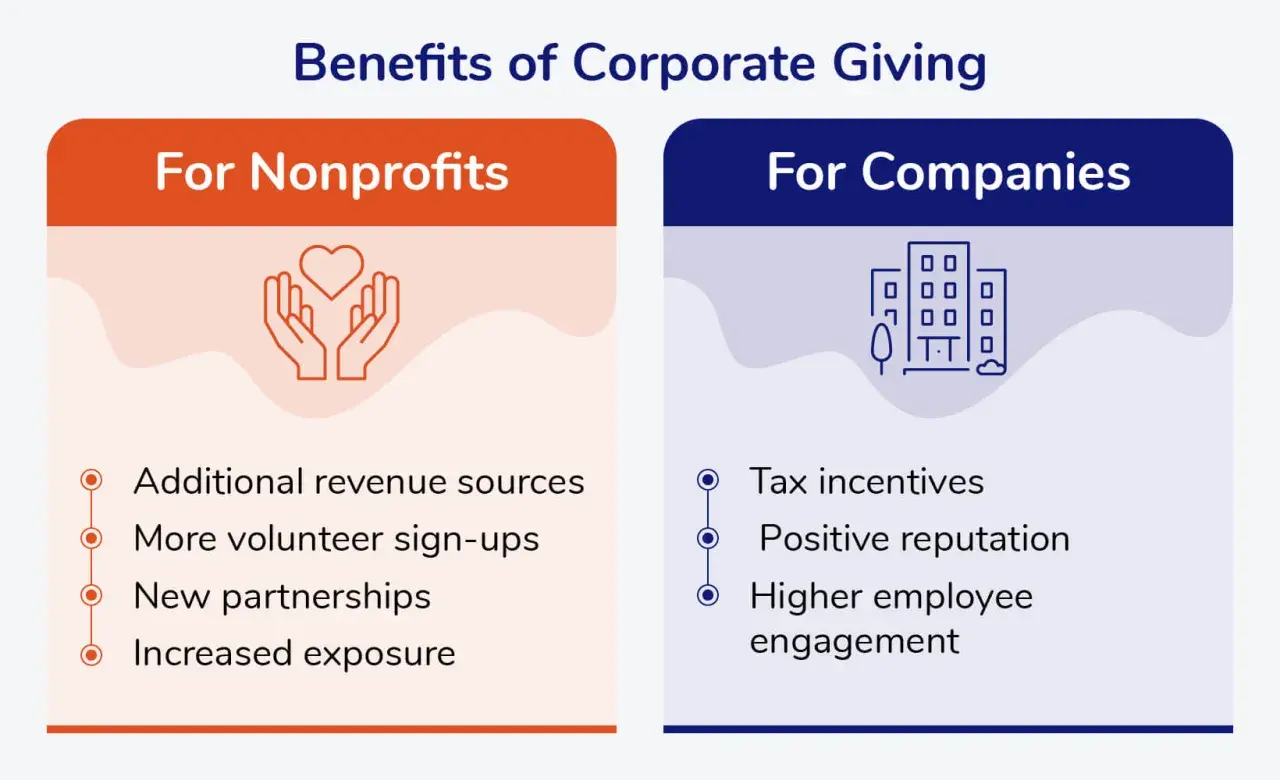
What makes company support valuable is not just the amount. It is the way one partner can unlock other resources around it. A business may help you reach employees, customers, suppliers, event guests, or local media. It may also stabilize a program through recurring support or lower your expenses through donated goods and services. For a fundraiser, that means one relationship can affect both revenue and cost structure, which is a rare combination.
That is also why I do not think of this channel as a side hustle for development teams. I think of it as a relationship system that can build trust, reduce friction, and create repeatable revenue if you treat it with the same discipline you would apply to major individual donors.
That distinction matters because the best vehicle depends on the outcome you want, not on what is easiest to ask for.

Which partnership model fits your goal
If I were choosing a company partnership from scratch, I would start with the outcome, then work backward to the format. The wrong model can waste weeks. The right one can turn a polite conversation into a funded commitment.
| Model | Best when | Why it works | Not ideal when |
|---|---|---|---|
| Cash grant | You need flexible money for programs, operations, or a campaign milestone | Fast to deploy and easiest to measure | The company only wants visible brand placement |
| Sponsorship | You have an event, report, or campaign with public visibility | Simple for marketing or community teams to approve | You cannot deliver recognition cleanly or on time |
| Matching gifts | You already have employee donors or a workplace audience | Amplifies giving without asking the company to fund everything directly | The employer has no matching infrastructure or the process is buried |
| In-kind support | Your main need is operational, not purely financial | Reduces direct costs immediately | The donated items are difficult to store, distribute, or value |
| Skills-based volunteering | You need expertise, not just labor | Builds deeper engagement and often creates a path to future giving | You need fast cash now |
My rule is simple: start with one primary model and one backup model. If you try to sell every option at once, the ask becomes harder to understand and harder to approve. Once the vehicle is clear, the next challenge is building a process that makes the yes easy.
How I build a company support plan that closes
When a fundraising team tells me their outreach is not converting, the problem is usually not effort. It is structure. A business needs to understand the fit, the value, the timeline, and what happens after it says yes.
- Start with a narrow target list. I would rather work ten well-matched prospects than fifty weak ones. Local employers, suppliers, and firms with an obvious mission overlap usually outperform random name-chasing.
- Build a case the partner can repeat internally. The best pitch is easy to explain to a manager who was not in the meeting. One sentence on the community need, one sentence on the company fit, and one sentence on measurable impact is often enough.
- Offer a small ladder instead of one big ask. For a local campaign, a three-tier structure such as $2,500, $5,000, and $10,000 can work better than a single flat request because it gives the company room to choose.
- Show the deliverables. If the company gets logo placement, employee volunteering slots, impact reporting, or speaking time, say so plainly. Ambiguity kills approvals.
- Plan stewardship before the money arrives. I like a simple rhythm: confirmation within a few days, a mid-campaign update if relevant, and a short impact report within 30 to 45 days after the gift is used.
One practical detail matters more than people expect: the ask should solve a problem for the company, not just for the nonprofit. If the partner can point to community relevance, employee engagement, and clean reporting, approval gets much easier. Even a strong pitch can fail if the paperwork and guardrails are sloppy.
Where support gets stuck
The most common mistakes are not dramatic, but they are expensive. A nonprofit asks before it has a clear use for the money. It offers a sponsorship package but forgets that the company wants marketing value. It accepts donated items that create storage, disposal, or staffing problems. Or it wins the gift and then goes quiet.
- Confusing sponsorship with a donation. If a company wants public recognition, booth space, or ad-like placement, I treat that as a sponsorship file, not a pure gift file.
- Asking without a use case. “Support our mission” is too soft. A business can approve a specific program, event, or equipment need much more easily.
- Ignoring the cost of fulfillment. An in-kind gift is not free if your staff has to sort it, store it, or distribute it.
- Accepting gifts you cannot use well. Outdated equipment, overbuilt products, or highly restricted items can create more work than value.
- Forgetting the compliance layer. The Council of Nonprofits notes that most states require charitable solicitation registration before a nonprofit asks residents for donations, and that written acknowledgments matter for single gifts of $250 or more.
- Failing to assign ownership. If no one owns company relationships, follow-up slips and renewal rates fall fast.
I also recommend a written gift acceptance policy, especially if your organization takes noncash support. It keeps staff from improvising when a gift arrives that looks generous on the surface but creates real operational strain underneath. Once those guardrails are in place, measurement tells you whether the relationships are actually compounding.
What I track before I call it a real win
It is easy to celebrate a big logo and miss the fact that the program is not actually growing. I look at a small group of metrics that tell me whether company relationships are becoming a reliable fundraising channel or just producing isolated wins.
| Metric | Why it matters | What I want to learn |
|---|---|---|
| Total cash secured | Shows how much unrestricted or program funding the channel actually delivers | Whether the pipeline is meaningful, not just symbolic |
| In-kind value used | Separates useful support from donated items that never translate into impact | Whether the organization is saving money in real terms |
| Renewal rate | Reveals whether partners come back without being pushed every year | Whether the relationship is healthy and sustainable |
| Ask-to-yes conversion rate | Shows how effective the pitch and timing are | Whether the offer is clear enough to approve quickly |
| Average partner value | Helps you see whether the program is moving up-market or staying flat | Whether the portfolio is maturing |
| Fulfillment burden | Captures staff time, event logistics, and reporting work tied to each gift | Whether the net value is still worth the effort |
If renewal is weak, I usually look first at the offer, then at stewardship, then at internal follow-through. That order matters because a bad process can make a good partner look unresponsive when the real issue is that the organization never gave the relationship a reason to continue.
Build one repeatable lane before you chase every sponsor
If I were starting a company-giving program from zero, I would not try to cover every sector at once. I would choose one or two industries with a natural reason to care, design one clear package, and build a simple stewardship rhythm that can be repeated without stress. That is usually the difference between a one-time win and a channel that becomes part of the fundraising mix.
The smartest first move is often the smallest one: pick a single partnership style, make the ask easy to understand, document the terms cleanly, and report back faster than expected. If you do that well, the next conversation is easier, the renewal is less fragile, and the program starts to feel less like outreach and more like a system.
